
 Back
Back





IN THE HIGH COURT OF JUDICATURE AT MADRAS
R.SAKTHIVEL, J.
K.M.Muthusamy – Appellant
Versus
Gokul Raghukumar – Respondent
S.A.Nos. 81 and 82 of 2019
Decided on : 25-11-2024
JUDGMENT :
PRAYER: Second Appeal filed under Section 100 of the Code of Civil Procedure, 1908, praying to set aside the Judgment and Decree dated January 30, 2018 passed in A.S.No.105 of 2017 by the learned II Additional District Judge, Erode reversing the Judgment and Decree dated December 22, 2016 passed in O.S.No.172 of 2013 by the learned Subordinate Judge, Perundurai.
PRAYER: Second Appeal filed under Section 100 of the Code of Civil Procedure, 1908, praying to set aside the Judgment and Decree dated January 30, 2018 passed in A.S.No.104 of 2017 by the learned II Additional District Judge, Erode reversing the Judgment and Decree dated December 22, 2016 passed in O.S.No.318 of 2009 by the learned Subordinate Judge, Perundurai.
The Second Appeal in S.A.No.81 of 2019 is directed against the Judgment and Decree dated January 30, 2018 passed in A.S.No.105 of 2017 by the 'II Additional District Court, Erode' [henceforth 'First Appellate Court'] reversing the Judgment and Decree dated December 22, 2016 passed in O.S.No.172 of 2013 by the 'Subordinate Court, Perundurai' [henceforth 'Trial Court'].
2. The Second Appeal in S.A.No.82 of 2019 is directed against the Judgment and Decree January 30, 2018 passed in A.S.No.104 of 2017 by the 'II Additional District Court, Erode' [henceforth 'First Appellate Court'], reversing the Judgment and Decree dated December 22, 2016 passed in O.S.No.318 of 2009 by the ‘Subordinate Court, Perundurai' [henceforth 'Trial Court'].
3. The facts, issues and parties involved in both these Second Appeals are essentially the same and both the Second Appeals are arising out of a Common Judgment. Hence, they both will be governed by this Common Judgment.
4. For the sake of convenience, hereinafter, the parties will be referred to as per their array in the Original Suit in O.S.No.318 of 2009 before the Trial Court.
CASE OF THE PLAINTIFFS IN O.S.NO. 318 OF 2009
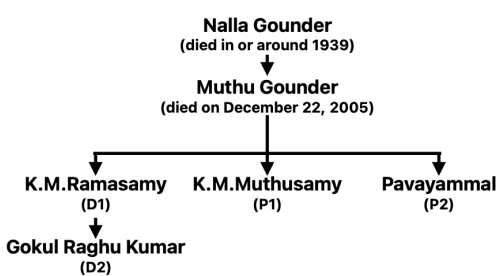
5. One Muthu Gounder, son of Nalla Gounder, had two sons viz., first plaintiff and first defendant, and one daughter viz., second plaintiff. Second defendant is the son of first defendant. The plaintiffs, first defendant and their father lived together as a joint family. The joint family owned the Suit Properties and other properties. The joint family properties excluding the Suit Properties were partitioned between the first plaintiff, first defendant and their father – Muthu Gounder vide Partition Deed dated October 26, 1994. The Suit Properties have been kept in common.
5.1. Muthu Gounder passed away on December 22, 2005 leaving behind the plaintiffs and first defendant as his legal heirs. In 2005, in view of the Hindu Succession Act, 1956 (henceforth ‘H.S. Act’) as amended by ‘the Hindu Succession (Amendment) Act, 2005 (Act No.39 of 2005)’ (henceforth ‘2005 H.S. Amendment Act’), the second plaintiff became entitled to coparcenary rights over the Suit Properties.
5.2. When the plaintiffs demanded partition, the first defendant alleged that Muthu Gounder had executed a Will bequeathing the Suit Properties in favour of first defendant’s son viz., second defendant. The alleged Will is forged and fabricated as Muthu Gounder was not in a disposing state of mind at the time of its execution. Moreover, Muthu Gounder himself had only ¼ share in the Suit Properties being joint family properties and hence, he had no right to execute the alleged Will in respect of entirety of Suit Properties. Further, Muthu Gounder had filed a Suit in O.S.No.870 of 1995 on the file of IInd Additional Subordinate Court, Erode against the first defendant herein, wherein he clearly described the Suit Properties as joint family properties.
5.3. Furthermore, the Sale Deed executed by a third party in favour of Kongu Vellalar Institute of Technology Trust, the first defendant in O.S.No.172 of 2013, does not bind the plaintiffs. The defendants have also managed to mutate revenue records in their names, which are not valid and binding on the plaintiffs. The first defendant failed to reply to the
AI
The court reaffirmed that joint family properties cannot be unilaterally declared separate through a Will, especially when surrounded by suspicious circumstances regarding its execution.

The judgment establishes that a will executed shortly before a testator's death can be valid if it meets the statutory requirements and the propounder successfully dispels any suspicious circumstance....
A registered Will has presumptive validity unless evidence demonstrates its invalidity, and execution shortly before death does not necessarily indicate suspicious circumstances.
The court clarified that properties must be inherited or acquired from a joint family nucleus to be classified as ancestral under Hindu law, rejecting claims based solely on joint acquisition.

The court affirmed that admissions made during trial are binding, and ancestral properties cannot be dismissed based on a registered Partition Deed that does not negate the rights of coparceners.
The propounder of a Will must prove its execution and attestation in accordance with law, and any suspicious circumstances surrounding the Will must be dispelled for it to be considered valid.
The father of the coparceners had no right to bequeath ancestral property via Will. Wills are invalid unless proven in accordance with statutory requirements.
The burden of proof lies with the plaintiff to establish that the properties are ancestral, and evidence must be pleaded and proved through evidence.
A Will remains valid unless completely revoked by clear and sufficient evidence as stipulated in the relevant succession laws.



An indispensable Tool for Legal Professionals, Endorsed by Various High Court and Judicial Officers
Please visit our Training & Support
Center or Contact Us for assistance

Scan Me!
India’s Legal research and Law Firm App, Download now!


For Daily Legal Updates, Join us on :



 Back to top


