Back
Back





2024 Supreme(Mad) 2016
IN THE HIGH COURT OF JUDICATURE AT MADRAS
M.S. RAMESH, C. KUMARAPPAN, JJ.
Dillibabu – Appellant
Versus
State Rep. by Inspector of Police, Tiruvallur – Respondent
Crl. Appeal No. 285 of 2019
Decided On : 22-10-2024
Advocate Appeared:
For the Appellant : T.S.N. Prabhakaran
For the Respondent: A. Gokulakrishnan
The prosecution must prove charges beyond reasonable doubt; reliance on unreliable witness testimony can lead to acquittal.
Headnote:(A) Criminal Procedure Code - Section 374(2) - Appeal against conviction - The first accused was convicted under Section 302 IPC for the murder of Venkatesan, while the second accused was acquitted - The court found that the prosecution failed to prove the charges beyond reasonable doubt, particularly due to unreliable witness testimonies and lack of corroborating evidence. (Paras 1, 7, 24)
(B) Evidence - Reliability of witnesses - The court emphasized that the evidence of chance witnesses PW-9 and PW-10 was neither wholly reliable nor wholly unreliable, and their testimonies were insufficient to uphold the conviction. (Paras 14, 24)
Facts of the case:
The deceased, Venkatesan, was murdered by the first accused, who conspired with the second accused, his illicit partner. The murder occurred on 20.12.2012, and the prosecution's case relied heavily on the testimonies of two witnesses who were not present at the time of the incident. (Paras 3, 4)
Findings of Court:
The court found that the prosecution failed to establish the case beyond reasonable doubt, particularly due to the unreliability of key witnesses and lack of evidence linking the accused to the crime. (Paras 24)
Issues: The main issues included the reliability of witness testimonies and whether the prosecution had proven the charges against the first accused beyond reasonable doubt. (Paras 24)
Ratio Decidendi: The court ruled that the prosecution's reliance on the testimonies of chance witnesses without corroboration was insufficient to sustain a conviction, leading to the conclusion that the charges were not proven. (Paras 24)
Result: The appeal was allowed, and the conviction was set aside, acquitting the appellant of all charges. (Paras 25)
JUDGMENT :
C. KUMARAPPAN, J.
Prayer: Criminal Appeal filed under Section 374(2) of the Criminal Procedure Code to call for the entire records connection with S.C. No. 81 of 2015 on the file of I Additional Sessions and District Judge, Tiruvallur and set aside the conviction and sentence imposed by the I Additional Sessions and District Judge, Tiruvallur in S.C. No. 81 of 2015 dated 28.03.2019.
1. The instant Criminal Appeal has been filed by the first accused against the order of conviction passed in S.C. No. 81 of 2015.
2. Originally, there were two accused, but the trial Court acquitted the second accused. Hence, the instant criminal appeal has been filed by the first accused.
3. The brief facts which give rise to the instant Criminal Appeal are that the deceased, Venkatesan, is the husband of the second accused. The second accused is a Nurse by avocation. While so, the first and second accused developed an illicit intimacy. After knowing the illicit intimacy, the deceased Venkatesan questioned the first accused and quarrelled with the second accused. Since both of them felt that the deceased is the obstacle for their illicit intimacy, they planned to do away him and hatched a conspiracy. In furtherance thereof, on knowing the movement of deceased in his two wheeler, on 20.12.2012 at about 7:15 p.m. the first accused waylaid him, and assaulted him on his head with a wooden log. As a result, the deceased died on the spot.
4. After the occurrence, PW-1, the brother of the deceased, gave a police complaint to PW-16, the Inspector of Police. On receipt of the police complaint, he registered an FIR on 21.12.2012 at about 3:00 a.m. in Crime No. 685 of 2012, and also made arrangements to forward the same to the concerned jurisdictional Magistrate. After that, he proceeded to the scene of occurrence and prepared an Observation Mahazar in the presence of Manikandan (PW-7) and Raju (PW-8) and recorded their statements. He also collected blood-stained soil, as well as sample soil, and recovered one blood-stained wooden log, and two other plain wooden logs, and prepared a Recovery Mahazar in the presence of the very same witnesses.
5. Thereafter, he conducted an inquest on the body of the deceased at the Government Hospital, Tiruvallur, and made arrangements for the post-mortem examination. He also collected the dress materials of the deceased and made arrangements to forward them to the concerned jurisdictional Magistrate. He then recorded statements from Velu (PW-1), Selvam (PW-2), Murugan (PW-3), Saravanan (PW-4), Karthick (PW-5), Muthu (PW-6), Karunanithi (PW-9), Prasath (PW-11), Meenakshi (PW-14) and other witnesses. On 22.12.2012, he arrested both the accused between 9:00 a.m. and 11:30 a.m. after the arrest, they voluntarily gave confession statements. In pursuance of the confession statements, the vehicle used by the first accused was recovered and he also identified the place of occurrence. Thereafter, he sent an alteration report and recorded statements from the forensic experts, and doctor who conducted the post-mortem. Eventually, after concluding the investigation, he laid the charge sheet against both the accused under Sections 302 read with 109 of the IPC.
6. Before the Trial Court, the prosecution examined as many as 16 witnesses as PW-1 to PW-16, marked 17 documents as Exs.P1 to P21, and 11 Material Objects.
7. The Trial Court, after considering the oral and documentary evidences, found the first accused guilty of the offence under Section 302 IPC. However, acquitted the second accused from all charges.
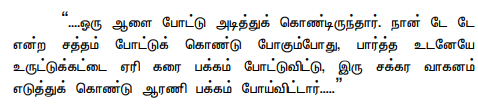
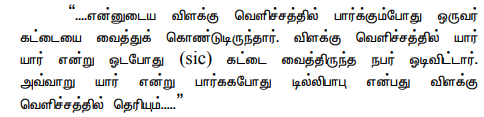
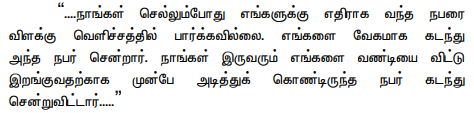
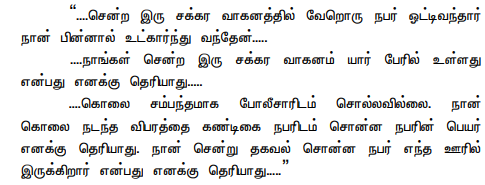
8. Assailing the said order of conviction, the learned counsel appearing for the appellant/first accused, vehemently contended that the entire case rests upon the evidence of PW-9 and PW-10, and that the other witnesses have not supported the prosecution's case. It was further contended that there was no recovery or discovery of fact through the accused, and even the recovery of the alleged blood-stained wooden log at the scene of