
 Back
Back





THE HIGH COURT OF JUDICATURE AT MADRAS
R.SUBRAMANIAN, G.ARUL MURUGAN, JJ.
V.Santhakumari - Appellant
Vs.
Registrar General, High Court, Madras, Chennai - Respondent
W.P.No.28275 of 2024 & W.M.P.No.30817 of 2024
Decided On : 03-04-2025
(A) Tamil Nadu Civil Services (Discipline and Appeal) Rules, 1955 - Rule 17(b) and Rule 8(vi) - Disciplinary proceedings - Compulsory retirement imposed on petitioner for receiving bribes in judicial service - Charge framed was found to be proved based on CCTV evidence and testimonies - The court emphasized the seriousness of corruption in judicial service and upheld the punishment as proportionate. (Paras 5, 18, 28, 30)
(B) Judicial Review - The court clarified that it does not re-evaluate evidence but ensures the fairness of the disciplinary process. (Paras 27)
Facts of the case:
The petitioner, a judicial officer, was accused of receiving bribes for processing civil suits. Following an enquiry, she was found guilty and subjected to compulsory retirement.
Findings of Court:
The enquiry was conducted fairly, and the evidence supported the charges of corruption.
Issues: The main issues included the validity of the charges based on the complainant's credibility and the sufficiency of evidence.
Ratio Decidendi: The court held that the disciplinary authority's findings were justified, and the seriousness of corruption warranted the imposed punishment.
Result: Writ Petition dismissed.
ORDER :
(Order of the Court was made by G.ARUL MURUGAN, J.)
This Writ Petition is filed challenging the order of the second respondent dated 29.04.2022, whereby the punishment of compulsory retirement from service was imposed on the petitioner, which was also confirmed by the order of the first respondent/appellate authority dated 15.07.2024.
2. The petitioner was originally selected through the Tamil Nadu Public Service Commission and appointed as Junior Assistant on 17.08.2009. Her services came to be regularised and the probation was declared with effect from 17.08.2011. Thereafter, she was promoted as Assistant on 19.02.2013 and was further promoted as Head Clerk and joined in the District Munsif Court, Pappireddipatti, Dharmapuri District, with effect from 03.05.2019.
3. Based on a complaint dated 25.03.2021 received from one S.Panneerselvam, S/o.Singaram, alleging that the petitioner is receiving bribe amount between Rs.500/- and Rs.1,000/- for numbering new civil suits in the District Munsif Court, Pappireddipatti, had requested to take necessary legal action. A discreet enquiry was conducted, which disclosed prima facie evidence against the petitioner. A memo was issued on 07.07.2021 and she submitted her explanation to the memo on 12.07.2021 denying the allegations.
4. The disciplinary authority issued a charge memo dated 30.07.2021 under Rule 17(b) of the Tamil Nadu Civil Services (Discipline and Appeal) Rules, 1955 [hereinafter referred to as “the Rules”] framing the following charge:-
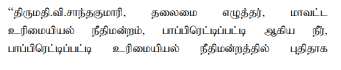
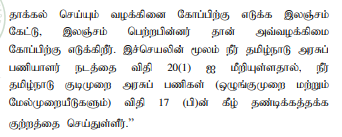
5. The petitioner submitted her explanation and not satisfied with the same, the enquiry officer was appointed. After completing the enquiry, the enquiry officer submitted the report on 02.12.2021, holding the charge as proved. A second show cause notice was issued and on receipt of the representation of the delinquent on 05.03.2022, the disciplinary authority, concurred with the findings of the enquiry officer and by order dated 29.04.2022, imposed the punishment of compulsory retirement under Rule 8(vi) of the Rules. The appeal preferred to the appellate authority challenging the punishment also came to be rejected by the first respondent on 15.07.2024. Assailing the punishment imposed, the petitioner had preferred the above writ petition.
6. Mr.V.Prakash, learned Senior Counsel for Mr.K.Premkumar appearing for the petitioner contended that the very charge issued against the petitioner is vague and in view of the vagueness, the entire disciplinary proceedings conducted and the punishment imposed cannot be sustained. The disciplinary authority had not framed the charge giving specific details in respect of time, place and date as to when the delinquent had received bribe and in the absence of any such details, the charge cannot be sustained on the ground of vagueness.
7. He further contended that the complainant, S.Panneerselvam, is a non-existent fictitious person and therefore, the very proceedings initiated based on his complaint dated 25.03.2021 cannot be sustained and the disciplinary authority ought to have dropped the entire proceedings.
8. The learned Senior Counsel vehemently contended that the details of the CCTV footage had not been disclosed in the annexure to the charge memo and the proceedings cannot be conducted and punishment be imposed relying on the CCTV footage. It is his further contention that the documents in Ex.P.2 to Ex.P.4, Ex.P.14 and Ex.P.15 had not been referred to in the charge memo, hence, the entire proceedings stand vitiated.
9. The learned Senior Counsel further contended that the enquiry officer had not conducted the enquiry in a fair and proper manner as the fact that these materials were not furnished, had not been taken note of. Further, when the delinquent had examined D.W.2, the advocate who is alleged to have handed over the bribe in respect of the delinquency, where he had deposed denying handing over any money to the delinquent and therefore, the charge is not proved.
10. In this regard, the learned Sen
The court upheld the compulsory retirement of a judicial officer for proven corruption, emphasizing the integrity required in judicial service.


Procedural fairness requires that employees facing major penalties be given reasonable opportunities to present a defense and cross-examine witnesses in disciplinary inquiries.

Disciplinary proceedings must adhere to procedural rules, and inconsistent penalties for similar offenses are impermissible under principles of natural justice.
Disciplinary authorities must provide reasons for disagreeing with enquiry officer findings and issue a second show cause notice before imposing punishment, adhering to principles of natural justice.

Disciplinary proceedings can be unjust if based on identical circumstances leading to a criminal acquittal, emphasizing the need for reliable evidence.
The court affirmed that deviations from an Enquiry Officer's findings can be justified if serious misconduct is established, and the imposed penalty must align with the gravity of the charges.
The court upheld the disciplinary authority's decision for removal from service based on proven misappropriation, affirming the fairness of the enquiry process despite procedural challenges.



An indispensable Tool for Legal Professionals, Endorsed by Various High Court and Judicial Officers
Please visit our Training & Support
Center or Contact Us for assistance

Scan Me!
India’s Legal research and Law Firm App, Download now!


For Daily Legal Updates, Join us on :



 Back to top


