
 Back
Back





IN THE HIGH COURT OF JUDICATURE AT MADRAS
M. SUNDAR, K. GOVINDARAJAN THILAKAVADI, JJ.
K. Guna - Petitioner
Versus
The Home Secretary, Government of Tamil Nadu, Fort St. George, Chennai and Ors. – Respondents
W.P. No.10937 of 2025 and W.M.P. No.12329 of 2025
Decided On : 27-03-2025
(A) Tamil Nadu Land Encroachment Act, 1905 - Sections 6, 7, 10, 10-A, and 10-B - Writ petition challenging an order/notice issued under Section 6 of the Act - The court found variance in signatures on the notice and noted that the impugned order did not state that the petitioner failed to respond to the Section 7 notice - The impugned order was withdrawn, allowing the petitioner to respond to the Section 7 notice and preserving the rights of both parties. (Paras 1, 7, 9, 11)
(B) Self-contained Code - The court reiterated that the Tamil Nadu Land Encroachment Act is a self-contained code, providing for notice, response, appeal, and revision processes. (Para 11)
Facts of the case:
The writ petition was filed to challenge an order issued under the Tamil Nadu Land Encroachment Act, claiming that the petitioner did not receive the required notice prior to the impugned order. (Para 1)
Findings of Court:
The court found significant discrepancies in the notice's signature and ruled that the impugned order should be withdrawn, allowing the petitioner to respond to the Section 7 notice. (Paras 7, 9)
Issues: The main issues included the validity of the impugned order based on the notice served and the procedural correctness of the actions taken under the Tamil Nadu Land Encroachment Act. (Paras 1, 8)
Ratio Decidendi: The court emphasized the importance of proper notice and response procedures under the Act, highlighting the need for accuracy in documentation and the preservation of rights for both parties. (Paras 7, 11)
Result: The impugned order/notice stands withdrawn.
ORDER :
[M. SUNDAR, J.]
Captioned main 'writ petition' (hereinafter 'WP' for the sake of brevity) has been filed with a prayer for issue of a writ of certiorarified mandamus. In and vide the certiorari limb, an order/notice signed on 06.03.2025 by R7 (Tahsildar) {hereinafter 'impugned order/notice' for the sake of convenience and clarity} has been assailed. To be noted, the impugned order/notice has been made under Section 6 of 'the Tamil Nadu Land Encroachment Act, 1905 (Tamil Nadu Act III of 1905)' (for brevity 'said 1905 Act'). In and vide the mandamus limb, the writ petitioner has sought a consequent direction to the first four of the seven official respondents {to be precise, RR 1 to 4} to grant permission to the writ petitioner to live in the same place, i.e., S.No.729 in Sundaravilagam Village, Tiruvarur Taluk, Tiruvarur District (hereinafter 'said property' for the sake of convenience and clarity).
2. Mr. M. Rajasekaran, learned counsel on record for the writ petitioner, adverting to the impugned order/notice, submits that the impugned order/notice shows that it was preceded by a notice under Section 7 of said 1905 Act but no such notice was received by the writ petitioner.
3. Issue notice to respondents.
4. Mr. T.K. Saravanan, learned Additional Government Pleader, accepts notice for all the seven respondents and submits, on instructions, that Section 7 notice was served on the writ petitioner, writ petitioner did not respond and therefore, the impugned order/notice came to be made by R7.
5. We find that the scope of the captioned main WP is fairly limited and therefore, with the consent of learned counsel on record for writ petitioner and learned State counsel for respondents, captioned main WP was taken up in the Admission Board i.e., Motion List.
6. The first point is, signature in the copy of Section 7 notice (signature of noticee) as placed before us by learned State counsel and the signature in the writ affidavit are at complete variance. To be noted, a scanned reproduction of the copy of the Section 7 notice, as placed before us by learned State counsel, is as follows:
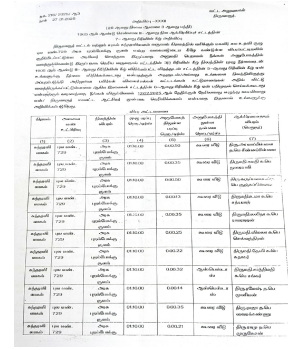
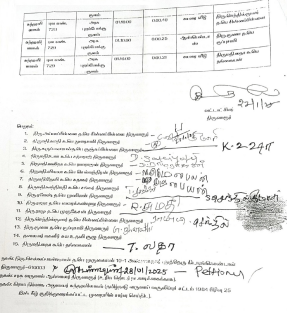
7. We hasten to add that we find the signatures at variance even to the naked eye. Further, in one case, there is no signature at all. We find that the variance is so striking that it warrants our interference. Therefore, we make it clear that this order is made in the light of the peculiar facts and circumstances of the case on hand and it will not serve as a precedent for all matters.
8. The second point is, the impugned order/notice does not mention that the writ petitioner has not responded to the Section 7 notice.
9. In the above circumstances, learned State counsel very fairly submitted that the impugned order/notice will now stand withdrawn but made a plea to preserve all the rights and contentions of the respondents and more particularly R7, to issue notice afresh under Section 7 of said 1905 Act. While we accede to this request, we make it clear that all the rights and contentions of the writ petitioner will also stand preserved.
10. Learned counsel for writ petitioner further submitted that if the Section 6 order/notice that is made afresh is adverse to the writ petitioner, writ petitioner shall file a statutory appeal under Section 10 of said 1905 Act, together with a stay petition thereat under Section 10-B and pursue the statutory appellate remedy under Section 10 without approaching this Court.
11. In the light of the narrative thus far, the following order is made:
i. The impugned order/notice dated 06.03.2025 bearing reference Na.Ka.no.5635/2024/A3 stands withdrawn;
ii. The aforementioned Section 7 notice shall be construed to have been served on the writ petitioner today (27.03.2025);
iii. The writ petitioner shall send a response to the Section 7 notice (if so advised and if so desired) in such a manner that it reaches R7 in a fortnight from today i.e., by 10.04.2025;
iv. Thereafter, R7 shall consider the response of the writ petitioner and pas
The Tamil Nadu Land Encroachment Act, 1905 is a self-contained code, requiring proper notice and response procedures, with the court emphasizing the preservation of rights for both parties.
The court upheld the validity of impugned orders under the Tamil Nadu Land Encroachment Act, confirming that proper notices were served and emphasizing the efficacy of statutory appeals as an alterna....

The court affirmed that the statutory appeal under the Tamil Nadu Land Encroachment Act is the appropriate remedy, and the Act is a self-contained code barring jurisdiction of courts over its orders.
Civil rights from a decree persist beyond execution limits, necessitating compliance by authorities with prior orders despite challenges on classification.
The Tamil Nadu Land Encroachment Act is a self-contained code that mandates a response to a show cause notice before any removal proceedings can be concluded.
A writ petition challenging proceedings under the Land Encroachment Act is premature if alternative remedies exist.
A writ petition challenging jurisdictional notice under the Tamil Nadu Land Encroachment Act requires factual determination, and jurisdictional claims cannot be settled without due process.

The Tamil Nadu Land Encroachment Act is a self-contained code allowing for a structured process regarding encroachments and appeals, ensuring rights preservation for all parties involved.
Litigants must exhaust alternative remedies provided by law before resorting to writ petitions, as per the Tamil Nadu Land Encroachment Act, 1905.
The necessity of a show cause notice under the Tamil Nadu Land Encroachment Act before issuing an order under Section 6 is essential for valid proceedings.



An indispensable Tool for Legal Professionals, Endorsed by Various High Court and Judicial Officers
Please visit our Training & Support
Center or Contact Us for assistance

Scan Me!
India’s Legal research and Law Firm App, Download now!


For Daily Legal Updates, Join us on :



 Back to top


