
 Back
Back





IN THE HIGH COURT OF JUDICATURE AT MADRAS
N. SESHASAYEE, J.
Paragon Polymer Products Private Limited, Previously M/s. Paragon Rubber Industries - Appellant
Versus
Sumar Chand Nahar and Anr. – Respondents
(T)CMA(TM) No.80 of 2023, (OA/8/2020/TM/CHN)
Decided On : 07-01-2025
| Table of Content |
|---|
| 1. trademark registration and opposition. (Para 4 , 5) |
| 2. involvement of well-known marks in trademark disputes. (Para 6) |
| 3. assessment of confusion and market distinctiveness. (Para 8 , 9 , 10) |
| 4. law principles on trademark rights and retrospective operation. (Para 11 , 13) |
| 5. final ruling and remand for co-existence conditions. (Para 14 , 15) |
JUDGMENT :
(N. SESHASAYEE, J.)
The appellant herein has lost its opposition against the registration of trade mark in an application filed by the first respondent for registering the device mark, which is a composite mark of a word 'PARAGON' + 'a flying bird' under Class-9. This Order is now under challenge.
2.1 The facts that led to the institution of this appeal may be briefly stated:
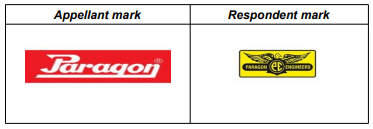
(a)The appellant has been in the business of manufacture and sale of footwear under its trade name 'PARAGON', since 1975. It has registered its mark PARAGON under Class-25 and allied classes associated with Class-25, on various dates.
(b)The first respondent has been doing business in the manufacture and sale of electric motors etc., since 1977, under the trade name PARAGON with a flying bird as a device. It has registered its mark as 'PE' along with words 'PARAGON ENGINEERS' written beneath it under Class 7.
(c)Be that as it may, a certain D.M.Tea Corporation, represented by Mr.Kundan Sharma, filed an application before the Trade Mark Registry, for registration of the very word 'PARAGON' under Class 30, for its products which inter alia included 'blended tea and tea powder'. The appellant herein had opposed the said registration successfully, and in its order dated 26.07.2017, the Trade Mark Registry had declared that the appellant's mark PARAGON is a well known mark.
(d) It is in these circumstances, the first respondent had applied for registration of an identical mark PARAGON under Class 9, which relates to electric motor starters, etc. For the current purpose, it may be stated that Class 9 is closely associated with Class 7 category of goods, all of which fall within one common denominator of 'electric motors' broadly. (This distinction may not be very relevant for the current purpose).
(e)The first respondent had filed its application on 28.09.2001, and after examination, it came to be published in the Trade Mark Journal 1330 dated 01.05.2005.
2.2 On gaining knowledge about the application of the first respondent for the registration of the mark PARAGON under Class 9, the appellant herein entered appearance to oppose the registration of the said mark on the following grounds:
a) That the word PARAGON, was coined by the appellant, that it is being used by it uninterruptedly from 1975, and ever since the word 'PARAGON' has come to be associated with the appellant as a composite mark. It is registered under various classes including classes 1,7, 17 and 25. The appellant has a pan India market for its products. Therefore, allowing the first respondent to trade using the mark 'PARAGON' for its products' would cause confusion in the minds of the consumers and lead to dilution of the appellant’s mark.
b) The adoption of the mark “PARAGON” by the first respondent is not bonafide. The first respondent began to use the mark only 10 years after the appellant started using its mark, and in the same geographical location as the appellant.
c) The mark of the appellant has been recognized as a well-known mark by the Trade Marks Registry, and it is associated with the products manufactured by the appellant. Therefore, even if the first respondent uses the mark to sell products belonging to a different classes, the public would still associate the same as that of the appellant.
d) The registration of the proposed mark of the first respondent would violate Sections 9,11,12 and 18 of the Trade Marks Act.
2.3 The first respondent rebutted the opposition of the appellant by stating:
a) The first respondent company was established in the year 1966, and is involved in the manufacture of a wide range of electrical products.
AI
The court held that a well-known trademark's protection is prospective, not retrospective, meaning it cannot eliminate prior similar trademarks duly registered and used in a different class.

The court emphasized the importance of determining the similarity of goods, establishing the well-known status of a mark, and considering non-use as a material consideration in trade mark disputes.


The principle of prior user of a trademark prevails over subsequent registrations, especially when confusion or association is likely between goods and services of similar trade sectors.

The court held that similar trademarks operating in different markets do not always lead to confusion, emphasizing the need to prove distinctiveness and absence of confusion under the Trade Marks Act....
Well-known trademarks require a higher degree of protection against deceptively similar marks to prevent consumer confusion.

A trade mark recognized as well-known under the Trade Marks Act is protected against concurrent use by others regardless of the class of goods, particularly when evidence of rightful prior use and bo....
The main legal point established in the judgment is that the plaintiff's mark 'AMPM' did not meet the threshold to be considered a well-known mark and the defendants' use of the impugned mark for int....

The court emphasized likelihood of consumer confusion in trademark law, holding that similar marks can infringe established trademarks regardless of differences in service or field, thus supporting t....



An indispensable Tool for Legal Professionals, Endorsed by Various High Court and Judicial Officers
Please visit our Training & Support
Center or Contact Us for assistance

Scan Me!
India’s Legal research and Law Firm App, Download now!


For Daily Legal Updates, Join us on :



 Back to top


