
 Back
Back





IN THE HIGH COURT OF JUDICATURE AT MADRAS
R.N. MANJULA, J.
G. Ravichandran - Appellant
Versus
T.N. Narayanan and Anr. – Respondents
S.A. No.1200 of 2011 and M.P. No.1 of 2011
Decided On : 07-01-2025
| Table of Content |
|---|
| 1. joint family property and rights (Para 1 , 2) |
| 2. defendant's claim over property disputed (Para 3) |
| 3. issues framed by trial court (Para 4 , 5) |
| 4. plaintiff's argument on possession rights (Para 6) |
| 5. defendant's argument on limitation (Para 7) |
| 6. effect of prior judgments on property rights (Para 8 , 9 , 10) |
| 7. the analysis clarifies the existing legal rights under previous rulings and their implications. (Para 11) |
| 8. knowledge of previous sale deeds relevant to limitation (Para 12) |
| 9. limited rights conveyed by possessory deeds (Para 13 , 14) |
| 10. timing of suit within limitation period (Para 15) |
| 11. non-necessity of declaratory action (Para 16 , 17) |
| 12. no adverse possession claim made (Para 18) |
| 13. final ruling and decree (Para 19) |
JUDGMENT :
(R.N. MANJULA, J.)
The appellant is the plaintiff and the respondents are the defendants 2 and 3. The plaintiff has filed a suit against the defendants for seeking the relief of recovery of possession and to pay the past and future damages for the unlawful use and occupation of the schedule mentioned property. The trial Court had dismissed the suit and the appeal preferred by the plaintiff in A.S.No.9/2001 has been allowed by setting aside the decree and judgment of the trial Court and the suit has been remitted back to the trial Court for fresh disposal. The defendants 2 and 3 have filed a Civil Miscellaneous Appeal in C.M.A.No.2819/2006 before the High Court by challenging the judgment of the first appellate Court in remitting the matter back to the trial Court. In the said Civil Miscellaneous Appeal the lower appellate Court was directed to receive the findings from the trial Court on the additional issues and then dispose the first appeal. In view of the same the judgment and decree passed by the first appellate court got set aside. Thereafter, the first appellate Court has passed a judgment on 08.06.2010 by dismissing the first appeal. Aggrieved over that the plaintiff has filed the present second appeal.
2. The facts pleaded in the plaint by the plaintiff in short :
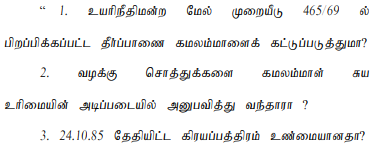
The suit property is a joint family property of one Devaraja Chetty and his four sons. The suit property was purchased by Devaraja Chetty on 27.07.1929 from the income of the joint family properties and hence the suit property has been treated as joint family property of Devaraja Chetty. After the demise of Devaraja Chetty, his wife was enjoying the property till her life. Devaraja Chetty executed a Will dated 12.08.1940 in respect of the suit property. As per the judgment of the High Court held in A.S.No.465/1969 dated 10.10.1974, it has been declared that the Will executed by Devaraja Chetty is not valid. It is further held that the suit property is a joint family property in which the four sons of Devaraja Chetty have also got share and the wife of Devaraja Chetty has got right to enjoy the suit property till her lifetime and the four sons can divide after her demise. The wife of Devaraja Chetty, Kamalammal died on 27.05.1985.
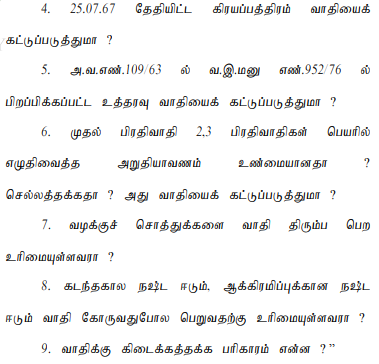
2.1 The plaintiff has purchased the suit property on 24.10.1985 from the four sons born to Devaraja Chetty and Kamalammal. At the instigation of the first defendant's husband Palani Chetty, Kamalammal executed a sale deed in favour of Palani Chetty on 25.07.1967 in respect of the suit properties. The sons of the Kamalammal are not parties to the said sale deed. The plaintiff came to know about the sale deed only on 08.01.1986 when he had taken the encumbrance certificate. The sale deed executed by Kamalammal in favour of Palani Chetty is not supported by any consideration and in this regard a suit in O.S.No.109/1963 was then pending. Palani Chetty died in the year 1968 without issues. The first defendant who is the wife of Palani Chetty had executed a settlement deed on 22.07.1975 in favour of defendants 2 and 3. The first defendant also died in the year 1990. Her husband's brother Thiruvengadam Chetty had filed a impleading petition and he has been impleaded as a party to the proceedings.
2.
AI
A lawful owner may recover possession of property within three years of the cause of action arising, irrespective of previous invalid sales, provided such claims do not establish adverse possession.

Point of law: “Conduct of indifference or Acquiescence and held that, it is settled law that an estoppel may arise as against persons who have not willfully made any misrepresentation, and whose cond....

(1) Pleadings – Evidence can be permitted to be given only on a plea properly raised and not in contradiction of plea.(2) Adverse Possession – Once plaintiff proves his title over suit property it i....

A suit filed to declare a sale deed null and void is barred by limitation if not filed within three years from the date of registration, and must disclose a valid cause of action.

Joint ownership claims persist until partition; rights in a partition suit are not bound by limitation, and the burden to prove legal necessity for property transfer lies with the transferee.


Parties must prove their title claims in property disputes, and long-standing adverse possession can extinguish demand for title.

Possession for property under void transactions does not confer title; the statutory periods of limitation apply rigorously, especially for minors claiming ownership post-majority.



An indispensable Tool for Legal Professionals, Endorsed by Various High Court and Judicial Officers
Please visit our Training & Support
Center or Contact Us for assistance

Scan Me!
India’s Legal research and Law Firm App, Download now!


For Daily Legal Updates, Join us on :



 Back to top


