
 Back
Back





IN THE HIGH COURT OF ORISSA AT CUTTACK
A.C.BEHERA, J.
Shantilata Mohanty and others - Appellants
Versus
Sohum World Foundation Trust & Another - Respondents
RSA No.161 of 2013
Decided On : 23-03-2026
| Table of Content |
|---|
| 1. jurisdiction and parties involved in the partition suit (Para 1 , 2 , 3 , 4 , 5 , 6) |
| 2. arguments presented by the parties regarding ownership and partition (Para 7 , 11 , 12) |
| 3. court's observations on the trial court's decisions (Para 10 , 16 , 20) |
| 4. established legal principles regarding partition and ownership (Para 21 , 27) |
| 5. final verdict confirming partition in favor of plaintiffs (Para 34) |
Judgment :
A.C. Behera, J.
This Second Appeal has been preferred against the reversing judgment.
2. The Appellants in this Second Appeal were the Plaintiff Nos.1 to 8 and Defendant No.1 before the learned Trial Court in the suit vide C.S. No.1107 of 2009 and Respondents before the learned 1st Appellate Court in the first appeal vide R.F.A. No.26 of 2011.
The Respondents in this 2nd Appeal were the Defendant Nos.2 and 3 before the learned Trial Court in the suit vide C.S. No.1107 of 2009 and Appellants before the learned 1st Appellate Court in the 1st appeal vide R.F.A. No.26 of 2011.
3. The suit of the Plaintiffs (Appellants Nos.1 to 8 in this 2nd Appeal) vide C.S. No.1107 of 2009 was a suit for partition.
4. The properties described in the Schedule-A of the plaint i.e. Plot No.177-Ac.0.985 decimals and Plot No.178-Ac.0.285 decimals, in total Ac.1.270 decimals under Khata No.246/8 in Mouza Binjhagiri under Chandaka P.S. in the District of Khurda are the suit properties for partition.
5. According to the Plaintiffs (Appellant Nos.1 to 8 in this 2nd appeal), they are Hindus and they are guided and governed by Mitakshara School of Hindu Law.
The genealogy of the Plaintiffs and Defendant No.1 is depicted hereunder for an instant reference.
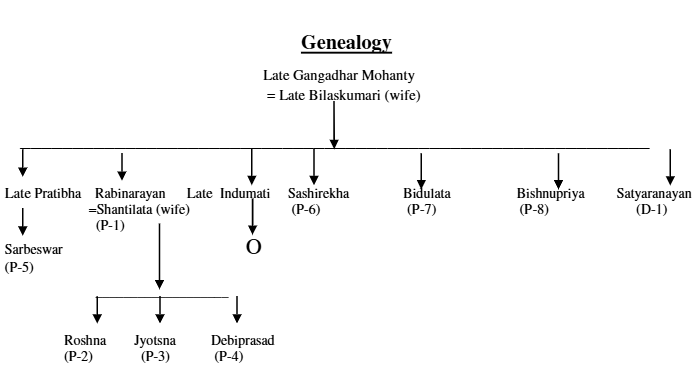
As per the aforesaid genealogy, The Plaintiffs and Defendant No.1 are the successors of Bilash Kumari Mohanty.
6. The suit properties described in Schedule-A of the plaint were the properties of Bilash Kumari Mohanty, wife of Gangadhar Mohanty. Bilash Kumari Mohanty had purchased the suit properties from one Chandra Sekhar Mohanty prior to the year 1965 from her stridhan properties. After purchase, she (Bilash Kumari Mohanty) mutated the Schedule-A suit properties to her name as per the order passed in Mutation Case No.1972 of 1965-66. As such, Bilash Kumari Mohanty was the exclusive owner and in possession over the suit properties described in Schedule-A of the plaint.
Bilash Kumari Mohanty died in the year 1978 leaving behind her husband Gangadhar Mohanty, two sons i.e. Rabinarayan Mohanty and Satyanarayan Mohanty (Defendant No.1) and five daughters i.e. Pratibha, Indumati, Sashirekha (Plaintiff No.6), Biduulata (Plaintiff No.7) and Bishnupriya (Plaintiff No.8).
The 1st daughter of Bilash Kumari Moyanty i.e. Pratibha Mohanty died leaving behind plaintiff no.5 as her successor. The 2nd daughter of Bilash Kumari Mohanty i.e. Indumati Mohanty died, while she was unmarried.
The first son of Bilash Kumari Mohanty i.e. Rabinarayan Mohanty died leaving behind the Plaintiff Nos.1 to 4 as his successors.
After the death of Bilash Kumari Mohanty, the suit properties left by her devolved simultaneously upon her husband Gangadhar Mohanty along with Plaintiffs and Defendant No.1.
By the time of death of Bilash Kumari Mohanty in the year 1978, her husband Gangadhar Mohanty was extremely old and he was incapable of looking after the management and cultivation of their properties including the Schedule-A suit properties. The eldest son of Gangadhar Mohanty i.e. Rabinarayan Mohanty was not physically and mentally fit either to cultivate or to look after the management of their properties including the Schedule-A suit properties. The father-in-law’s house of Gangadhar Mohanty is at village Chhatabar, which is the native village of Kunjabehari Sahu (Defendant No.3). The father of the Defendant No.3 had intimacy with Gangadhar Mohanty. For which, Gangadhar Mohanty entrusted the management and cultivation of Schedule-A suit properties to the father of the Defendant No.3. Gangadhar Mohanty died in the year 2006, for whic
AI
Joint ownership claims persist until partition; rights in a partition suit are not bound by limitation, and the burden to prove legal necessity for property transfer lies with the transferee.
Widow's remarriage does not strip her of inheritance rights, and married daughters have equal entitlement to family property under the amended Hindu Succession Act.


Point of law: “Conduct of indifference or Acquiescence and held that, it is settled law that an estoppel may arise as against persons who have not willfully made any misrepresentation, and whose cond....

The sale deed executed without legal necessity and consideration does not bind the joint family properties, affirming the plaintiffs' entitlement to a share.


In a partition suit, registered documents act as constructive notice, initiating the limitation period. Prolonged exclusive possession of ancestral property by a co-owner establishes ouster. Addition....

A co-owner can validly sell their share in joint properties, and the sale deed cannot be declared void if it is within the extent of the seller's interest.
A plaintiff must prove interest in joint family property to maintain a partition suit; failure to do so results in dismissal.



An indispensable Tool for Legal Professionals, Endorsed by Various High Court and Judicial Officers
Please visit our Training & Support
Center or Contact Us for assistance

Scan Me!
India’s Legal research and Law Firm App, Download now!


For Daily Legal Updates, Join us on :



 Back to top


