
 Back
Back





IN THE HIGH COURT OF JUDICATURE AT MADRAS
M.S. Ramesh, C.Kumarappan, JJ.
Muniyappan @ Chinnapillai - Appellant
Vs.
State represented by The Inspector of Police - Respondent
Crl.A.No.554 of 2021
Decided On : 22-01-2025
| Table of Content |
|---|
| 1. details of the incident (Para 3) |
| 2. trial court proceedings (Para 4) |
| 3. investigation process (Para 5 , 6) |
| 4. defense's contention (Para 7) |
| 5. prosecution's stance (Para 8 , 9) |
| 6. analysis of evidence (Para 10) |
| 7. extra-judicial confession (Para 11 , 12) |
| 8. admissibility of confession (Para 13 , 24 , 25 , 26 , 27 , 28 , 29 , 30) |
| 9. eyewitness reliability (Para 14 , 15 , 16 , 17 , 18 , 19 , 20 , 21 , 22 , 23) |
| 10. judgment outcome (Para 31) |
JUDGMENT :
C.KUMARAPPAN, J.
The instant Criminal Appeal is filed against the judgment of conviction passed against the first accused in S.C. No. 14 of 2018, dated 27.09.2021, by the Sessions Judge, Fast Track Mahila Court, Krishnagiri.
2. In the said Sessions Case, there were two accused, viz., Muniappan @ Chinnapillai, and Palanisamy. As against the second accused/Mr.Palanisamy, the Trial Court acquitted him from all charges. Thus, the present appeal is filed by the appellant/first accused.
3. According to the prosecution, the appellant/first accused, qua Muniappan @ Chinnapillai, had two wives, viz., Mariammal and Amutha. The second wife, Amutha was allegedly murdered by the first accused. He has got three children through the deceased Amutha. Among them PW1 and PW2 are his daughter and son respectively. Besides them, they also have another daughter by name Manju. The second accused is also the son of the first accused, through his first wife, viz., Mariammal. The prosecution further states that after the demise of his first wife, Mariammal, the second accused requested the first accused to support him. In order to support the second accused, the first accused requested his second wife, deceased/Amudha, to give certain property to the second accused, which was strongly objected by her.
3.1. In furtherance thereof, on 31.07.2017 at 8.45 a.m., the first accused attacked the deceased with a wooden log, and the said occurrence was witnessed by his daughter PW1/Revathi and PW2/Balaji, and the first accused's brother-in-law PW4/Thirupathi. According to PW1, immediately after the assault, the first accused's wife, Amudha, died on the spot. Thereafter, PW1 went to the Police Station and gave a complaint before the Sub Inspector of Police, viz., Ganesan (PW14). On the basis of the complaint given by PW1, PW14, the Sub Inspector of Police registered an F.I.R. at about 10 a.m. on the same day and forwarded the same to the jurisdictional Magistrate as well as to the Investigating Officer.
3.2. Immediately after the receipt of the First Information Report, the Investigating Officer (PW15) proceeded to the scene of occurrence and prepared an observation mahazar and rough sketch at about 11.15 a.m. in the presence of PW6/Govindaraj and PW7/Perumal. Thereafter, the Investigating Officer recovered the wooden log and other material objects at the scene of occurrence. He also recorded the statements of the eyewitnesses PW1, PW2, PW3 and PW4, mahazar witnesses PW6 and PW7, and one Murugan/PW13. After recording their evidences, he proceeded to the Government Hospital, Krishnagiri, where the deceased's body was kept for postmortem. In the hospital, the Investigating Officer conducted inquest upon the body of the deceased and made arrangements for it's postmortem. Thereafter, PW9/Dr. A. Kalaiarasan conducted a postmortem and in the postmortem certificate [Ex.P12], he gave his opinion that the deceased appears to be died of shock and hemorrhage due to head injury.
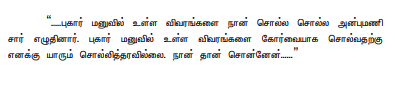
3.3. It appears that on 01.08.2017, at about 10.00 a.m., the accused voluntarily surrendered before the Village Administrative Officer [PW8], and gave an extra-judicial confession. Immediately after recording the extra-judicial confession, PW8 made arrangements to surrender the accused before the Police. On his surrender before the Police Station, the Investigating Officer made arrangements to remand him for judicial custody.
3.4. It is further case of the prosecution that, the accused once again voluntarily confessed his guilt before the Investigating




The prosecution must prove guilt beyond reasonable doubt; any reasonable doubt benefits the accused.


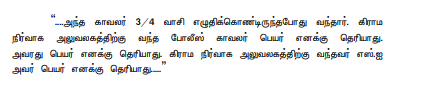
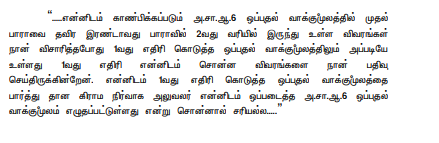
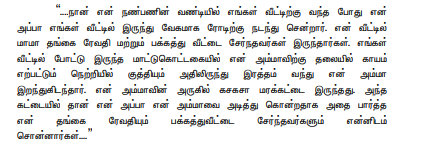
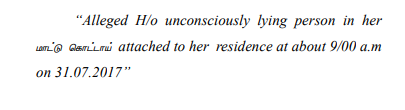
If the deceased had died on the previous day then it cannot be believed that the informant i.e. the PW-5 and the other members of the family including the PW-1 were not aware of the actual incident.

In criminal cases based on circumstantial evidence, the prosecution must establish a complete and unbroken chain of evidence to prove guilt beyond reasonable doubt.

In murder cases based on circumstantial evidence, each link must be established beyond reasonable doubt, with all evidence consistently pointing to the guilt of the accused.
The prosecution must prove the guilt of the accused beyond reasonable doubt; insufficient and inconsistent evidence led to the acquittal of the accused.
Eyewitness testimony, particularly from injured witnesses, is crucial in establishing guilt, even with minor inconsistencies in their accounts.
The prosecution's failure to establish reliable eyewitness identification and conspiratorial actions led to the acquittal of all appellants due to reasonable doubt.
The court found that eyewitness testimony and extra-judicial confessions were unreliable and insufficient to uphold a conviction, resulting in acquittal.



An indispensable Tool for Legal Professionals, Endorsed by Various High Court and Judicial Officers
Please visit our Training & Support
Center or Contact Us for assistance

Scan Me!
India’s Legal research and Law Firm App, Download now!


For Daily Legal Updates, Join us on :



 Back to top


