
 Back
Back





BEFORE THE MADURAI BENCH OF MADRAS HIGH COURT
V.SIVAGNANAM, J.
Hitler rep. by his power agent Mr.G.Narayanasamy - Appellant
Versus
Ganesan - Respondent
Second Appeal No.558 of 2003
Decided on : 29-01-2025
JUDGMENT :
The Second Appeal has been filed against the Judgment and Decree passed in A.S.No.125 of 2000 dated 29.11.2001 on the file of the Principal District Judge, Pudukottai reversing the Judgment and Decree passed in O.S.No.249 of 1995 dated 16.06.2000 on the file of the District Munsif, Arantangi.
2. For the sake of convenience, the parties are referred to as per their ranking in the Trial Court.
3. The appellant is the first defendant and the respondents are the plaintiffs in the suit.
4. The brief averment of the plaint is as follows:-
The suit property originally belonged to one Arunachalam Servai.Arunachalam Servai had two sons namely, Narayayanasamy (first plaintiff) and the Shanmugam Servai. Arunachalam Servai died intestate. Hence, his legal heirs are entitled to the properties owned by the said Arunachalam Servai. The first plaintiff Narayanasamy Servai died. His son Ganesan (second plaintiff), his wife Chinnammal (third plaintiff) and his daughter Umarani (fourth plaintiff) are his legal heirs. The said Shanmugam Servai, who is the brother of the first plaintiff, died on 25.08.1991. His wife Chinnammal (second defendant) is his legal heir. He had no children. After the death of the said Shanmugam Servai, the second defendant had executed a registered relinquish deed dated 29.12.1999 in favour of the first plaintiff and thereby, relinquishing her share in the plaint joint family properties. Therefore, the plaintiffs are entitled and having title over the plaint joint family property. The alleged Will dated 24.04.1991 is not true and genuine and it will not confer any title to the first defendant with respect to the suit property. Hence, the plaintiffs filed the suit for the relief of declaration declaring that the suit properties are the Hindu joint family property of the plaintiff and the consequential relief of permanent injunction.
5. The first defendant contested the suit and filed the written statement. The contention of the written statement is that the suit properties were divided between the deceased Shanmugam Servai and the first plaintiff Narayasansamy, 20 years ago. Shanmugam Servai had no issue. Therefore he executed a registered Will dated 24.04.1991 in favour of Hitler who is the son of the second defendant's brother. The second defendant is the wife of Shanmugam Servai. The Will is true and genuine one and therefore, the first defendant is entitled to the suit property pertaining to the Will.
6. The second defendant filed the written statement by supporting the case of the plaintiffs. It is further contended that the alleged Will dated 24.04.1991 is a forged one and her husband Shanmugam Servail was not in fit state of mind for executing such Will dated 24.04.1991.
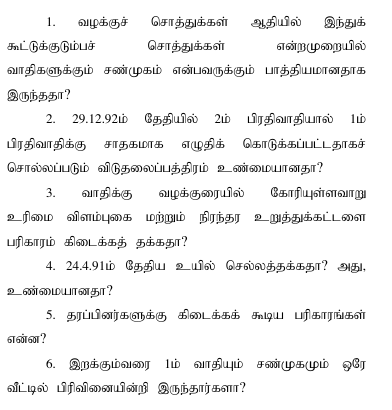
7. On the basis of the above said pleas set out by the respective parties, the following issues were framed by the Trial Court for consideration:
8. Before the Trial Court, on the side of the plaintiffs, the second plaintiff Ganesan examined himself as P.W.1 and examined three witnesses as P.W.2 to P.W.4 and marked 112 documents as Ex.A1 to Ex.A112. On the side of the defendants, the second defendant examined herself as D.W.1 and marked 96 documents as Ex.B1 to Ex.B96.
9. On consideration of the oral and documentary evidenced adduced by the respective parties and the submission made, the Trial Court found that the second defendant Chinnammal had executed a registered relinquish deed dated 29.12.1992 in favour of the first plaintiff Narayanasamy and in view of the Will dated 24.04.1991, she had no right to execute the relinquish deed dated 29.12.1992. The Trial Court further held that the first plaintiff is not a competent person to challenge the Will and in the absence of challenge by the second defendant, the plaintiff is not competent to challenge the Will dated 24.04.1991. The suit is filed by the plaintiffs relying upon the relinquish deed dated 29.12.1992 executed by the second defendant Chinnammal. Since she has no legal right to execute the
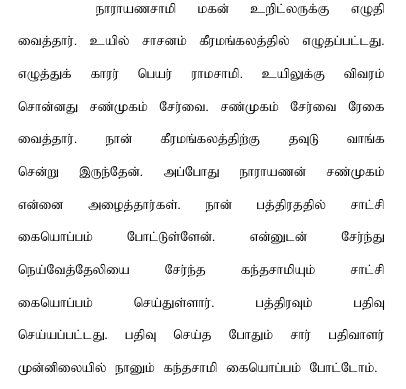
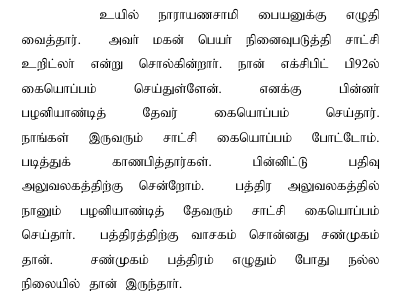
The court reaffirmed that a Will must be proven according to statutory requirements, and the First Appellate Court's findings regarding its genuineness were deemed perverse, restoring the Trial Court....
The propounder of a Will must prove its execution and attestation in accordance with law, and any suspicious circumstances surrounding the Will must be dispelled for it to be considered valid.

The court clarified that properties must be inherited or acquired from a joint family nucleus to be classified as ancestral under Hindu law, rejecting claims based solely on joint acquisition.
A registered Will has presumptive validity unless evidence demonstrates its invalidity, and execution shortly before death does not necessarily indicate suspicious circumstances.

Determination of Will validity requires adherence to statutory conditions, burden of proof lies with the challenger; possession claims alone do not supersede validly executed instruments.
The validity of a Will can be upheld despite procedural omissions if supported by sufficient evidence, and a partition suit may be dismissed if barred by limitation.


legal requirements of proving the Will has been satisfied and the factum of excluding the plaintiff Akha from the properties by the testator is reflected in the Will itself, are sufficiently proved. ....
The father of the coparceners had no right to bequeath ancestral property via Will. Wills are invalid unless proven in accordance with statutory requirements.



An indispensable Tool for Legal Professionals, Endorsed by Various High Court and Judicial Officers
Please visit our Training & Support
Center or Contact Us for assistance

Scan Me!
India’s Legal research and Law Firm App, Download now!


For Daily Legal Updates, Join us on :



 Back to top


