
 Back
Back





PUNJAB AND HARYANA HIGH COURT AT CHANDIGARH
AMARINDER SINGH GREWAL, J.
Bhajno Alias Bhajo - Appellant
Vs.
Harbans Singh (Since Deceased) Through Lrs And Others - Respondent
RSA No. 2351 of 1992 (O&M)
Decided On : 16-09-2025
| Table of Content |
|---|
| 1. background of the ownership dispute and initial claims based on wills. (Para 3 , 4 , 5) |
| 2. arguments regarding the validity and execution of the contested will. (Para 8 , 10) |
| 3. legal standards for proving will validity under the indian succession act. (Para 12 , 16 , 18) |
| 4. conclusion affirming the dismissal of the plaintiff's appeal. (Para 22) |
JUDGMENT :
Amarinder Singh Grewal, J.
The plaintiff is the appellant before this Court challenging the judgment and decree dated 12.10.1992 passed by the learned 1st Appellate Court whereby the judgment and decree dated 05.06.1987 passed by the learned trial Court decreeing the suit of the appellant-plaintiff has been reversed and while allowing the appeal of the respondents-defendants, the suit was dismissed.
2. For the sake of convenience, parties are being referred to in terms of their status before the learned trial Court.
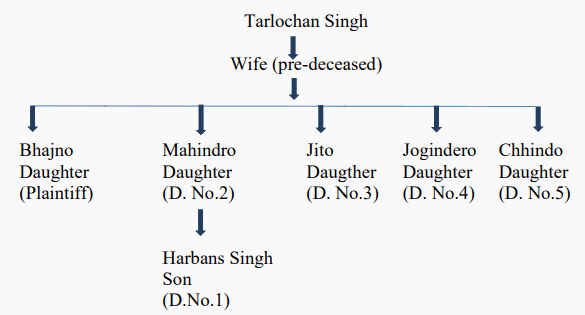
3. In brief, the facts are that plaintiff had filed a suit for declaration regarding suit property as detailed in the head note of the plaint, situated in village Bathe Bhaini, Tehsil Patti, District Amritsar to the effect that the plaintiff is in possession of 1/5th share of land qua the share of Tarlochan Singh son of Sh. Sadhu Singh on the basis of registered Will dated 31.03.1981 and defendants No.1 and 2 are owners of 1/5th share and defendants No.3 to 5 are owners of 3/5th share in the estate of Tarlochan Singh, with the consequential relief of permanent injunction with the direction that defendants No.1 and 4 should not dispossess the plaintiff and further alienate the suit land in favour of any person. Tarlochan Singh son of Sadhu Singh had pre-deceased his wife and he had five daughters. A pedigree table is drawn as under to better understand the relationship between the parties.
4. The plaintiff propounded a Will dated 31.03.1981 executed by Tarlochan Singh bequeathing his estate in favour of his five daughters as mentioned above in the ratio of 1/5th share each in favour of plaintiff and defendants No.3 to 5 and 1/5th share in favour of defendants No.1 and 2. The said Will was registered in the office of Sub-Registrar, Patti. However, defendants No.1 and 4 propounded another Will dated 24.01.1984 allegedly executed by Tarlochan Singh whereby they were declared sole owners of the suit property and on the basis of same, they made attempts to dispossess the plaintiff from Khasra Nos.2//25, 3//22/1, 5//11/2/1 and 38//25 and also got mutations of the land bearing Nos.1010 and 1516 sanctioned in their names excluding all other legal heirs and completely ignoring the Will dated 31.03.1981. Hence, the civil suit.
5. The suit was contested by defendants No.1 to 4 by filing written statement wherein preliminary objections qua suppression of material facts and plaintiff not coming with clean hands etc. were taken. On merits, it was stated that defendant No.1 and husband of defendant No.4 took care of Tarlochan Singh throughout his life and thus, out of love and affection, he bequeathed the Will dated 24.01.1984 in their favour and cancelled his earlier Will dated 31.03.1981 on the basis of which mutations were sanctioned in their favour as well. They denied the possession of plaintiff over 1/5th share of the land in dispute. It was also stated that defendant No.5 got executed a fabricated Will dated 24.01.1984 and got sanctioned mutations on the basis of said Will but the same were rejected by SDO (Civil), Patti exercising the power of Assistant Collector 1st Grade, SDO (C) after affording opportunity of leading evidence to all parties.
6. Replication was filed by the plaintiff whereby she controverted the pleas of defendants and reiterated the pleas taken in the plaint.
7. On the basis of pleadings, the learned trial Court framed as many as eight issues including the issue of relief. After appreciating the oral as well as documentary evidence led by both the parties, the learned trial Court decreed the suit and declared the plaintiff to be owner in posses
Determination of Will validity requires adherence to statutory conditions, burden of proof lies with the challenger; possession claims alone do not supersede validly executed instruments.


A will's validity must be proven beyond suspicion, especially when claims of fraud or undue influence arise; the burden of proof lies on the party benefiting from the will under suspicious circumstan....

The propounder of a Will must prove its execution and attestation in accordance with law, and any suspicious circumstances surrounding the Will must be dispelled for it to be considered valid.


Proof of execution of Will – There can be no interference to Will which stands proved unequivocally.

The propounder of a Will must dispel any suspicious circumstances surrounding its execution to establish its validity.
The main legal point established in the judgment is the fulfillment of legal requirements for proving a Will and the production of sufficient evidence to remove suspicious circumstances, thereby upho....

The execution of a will must strictly adhere to statutory requirements, including valid attestation by witnesses, and mere registration does not suffice to validate a will in the presence of suspicio....



An indispensable Tool for Legal Professionals, Endorsed by Various High Court and Judicial Officers
Please visit our Training & Support
Center or Contact Us for assistance

Scan Me!
India’s Legal research and Law Firm App, Download now!


For Daily Legal Updates, Join us on :



 Back to top


