
 Back
Back





BEFORE THE MADURAI BENCH OF MADRAS HIGH COURT
V. Sivagnanam, J.
Muthusamy Gounder and ors. - Appellants
Versus
Soliammal - Respondent
S.A.(MD)Nos.734 & 985 of 2005 and C.M.P(MD)No.4826 of 2005
Decided On : 21-01-2025
JUDGMENT :
V.Sivagnanam, J.
These Second Appeals have been filed against the Judgment and Decree passed in A.S.Nos.30 and 45 of 2004, dated 18.02.2005 on the file of Sub Court, Karur reversing the Judgment and Decree passed in O.S.No.489 of 2001, dated 23.02.2004 on the file of Principal District Munsiff Court, Karur.
2.For the sake of convenience, the parties are referred to as per their ranking in the Trial Court.
3.The defendants in O.S.No.489 of 2001 on the file of the Principal District Munsif Court, Karur are the appellants herein in both the Second Appeals.
4.The plaint averments in brief are as follows:-
The fact of the case is that the plaint schedule properties are owned by Veerapa Gounder. The first defendant and the plaintiff are brother and sister. The second defendant is the son of the first defendant. Nallamal is the wife of Veerapa Gounder. The property is the self acquired property of Veerappa Gounder. Veerappa Gounder has died intestate. Therefore, his legal heirs Nallammal and the plaintiff and the first defendant are entitled to the properties. Nallammal has also died intestate leaving the plaintiff and the first defendant as the legal heirs. Since the property is the self acquired property of Veerapa Gounder, the plaintiff and the first defendant are entitled to ½ share of the properties. Therefore, they filed the suit for passing preliminary decree for ½ share in the plaint schedule properties.
5.The defendant filed a written statement and contested the suit. The defendant specifically denied the contention in the plaint and further contented that Veerappa Gounder has purchased the property from the income of the ancestral property and the plaint schedule property is the joint family property. It is not self acquired property of Veerappa Gounder. After the death of Veerappa Gounder, the plaintiff and the first defendant are equally entitled for ½ share in the property. Therefore, the plaintiff is entitled for only ½ share, besides the plaintiff has orally relinquished her ½ share to the first defendant a long back. Under such circumstances, the plaintiff is not entitled to claim any share over the plaint schedule property and thus pleaded to dismiss the suit.
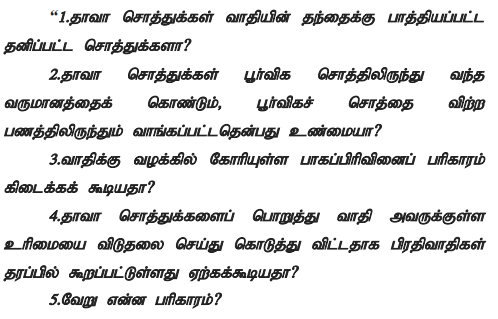
6.On the basis of the above said pleas set out by the respective parties, the following issues were framed by the trial Court for consideration: -
7.Before the trial Court, in support of the plaintiff's case, the plaintiff herself examined as P.W.1 and one Mani examined as P.W.2 and 6 documents have been marked as Ex.A1 to Ex.A6. On the side of the defendants, the first defendant was examined as D.W.1 and 13 documents have been marked as Ex.B.1 to Ex.B13.
8.The trial Court after considering the submissions of the Counsel for the parties and the evidence on record decreed ¼ share to the plaintiff and thus passed the preliminary decree as the plaintiff is entitled for ¼ share in the suit schedule property. Aggrieved by this Judgment and Decree, the plaintiff has filed a suit in A.S.No.30 of 2004 and the defendant filed an appeal in A.S.No.45 of 2004.
9.On considering the evidence on record, the first appellate Court has allowed the appeal in A.S.No.30 of 2004 and set aside the Judgment and Decree of the trial Court in O.S.No.489 of 2001, dated 23.02.2004 and modified and granted preliminary decree of ½ share to the plaintiff and decreed the suit filed by the plaintiff in A.S.No.30 of 2004 and dismissed the appeal filed by the defendant in A.S.No.45 of 2004. Aggrieved over the same, the defendant has filed a Second Appeal before this Court.
10.This Court while admitting the Second Appeal has framed the following substantial questions of law :-
1.Whether the 1st Appellate Court not erred in holding that the suit properties are self acquired properties and the existence of joint family property not formed the nucleus for acquisition of the suit property?
2.Whether the 1st Appellate Court erred in not holding that the Appellant/Defendant discharged the onus of proving t
The court confirmed equal inheritance rights for siblings over self-acquired property despite claims of relinquishment without written evidence.
A daughter's entitlement to inherit a share as a co-parcener in ancestral property is upheld, emphasizing the need to distinguish between ancestral and self-acquired properties.

A legal heir is entitled to an equal share in joint family properties, and claims of exclusive ownership must be substantiated by evidence.
The court upheld the entitlement of the plaintiff's share in ancestral properties and directed the determination of her legal heirs and the validity of her Will before distribution.

The main legal point established in the judgment is that properties derived by the father through a partition deed are to be treated as his self-acquired properties, as per Section 8 of the Hindu Suc....

The mother of a deceased Hindu male is a Class-I heir and entitled to a share in the property left by the deceased. Her legal heirs are also entitled to a share after her death.
Oral relinquishments of joint family property rights are insufficient without written documentation; statutory rights persist despite prior agreements made by family members.
The court affirmed that items 1 and 2 of suit properties are ancestral, and items 3 to 11 are self-acquired, highlighting the plaintiffs' burden to prove family property claims.



An indispensable Tool for Legal Professionals, Endorsed by Various High Court and Judicial Officers
Please visit our Training & Support
Center or Contact Us for assistance

Scan Me!
India’s Legal research and Law Firm App, Download now!


For Daily Legal Updates, Join us on :



 Back to top


