
 Back
Back





IN THE HIGH COURT OF JUDICATURE AT MADRAS
MUMMINENI SUDHEER KUMAR, J.
E. Balakrishnan - Appellant
Versus
Commissioner Hindu Religious and Charitable Endowment Department - Respondent
W.P. No. 19892 of 2015
Decided On : 31-01-2025
ORDER :
1. While the petitioner was working as Regional Audit Officer, he was subjected to disciplinary proceedings, by issuing a charge memo dated 01.02.2011 containing four charges, which are as under:
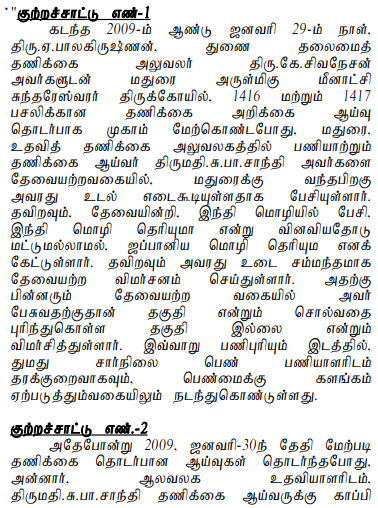
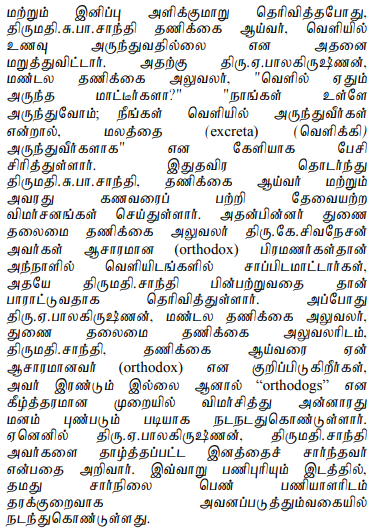
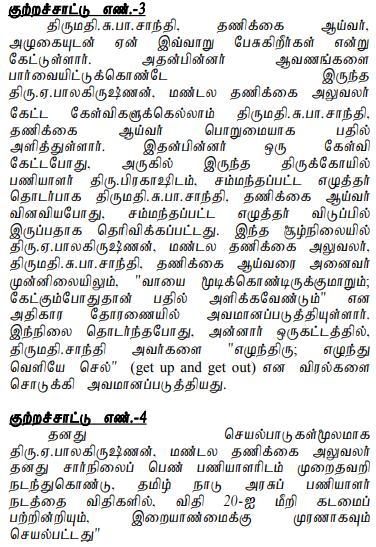
2. The petitioner submitted his explanation in response to the charge memo on 21.02.2011, 06.04.2011 and finally on 16.05.2011 denying the charges. It was thereafter, an enquiry officer was appointed on 22.07.2011 for enquiring into the charges levelled against the petitioner. The enquiry officer, after having conducted detailed enquiry, submitted his report dated 24.06.2013, concluding that the Charge No.1 levelled against the petitioner as not proved and Charge Nos.2 to 4 as proved. It was thereafter, a copy of the report of the enquiry officer was communicated to the petitioner on 06.09.2013 duly affording an opportunity to the petitioner to submit his further representation. Accordingly, the petitioner submitted his further representation on 05.12.2013. It was thereafter, the Government issued a provisional conclusion order proposing to impose the punishment of cut in pension of Rs.2,000/- per month for a period of three years. In response to the said show cause notice, the petitioner submitted his explanation on 25.04.2014. It was thereafter, the 2nd respondent passed orders in G.O.Ms.No.63 Tourism, Culture and Religious Endowments Department, dated 17.04.2015, imposing the punishment as proposed. It is aggrieved by the said order, the petitioner approached this Court by filing the present writ petition.
3. Heard Mr.K.Venkataramani, learned Senior Counsel for Mr.M.Muthappan, learned counsel for the petitioner and Mr.S.Ravichandran, learned Additional Government Pleader for the respondents (HR & CE).
4. As already noted above, in all four charges were framed against the petitioner. Out of the four charges, Charge No.1 was held as not proved. The reason for holding the said charge as not proved is that the alleged incident of abusing/insulting Tmt.S.P.Santhi, Audit Inspector was on 29.01.2009, but the said Audit Inspector has not attended at all the office on 29.01.2009 and therefore, the question of petitioner abusing or insulting the Audit Inspector on 29.01.2009 does not arise.
5. The Charge No.2 is on the basis of some conversation between the petitioner and the alleged victim, Tmt.S.P.Santhi, Audit Inspector in connection with the eating habit of the said Audit Inspector, and the petitioner making certain comments against the said Audit Inspector and her husband by calling her 'ortho dog', etc. The said charge was held to have been proved by the enquiry officer by placing reliance on the two suggestions put by the learned counsel for the delinquent/petitioner to Tmt.S.P.Santhi during her cross-examination, on advising her to learn Japanese language, as the persons who have learned Japanese language are earning Rs.5,000/- per hour, etc. As a matter of fact, the so called advise by the petitioner to Tmt.S.P.Santhi, about learning Japanese language was alleged in the Charge No.1, but not in Charge No.2. The incident which is the basis for Charge No.1 was alleged to have been taken place on 29.01.2009 and whereas, the instances which are basis for Charge No.2 are alleged to have been taken place on 30.01.2009. But the enquiry officer instead of examining the truth or otherwise of Charge No.2, by placing reliance on two suggestions made on behalf of the petitioner, during the cross examination of Tmt.S.P.Santhi pertaining to the incidents which is subject matter of Charge No.1, came to the conclusion that the Charge No.2 is proved against the petitioner. Thus, the entire evidence that was relied upon by the enquiry officer to come to the conclusion that the Charge No.2 as proved is totally an irrelevant evidence and as a matter of fact, there is no finding on the alleged, making of unnecessary comments against Tmt.S.P.Santhi affecting her mentally as alleged in the Charge No.2. Hence, the finding recorded by the enquiry officer
Disciplinary proceedings must adhere to principles of natural justice, and disproportionate punishment may be reduced by the court.


Disciplinary findings are unsustainable without cogent evidence, reflecting violations of natural justice principles, requiring independent evaluation by authorities.

Unexplained delay in disciplinary proceedings may indicate bias and prejudice, and procedural irregularities can render the entire proceeding non est in the eye of law.
The framing of charges by an Enquiry Officer does not invalidate disciplinary proceedings, and modified punishments can be upheld if deemed proportionate.

The central legal point established in the judgment is the requirement to prove charges with evidence, the denial of reasonable opportunity to defend the charges effectively, and the inapplicability ....

The central legal point established in the judgment is the requirement for disciplinary authorities to base their findings on cogent reasons, seek explanation before inflicting major penalty, and pro....
The court emphasized the importance of adhering to procedural rules and highlighted the impermissibility of relying on statements made during preliminary enquiry in disciplinary proceedings.
Procedural irregularity and lack of natural justice can invalidate disciplinary proceedings.



An indispensable Tool for Legal Professionals, Endorsed by Various High Court and Judicial Officers
Please visit our Training & Support
Center or Contact Us for assistance

Scan Me!
India’s Legal research and Law Firm App, Download now!


For Daily Legal Updates, Join us on :



 Back to top


