


 Back
Back





2025 Supreme(Mad) 4550
BEFORE THE MADURAI BENCH OF MADRAS HIGH COURT
G.R.SWAMINATHAN, K.RAJASEKAR, JJ.
M.Arasupandi - Appellant
Versus
The Commissioner of Police - Respondent
W.A(MD)No.1673 of 2025 and C.M.P(MD)No.9366 of 2025
Decided on : 20-06-2025
Advocate Appeared:
For the Appellant :Mr.N.Ananthapadmanabhan, Senior Advocate, Mr.K.P.S.Palanivelrajan, Senior Advocate for Mr.M.Karthikeya Venkitachalapathy
For the Respondents:Mr.R.Baskaran Additional Advocate General Assisted by Mr.T.Senthil Kumar Additional Public Prosecutor
Imposing conditions on public gatherings must be justified and reasonable, ensuring no violation of fundamental rights to movement and assembly.
Headnote:(A) Constitution of India - Article 19(1)(d) and Article 19(5) - Madras City Police Act, 1888 - Regulation of gatherings - Condition imposed by police requiring vehicle passes for attendees struck down for lack of jurisdiction and unreasonableness - Condition hindered citizens' right to movement and participation. (Paras 5, 6, 7, 8, 9, 18)
(B) Fundamental Rights - Any restriction on movement must be reasonable and justified, balancing individual rights and public interest. (Paras 9, 13, 16)
Facts of the case:
Appellant sought to challenge the imposition of a condition by police on vehicle passage for a religious conference, claiming violation of fundamental rights, while police argued for order maintenance.
Findings of Court:
Condition imposed lacked jurisdiction and was unreasonable, violating rights to movement and assembly.
Issues: Jurisdiction of police to impose vehicle restrictions and the reasonableness of such conditions.
Ratio Decidendi: The Assistant Commissioner's condition was outside jurisdiction and unreasonable, failing to justify its necessity.
Result: Condition No.7 set aside; Writ Appeal allowed.
| Table of Content |
|---|
| 1. factual background of the case. (Para 1) |
| 2. arguments regarding the imposition of vehicle pass condition. (Para 2 , 3) |
| 3. court examines the legality of imposed conditions. (Para 4 , 5) |
| 4. analysis of legal powers regarding public assemblies. (Para 6 , 7 , 9 , 10) |
| 5. assessment of balance between rights and public interest. (Para 8 , 11 , 12 , 13) |
| 6. rights of citizens and limitations on authority. (Para 14 , 15 , 16) |
| 7. clarification of proposed arrangements to satisfy law enforcement. (Para 17) |
| 8. final judgment and reasons for modifying the previous order. (Para 18 , 19) |
JUDGMENT :
G.R. Swaminathan, J.
This Writ Appeal is directed against the order dated 13.06.2025 made in W.P.Crl(MD)No.185 of 2025. Hindu Munnani has proposed to conduct a conference of the devotees of Lord Muruga on 22.06.2025 from 03.00 p.m to 08.00 p.m in the city of Madurai near Vandiyur Toll Plaza, Pandi Kovil Ring Road. Permission for conducting the conference had been granted by the Assistant Commissioner of Police, Anna Nagar Range, Madurai Greater City (North) vide proceedings dated 12.06.2025. However, it was subject to as many as 52 conditions. The organisers feel aggrieved by condition No.7. It reads as follows:
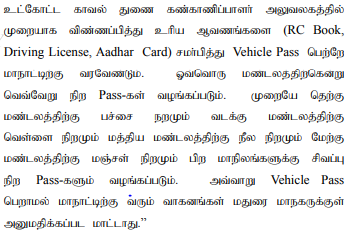
Questioning the said condition, the appellant filed W.P.Crl(MD)No.185 of 2025. The learned single Judge however declined to interfere with the said condition. The learned single Judge observed as follows:
“28. The learned Senior Counsel for the petitioner has raised serious objections with regard to condition No.7 that apart from the members of their organisation, common devotees may also attend the event and it would be difficult for the common devotees to approach the Deputy Superintendent of Police to apply and to obtain vehicle pass. This condition, according to the learned Additional Advocate General is only to organise the vehicles, which are supposed to take part in the event and also to prevent any vehicle procession.
29. The learned Senior Counsel for the petitioner submits that they are not having plan to conduct vehicle procession in any form. This Court is of the view that this condition has been imposed in order to regulate the vehicles which are likely to participate in the event. If any participant applies for the vehicle pass, the police officer concerned shall issue the vehicle pass within 24 hours of the application. There is no reason to interfere with the condition. In the event, if the police refuse to grant vehicle pass, it has to be rejected with valid reasons.”
Aggrieved by the same, the appellant herein moved the Hon'ble Supreme Court of India by filing S.L.P(Crl)No.009176-009177 of 2025. It was disposed of in the following terms:
“1. Mr.Sidharth Luthra, learned senior counsel submits that recently the High Court has taken a view that the nature of orders which are assailed in the instant special leave petitions are amenable to challenge in the Letters Patent Jurisdiction.
2. He, thus, prays for liberty to withdraw the instant special leave petitions so that the petitioner can avail suitable remedy before the High Court.
3. Accordingly, the special leave petitions are disposed of as withdrawn with liberty, as prayed for.”
Availing the liberty granted by the Hon'ble Supreme Court, this Writ Appeal has been filed.
2. The learned Senior Counsel appearing for the appellant primarily contended that the imposition of the impugned condition is violative of the fundamental right guaranteed under Article 19(1)(d) of the Constitution of India . According to him, this condition is unreasonable and onerous. He also contended that the Assistant Commissioner, Anna Nagar Range, Madurai City lacks the jurisdiction to stipulate such a condition. He pointed out that when similar conferences far greater in magnitude were organized in Madurai City in the very recent past by the political parties, such a condition had not been stipulated. He also cited certain practical difficulties in complying with the impugned condition. He lamente












