
 Back
Back





IN THE HIGH COURT OF JUDICATURE AT MADRAS
R.Sakthivel, J.
S.Thangarasu Pillai - Appellant
Versus
S.Arumugam Pillai (Died) and ors. - Respondents
S.A.NO.103 of 2021 And C.M.P.No.2219 of 2021
Decided On : 04-06-2025
| Table of Content |
|---|
| 1. parties and facts of the case (Para 1 , 3 , 4) |
| 2. establishing facts around property ownership and previous agreements. (Para 5 , 6) |
| 3. arguments presented by both parties regarding property partition. (Para 8) |
| 4. arguments presented by both parties (Para 9 , 10) |
| 5. court's rationale on statutory requirements for property partition. (Para 11) |
| 6. legal analysis regarding partition (Para 12 , 14 , 15 , 19) |
| 7. determination of plaintiff's share (Para 24) |
| 8. final judgment and decree (Para 28) |
JUDGMENT :
R.Sakthivel, J.
This Second Appeal is directed against the Judgment and Decree dated December 12, 2019 passed in A.S.No.69 of 2014 by the 'Principal District Court, Ariyalur' [henceforth 'First Appellate Court' for the sake of brevity and convenience] reversing the Judgment and Decree dated October 27, 2006 passed in O.S.No.65 of 2004 by the 'Subordinate Court, Ariyalur' [henceforth 'Trial Court'].
2. For the sake of convenience, hereinafter, the parties will be referred to as per their array in the Original Suit.
PLAINTIFF'S CASE
3. The plaintiff is the elder brother of the 1st defendant. The 2nd and 3rd defendants are the sisters of the plaintiff and the 1st defendant. The plaintiff worked as an Engineer in several places in the State of Tamil Nadu and he retired from service in 1993. Thereafter, he is residing along with his son at Pennadam. The 1st defendant who is the younger brother of the plaintiff was living along with his father Subbaraya Pillai in the native village - Sendurai and he has been employed as a Village Administrative Officer. The 2nd and 3rd defendants / sisters are already married.
3.1. Late Subbaraya Pillai is the father of the plaintiff and defendants and they have already divided the landed properties on February 14, 1972 by way of registered deed of partition, excluding the Suit Properties which are house and house-sites. It was agreed that the Suit Properties being enjoyed in common as joint family properties, shall be reserved for partition at a later point of tine. The 1st defendant and father - Subbaraya Pillai were residing in the 1st item of the Suit property and other Suit items were under the control of the Subbaraya Pillai till his death. Around 1995, Subbaraya Pillai died intestate leaving behind the plaintiff and the defendants as his legal heirs. After the death of Subbaraya Pillai, the Suit Properties are under the management of the 1st defendant and as such the Suit Properties are tenancy in common.
3.2. Then, the plaintiff approached the 1st defendant to divide the Suit Properties equally. The plaintiff stated that the sisters should be given a share in terms of money. But the 1st defendant refused for the same and subsequently attempted to alienate some of the Suit items and now he is trying to put up construction in 6th item of the Suit Property. Under such circumstances, the plaintiff demanded partition on March 14, 2004 to divide the Suit properties and the 1st defendant denied the right of the plaintiff by saying that the plaintiff and the other defendants have no right at all over the Suit properties. Hence, the Suit for partition.
DEFENDANTS' CASE
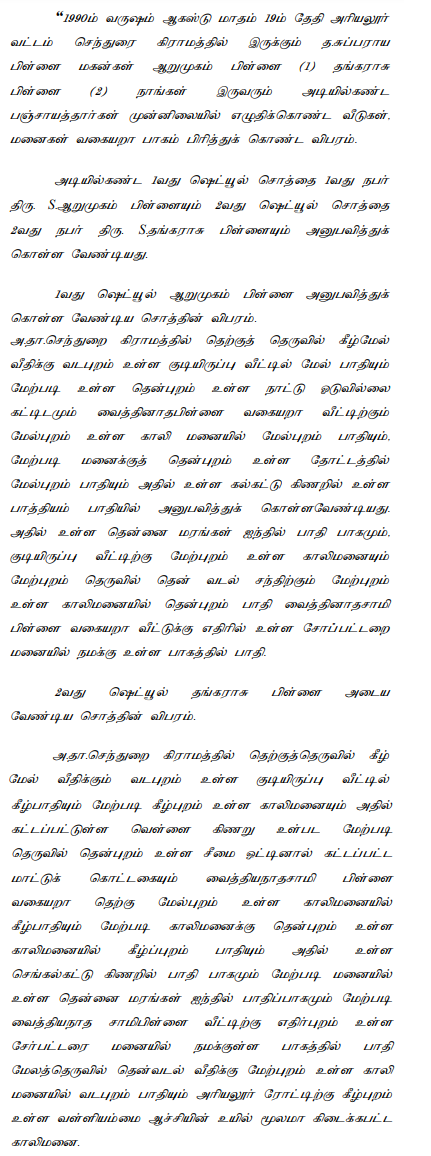
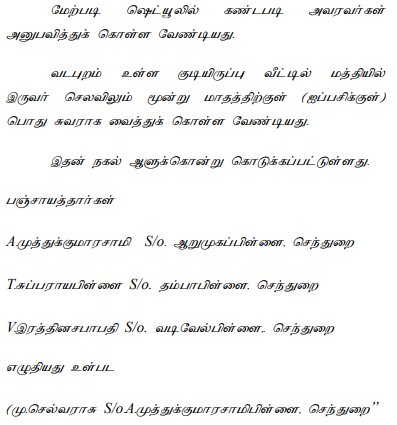
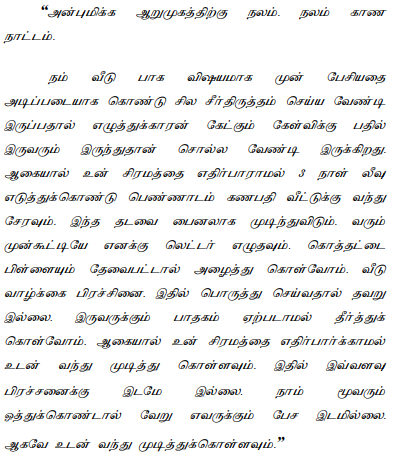
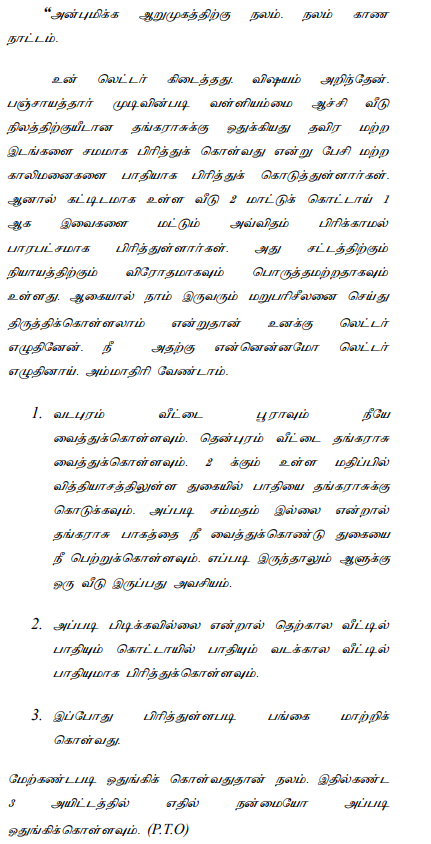
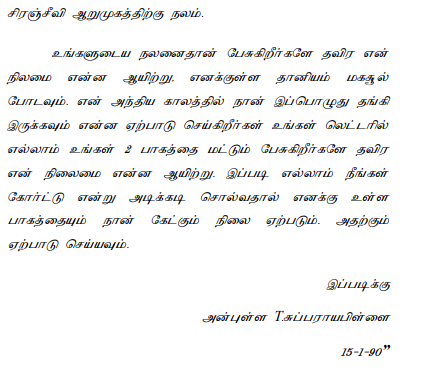
4. The first defendant filed written statement and the same was adopted by defendants 2 and 3. The defendants denied the allegations made in the plaint. It is averred that the Suit properties are not joint family properties and were already divided through a Panchayat comprising Muthukumarasamy Pillai, Subbaraya Pillai, Rathinasabapathy Pillai and others, around the year 1990. To record the same for remembrance, on August 19, 1990, the partition was reduced into a Partition List in the presence of the Panchayatdhars, drafted by one Selvaraj of Sendurai, and duly attested by all the Panchayatdhars after it was signed by the plaintiff and the first defendant. Since then, the plaintiff and the 1st defendant have been in absolute possession and enjoyment of their respective shares. The plaintiff issued a notice dated November 6, 1990, acknow

AI
A partition agreement requires registration if it creates rights; a document lacking registration cannot substantiate a partition despite acknowledgments.

Oral partitions, while valid, must be substantiated by evidence, and unregistered documents regarding such partitions are inadmissible in court; res judicata applies to suits dismissed for default wi....

The court reaffirmed that for a valid partition among joint family properties, proper registration and absence of fraud are crucial, emphasizing joint possession and familial rights.
The burden of proof for claims of oral partition lies with the party asserting it, and failure to establish legal ownership results in dismissal of the suit.

Rule 73 of Rules reads as duties of Registering Officer.


A Second Appeal lacks merit if it raises factual disputes already resolved by lower courts and does not present a substantial question of law.
In a partition suit, all legal heirs must be parties, and failing to prove a settlement deed invalidates claims to partition. The court upheld the necessity for complete participation of all heirs in....
The main legal point established in the judgment is the requirement for compulsory registration of family settlement documents under Section 17(1)(b) of the Registration Act, 1908, and the inadmissib....



An indispensable Tool for Legal Professionals, Endorsed by Various High Court and Judicial Officers
Please visit our Training & Support
Center or Contact Us for assistance

Scan Me!
India’s Legal research and Law Firm App, Download now!


For Daily Legal Updates, Join us on :



 Back to top


