
 Back
Back





IN THE HIGH COURT OF JUDICATURE AT MADRAS
R. Sakthivel, J.
Kannan - Appellant
Versus
Venkatesan - Respondent
S.A.No.489 of 2019 and CMP No.8148 of 2019
Decided On : 04-06-2025
| Table of Content |
|---|
| 1. sale agreement details and disputes (Para 3 , 4) |
| 2. trial court's finding of validity. (Para 5) |
| 3. trial court and first appellate court rulings (Para 6 , 7) |
| 4. arguments of both parties in appeal (Para 8 , 9 , 10) |
| 5. court's analysis of evidence and legal principles (Para 11 , 12 , 13 , 14 , 16) |
| 6. conclusion and modification of appellate court's decision (Para 17 , 18) |
JUDGMENT :
R. Sakthivel, J.
This Second Appeal is directed against the Judgment and Decree dated October 30, 2018 passed in A.S.No.26 of 2016 by the 'Additional District Court (Fast Track Court) Villupuram' ['First Appellate Court' for brevity], whereby the Judgment and Decree dated December 22, 2015 passed in O.S.No.36 of 2012 by the '1st Additional Sub Court, Villupuram' ['Trial Court' for brevity] was set aside and alternate remedy of return of advance money was granted.
2. For the sake of convenience, hereinafter, the parties will be referred to as per their array in the Original Suit.
PLAINTIFF'S CASE
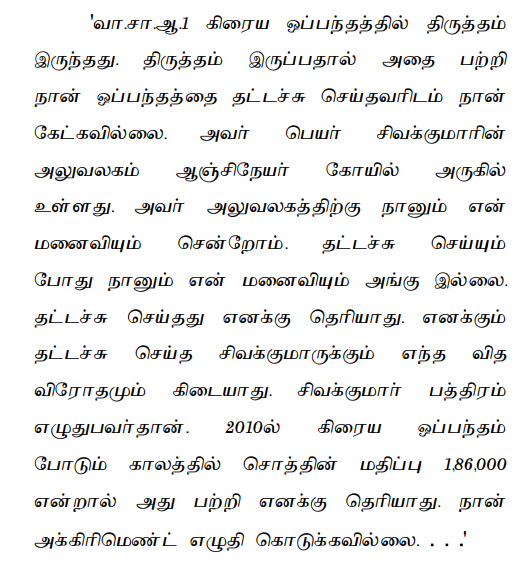
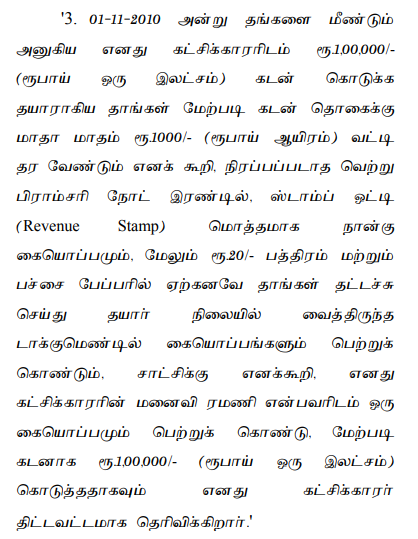
3. The Suit property was owned and possessed by the defendant. On November 1, 2010, both parties entered into a Sale Agreement, wherein the plaintiff agreed to purchase the Suit Property for Rs.1,86,000/- and the defendant accepted an advance of Rs.1,00,000/-. The remaining Rs.86,000/- was to be paid within 40 days, after which the defendant was to execute the Sale Deed in the plaintiff's name. The Sale Agreement was properly executed with signatures from both parties, witnesses and the scribe. The plaintiff was always ready and willing to perform his part of the contract and repeatedly requested the defendant to execute the sale deed, but the defendant delayed under various pretexts. The plaintiff issued a legal notice on December 1, 2010 demanding performance, but the defendant responded with a false reply notice, claiming the amount was a loan alleging coercion in obtaining blank promissory notes and other documents. The plaintiff denied these allegations and asserted that the agreement was genuine and the advance was paid in the presence of the defendant’s wife. Since the defendant failed to execute the Sale Deed, the plaintiff has no option but to file the Suit for specific performance of the agreement and for the alternate relief of return of advance amount.
DEFENDANT'S CASE
4. The defendant asserts that the suit is vexatious, unsustainable in law and should be dismissed with costs. The defendant denied the alleged Sale Agreement dated November 1, 2010, the agreed sale price of Rs.1,86,000/- and the receipt of Rs.1,00,000/- as advance, and contended that the plaintiff is put to strict proof of the same. The defendant never intended to sell the Suit Property and did not execute any such agreement. The Suit Property’s total value is at Rs.4,18,500/- which contradicts the claimed sale price, showing no consensus ad idem. The defendant states that the plaintiff has suppressed the true facts and filed a false case. The defendant never intended to sell the Suit Property to the plaintiff. On October 28, 2010, he sought a loan from the plaintiff, who demanded a photo copy of the Sale Deed pertaining to the Suit Property. On November 1, 2010, the plaintiff obtained the copy as well as the defendant’s signatures in a Rs.20/- stamped paper, a green paper, and two blank promissory notes. It was all intended for the purpose of money transaction and not any Sale Agreement. The plaintiff fabricated the Sale Agreement. The defendant was ready to repay the loan of Rs.1,00,000/- with interest from October 28, 2010, but the plaintiff refused to acknowledge it. The defendant sent a legal Notice on November 30, 2010, but the plaintiff, with an ulterior motive, responded on December 1, 2010 without referring to the defendant’s notice. Hence, the plaintiff is disqualified from seeking specific performance or alternative relief.Accordingly, the defendant sought to dismiss the Suit.
TRIAL COURT
5. At trial, plaintiff was examined as P.W.1 and one Sivakumar was examined as
AI
The plaintiff's claim for specific performance was denied due to the lack of clean hands and undisclosed encumbrances; however, he was entitled to the return of the advance amount with interest.


The court ruled that doubts surrounding the authenticity of a Sale Agreement preclude the granting of specific performance, emphasizing the plaintiff's burden to prove the agreement's validity.
The plaintiff must prove readiness and willingness to perform a contract under Section 16(c) of the Specific Relief Act, and failure to do so negates entitlement to specific performance.
The plaintiff's failure to prove readiness and willingness to perform the contract precludes specific performance, but the first defendant must return the advance amount with interest.

The failure to prove the non-execution of a sale deed is detrimental to the appeallant's case.
The court established that a sale agreement lacking necessary signatures and evidence of payment cannot be enforced for specific performance, but a partial refund of advance is permissible.
An agreement of sale signed by vendor alone and delivered to purchaser, and accepted by the purchaser, has always been considered to be a valid contract. In the event of breach by the vendor, it can ....
Specific performance denied for lack of continuous readiness proof and evidence of agreement as loan security.
Point of law: Absence of any material, that the plaintiff had exercised undue influence in obtaining the sale agreement from the defendant at the time of the alleged loan transaction.



An indispensable Tool for Legal Professionals, Endorsed by Various High Court and Judicial Officers
Please visit our Training & Support
Center or Contact Us for assistance

Scan Me!
India’s Legal research and Law Firm App, Download now!


For Daily Legal Updates, Join us on :



 Back to top


