Back
Back





2024 Supreme(Mad) 2501
BEFORE THE MADURAI BENCH OF MADRAS HIGH COURT
D. BHARATHA CHAKRAVARTHY, J.
Justinraj - Petitioner
Versus
Arockiaraj - Respondent
C.M.P. (MD) No. 11016 of 2022, C.R.P. (MD) No. 2296 of 2022
Decided On : 26-07-2024
Advocate Appeared:
For the Petitioner: R. Paranjothi
For the Respondents: G. Sridharan, S.R.A. Ramachandran
Family arrangements creating present rights must be registered under the Registration Act, while those reflecting past oral arrangements do not require registration for admissibility as evidence.
Headnote:(A) Registration Act - Section 17 - Document titled as family partition Muchalika - Trial Court's refusal to take document on file due to lack of registration - Document characterized as evidence of oral partition or as a present partition, relevant to admissibility. (Paras 2, 9, 11)
(B) The court emphasized that family arrangements when not affecting present interests need not be registered; however, if the document creates present rights, compulsory registration is mandated. (Paras 8, 10)
Facts of the case:
The petitioner contended that a family partition deed was executed in 1976, leading to disputes when the defendants challenged its legitimacy, claiming it was fraudulent due to lack of registration.
Findings of Court:
The Court ruled to allow the document to be taken on file for consideration of admissibility and relevance, remanding such considerations to the trial court.
Issues: The primary issues revolved around whether the document was to be treated as a family arrangement or as creating present rights necessitating registration.
Ratio Decidendi: The court concluded that refusing to accept the document outright hindered the plaintiff's ability to present evidence; the admissibility will be treated under the trial court's discretion based on evident circumstances.
Result: Civil Revision Petition allowed.
| Table of Content |
|---|
| 1. court's consideration of document admissibility (Para 1 , 3) |
| 2. arguments on fraudulent claims (Para 4 , 5) |
| 3. court’s review of family arrangement legitimacy (Para 6 , 7 , 8) |
| 4. distinction between present and past rights (Para 9 , 10) |
| 5. allowed revision, document to be considered (Para 11) |
ORDER :
D. BHARATHA CHAKRAVARTHY, J.
1. The Civil Revision Petition is filed against the fair and decreetal order in I.A.No.477 of 2022 in OS.No.130 of 2016 on the file of the District Munsif Court, Keeranur.

 The ground on which, the said document was rejected is that the said document, which partitioned the suit properties is a compulsorily registrable document and therefore, in the absence of registration, as per section 17 of the Registration Act, cannot be taken as evidence and cannot be marked.
3.The learned counsel appearing on behalf of the petitioner would contend that the case of the plaintiff in the suit is that the suit property which devolved upon four brothers, upon the death of their father was already partitioned as early as in the year 1976 by the said partition deed and pursuant thereto, the revenue records were mutated. But however, when the plaintiff's father executed a settlement deed in favour of the plaintiff and further mutation of the patta was resorted to, at that point of time, the defendants started to interfere in the Pata proceedings and also claimed rights and therefore, the suit for declaration of title and consequential injunction is filed.
4.The suit is resisted by the defendants. The first defendant had filed a written statement, in which, the following averments are made in paragraph No.3:
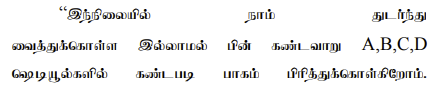
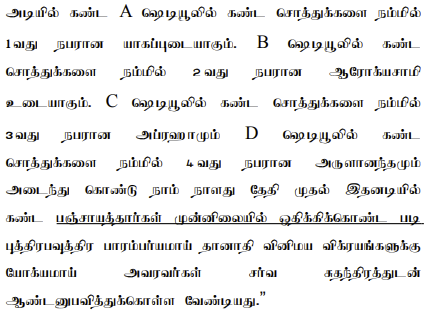
“It is fraudulent to state that the family properties were divided between the four brothers on 31.03.1976 in to four schedules “A to D” and a written Partition Muchalika was prepared. It is fraudulent to state that Arockiasamy got transferred Pattas to the properties allotted to his shares in the said partition is fraudulent.”
Therefore, except to state that the division of family properties by the four brothers as on 31.07.1976 as fraudulent, nothing is stated about the partition deed, whether the signature contained in the written statement belong to all the four brothers and if so, no further averments were made. In that background, when the application is filed for bringing on record the unstamped, unregistered family arrangements, the same was resisted by the defendants by stating that it requires compulsory registration and accepting their case, the trial court has rejected the document and aggrieved by which, the present Civil Revision Petition is filed.
5.The learned counsel appearing on behalf of the petitioner would submit that the impugned document is only a family Muchalika. He would submit that in any event, at least for proving possession, the document is admissible in evidence. He would submit that the property has been treated as separate property pursuant to the family arrangement from the year 1976 and suddenly disputes are made by the defendants. He would rely upon the judgment of the Co-ordinate single Bench of this Court in R.Munusamy vs. Krishttappillai and others , reported in 2014 (6) CTC 773, to contend that the document shall be taken on file and the same can at least be relied upon to prove the possession.
6.Per contra, the learned counsel appearing on behalf of the first respondent would submit that a plain reading of the document, it is very clear that the document effects partition in presenti and as such is compulsorily registrable. In this case, there is no question of any collateral purpose because the main purpose for which the document is sought to be introduced is to prove the partition. He would further submit that the property is enjoyed in common by the family even as on date. The mother's property alone was partitioned between the brothers recently. The father's