Back
Back





2024 Supreme(MP) 512
IN THE HIGH COURT OF MADHYA PRADESH AT INDORE
Subodh Abhyankar, J.
Hasu Bai D/o Late Shri Bhagwan - Appellant
Vs.
Lotan S/o Late Shri Bhagwan Mali - Respondent
Misc. Petition No. 847 of 2021
Decided On : 05-04-2024
Advocate Appeared:
For the Appellant : Ms. Swati Sharma, Adv.
For the Respondent: Shri Rohit Kumar Mangal, Adv.
A memorandum of partition acknowledging pre-existing rights does not require registration, distinguishing it from a deed of partition that creates new rights.
Headnote:(A) Constitution of India - Article 227 - Civil Procedure - Admissibility of documents - The trial court rejected the plaintiff's objection to a document being classified as a memorandum of partition rather than a deed of partition requiring registration - The court upheld the trial court's decision, affirming that the document acknowledged pre-existing rights and did not create new rights. (Paras 1, 2, 10, 17)
(B) Family Settlement - Essentials - A family settlement must be bona fide, voluntary, and may be oral; registration is only necessary if the terms are reduced to writing. (Paras 12, 14)
Facts of the case:
The plaintiff filed a partition suit against her brothers and subsequent purchasers, contesting the admissibility of a document dated 29.4.1991, which the defendants claimed was a memorandum of partition. The plaintiff argued it was a deed of partition requiring registration.
Findings of Court:
The court found no illegality in the trial court's ruling that the document was a memorandum of partition, not requiring registration.
Issues: The main issues were whether the document was a deed of partition requiring registration and the nature of the rights acknowledged in the document.
Ratio Decidendi: The court ruled that the document was a memorandum of partition acknowledging pre-existing rights and did not create new rights, thus not requiring registration.
Result: Petition dismissed.
ORDER :
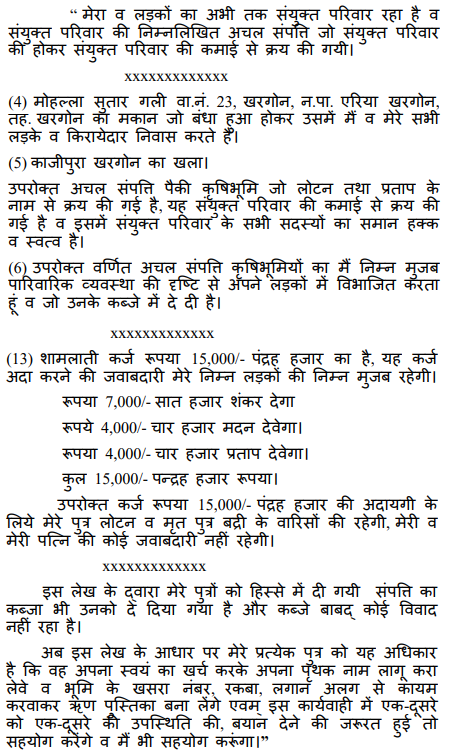
1. This petition has been filed by the petitioner/Plaintiff under Article 227 of the Constitution of India, against the order dated 17.2.2021, passed by the IIIrd Civil Judge Class-I, Khargone, West Nimard (M.P.) in Civil Suit No.11-A/2017 whereby, during the recording of the defendants’ evidence the petitioner’s/plaintiff's objection regarding admissibility of a document has been rejected, as the contention of the respondents/defendants has been accepted that it is a memorandum of partition and not a deed of partition which requires registration and stamp duty, as contended by the plaintiff.
2. In brief, the facts of the case are that a civil suit was filed by the petitioner/plaintiff for partition against the respondents/defendants, who are her brothers, nephews, and the subsequent purchasers of the property.
3. In the aforesaid suit, the case is at the stage of recording of evidence of the respondents/defendants, and on 17.2.2021, when the respondents’/defendants’ witness was being examined, at that time, a document dated 29.4.1991 was sought to be exhibited by the defendants claiming the same to be a memorandum of partition amongst the brothers of the plaintiff. The plaintiff has taken exception to the aforesaid document, and it was submitted that it is not merely a memorandum of partition but, is a deed of partition which can be ascertained from its recitals only. However, learned Judge of the trial Court holding the same to be a memorandum of a partition has rejected the objection. Hence, this petition.
4. Ms. Swati Sharma, learned counsel for the petitioner/plaintiff has vehemently argued that the document is purely a deed of partition and is not a mere memorandum of the partition, for the reasons that it also refers the future rights and liabilities of the parties. Thus, it is submitted that the impugned order be set aside, and the document be held to be a deed of partition which cannot be exhibited.
5. It is also submitted that since there was no stay on the proceedings of the trial court the document has already been exhibited and the matter is already kept for final arguments.
6. On the other hand, Shri Rohit Mangal, learned counsel for the respondents No.2,3,11 and 12 has opposed the prayer and it is submitted that no interference is called for as a bare perusal of the aforesaid document clearly reveals that it is only a memorandum of partition which is not required to be registered and not a deed of partition which requires registration.
7. Shri Mangal has drawn attention of this Court to the recitals of the document in which, it is clearly stated that it is a family arrangement of pre-existing rights and has been written by the father of the plaintiff acknowledging the pre-existing rights of his sons in the property and no new rights have been created. Counsel has submitted that the property was a joint family property which was purchased from the income of the joint family only.
8. In support of his submissions, that the document is only a memorandum of partition merely acknowledging the pre-existing rights of the parties which is not required to be registered and stamped as the possession has already been obtained by the respective parties, Shri Mangal has relied upon the decision rendered by the Supreme Court in the case of Phool Patti and another vs. Ram Singh (Dead) through legal representatives and another reported as (2015) 3 SCC 164 which provides that if a settlement has been created in favour of a person who is having pre-existing rights in respect of the property in question, the same need not be compulsorily registered, and has also held that in case of a gift or the settlement deed executed in favour of the persons having pre-existing rights over the property, the document is not required to be compulsorily registered.
9. Shri Mangal has also relied upon the other decisions in which also similar observations have been made by the Supreme Court.
10. In view of the same, shri Mangal has submitted that th