Back
Back





2025 Supreme(Mad) 4716
IN THE HIGH COURT OF JUDICATURE AT MADRAS
R.SAKTHIVEL, J.
Rajaraman - Appellant
Vs.
Nagarathinam - Respondent
S.A.NO. 636 OF 2017 AND CMP NO.15691 OF 2017 IN S.A.NO.636 OF 2017
Decided On : 20-01-2025
Advocate Appeared:
For the Appellant : Mr.A.Arun Babu
For the Respondents: Mr.A.Muthukumar
A partition suit must include all necessary parties; their absence renders the suit incompetent and affects the plaintiff's claims.
Headnote:(A) Hindu Succession Act, 1956 - Section 8 - Code of Civil Procedure, 1908 - Order I Rule 9 - Second Appeal concerning partition of properties - Appellant claimed a 1/3 share in properties inherited from deceased father, alleging exclusion of necessary parties - Legal heirs of deceased daughters not included; Suit dismissed for non-joinder of necessary parties - Courts confirmed that oral partition occurred and defendants possessed properties. (Paras 1, 13, 19)
(B) Non-joinder of parties - A Suit for partition must include all necessary parties; their absence renders it incompetent. (Paras 13, 13.1)
(C) Burden of Proof - Burden lies with party alleging oral partition; technical defects must be cured prior to dismissal. (Paras 10, 10.1)
(D)
Findings of Court:
Trial Court established that plaintiff failed to prove his claim, and concurrent findings upheld on Appeal - Oral Partition recognized. (Paras 8, 19) (E)
Issues: Entitlement of plaintiff to claim share, assessment of technical defects in Suit and legal status of omitted properties. (Paras 7.1, 10) (F)
Ratio Decidendi: The absence of necessary heirs in partition Suit is fatal; oral partition previously established by evidence. (Paras 13, 19) (G)
Result: Second Appeal dismissed.
| Table of Content |
|---|
| 1. second appeal follows prior court decisions. (Para 1 , 2 , 3) |
| 2. plaintiff claims partition based on inheritance. (Para 4 , 5 , 6) |
| 3. trial court rulings regarding oral partition. (Para 7 , 8) |
| 4. appellant's arguments rely on procedural technicalities. (Para 10 , 11) |
| 5. non-joinder of necessary parties invalidates partition suit. (Para 12 , 13 , 14 , 15) |
| 6. defendants establish oral partition through evidence. (Para 16 , 17 , 18 , 19) |
| 7. second appeal denied with no costs. (Para 20) |
JUDGMENT :
R. SAKTHIVEL, J.
The Second Appeal is directed by unsuccessful plaintiff against the Judgment and Decree dated February 17, 2016 passed in A.S.No.7 of 2014 by the 'Subordinate Court, Thiruvarur' ['First Appellate Court' for brevity], whereby the Judgment and Decree dated March 24, 2014 passed in O.S.No.28 of 2008 by the 'District Munsif cum Judicial Magistrate Court, Nannilam' ['Trial Court' for brevity] was confirmed.
2. For the sake of convenience, hereinafter, the parties will be referred to as per their array in the Original Suit.
3. The third defendant remained ex-parte throughout and it is represented that she is no more. The appellant/plaintiff had filed a memo dated March 3, 2022 and sought to dispense with the notice to her. Hence, notice to her is hereby dispensed with.
PLAINTIFF'S CASE
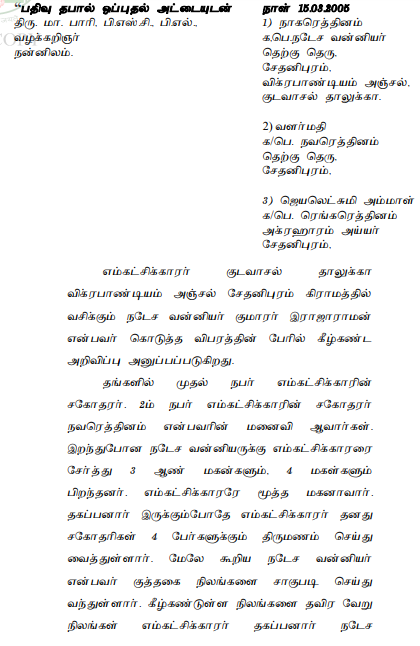
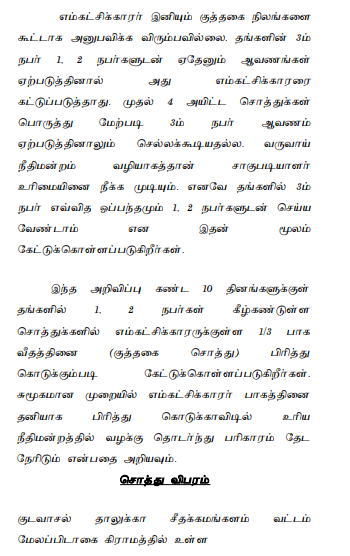
4. The plaintiff filed the Original Suit for partition claiming that Item No.1 of Suit Properties belonged to plaintiff’s father - Nadesa Vanniyar while Item No.2 is Nadesa Vanniyar’s lease hold properties owned by third defendant - Jayalakshmi. Nadesa Vanniyar’s wife predeceased him. Nadesa Vanniyar died intestate around 1992, leaving behind his three sons - the plaintiff, the first defendant and second defendant’s husband, Navarathinam. After Nadesa Vanniyar’s demise, revenue records in respect of Item No.1 was mutated to the names of the plaintiff, first defendant and the husband of the second defendant jointly. As regards Item No.2, the plaintiff alone is in possession and enjoyment of it as a cultivating tenant. However, the plaintiff preferred to partition the same with defendants 1 and 2. The defendants 4 and 5 in collusion with defendants 1 and 2, attempted to disturb the plaintiff’s peaceful possession and enjoyment of the Item No.2 on March 29, 2008. Hence, the Suit for partition of his 1/3rd share in Suit Properties.
DEFENDANTS' CASE
5. The second defendant filed written statement which was adopted by defendants 1, 4 and 5. The third defendant remained ex-parte throughout.
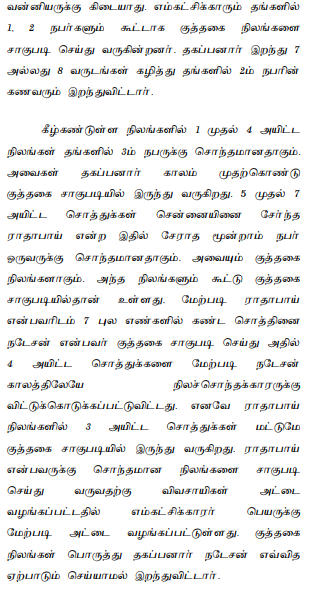
6. In the written statement, it is averred that the Suit Properties and other properties were orally partitioned 25 years ago during the lifetime of Nadesa Vanniyar and that the parties have been in exclusive possession of their respective shares since then. The plaintiff has deliberately excluded other properties left by father – Nadesa Vanniyar from the Suit; there are some more lease hold properties enjoyed by father - Nadesa Vanniyar which belong to one Radhabai. It is false to aver that the plaintiff alone is cultivating and enjoying the lease hold properties post the demise of Nadesa Vanniyar. The plaintiff has never cultivated Item No.2. Item Nos.1 and 2 were allotted to defendants 1 and 2 in the aforesaid Oral Partition while the plaintiff being the eldest son, was allotted 350 Kuzhies of Nadesa Vanniyar’s self-acquired properties and the lease hold properties that belonged to said Radhabai along with an ancestral house and some other properties. Defendants 1 and 2 are in possession and enjoyment of the Item No.2 and paying the lease amount in kind to third defendant.
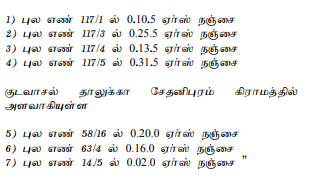
6.1. On November 16, 2004, the first defendant purchased the leasehold properties of an extent of 26 Cents in Survey No.117/1, 44 Cents in Survey No.117/3 and 20 Cents in Survey No.117/4 from the third defendant. Thereafter, he sold an extent of 10 Cents in Survey No.117/1 and 5 Cents in Survey No.117/4 to fourth defendant. Further, the first defendant is residing in a thatched house built b