
 Back
Back





IN THE HIGH COURT OF JUDICATURE AT MADRAS
N.SATHISH KUMAR, R.SAKTHIVEL, JJ.
Sarasu, W/o. Late Palaniappan – Appellants
Versus
Mani @ Venkatachalam, S/o. Ramagoundanur @ Ramasamy Gounder – Respondents
Appeal Suit No.980 of 2020
Decided On : 03-02-2026
| Table of Content |
|---|
| 1. appeal against the trial court's judgment (Para 1 , 2) |
| 2. factual background and nature of properties (Para 3 , 4 , 8 , 12 , 13) |
| 3. arguments presented by both parties (Para 6 , 10 , 11) |
| 4. determining the ancestral nature of properties (Para 14 , 15 , 17 , 30) |
| 5. implications of oral family partition (Para 29 , 31) |
| 6. conclusion and decree of the appeal (Para 34) |
JUDGMENT :
R.SAKTHIVEL, J.
Feeling aggrieved by the Judgment and Decree dated June 05, 2018 passed in O.S. No.204 of 2012 by 'the Sessions (Fast Track Mahila) Court, Namakkal' ['Trial Court' for brevity], the Plaintiffs therein have preferred this Appeal Suit under Section 96 read with Order XLI Rules 1 and 2 of 'the Code of Civil Procedure, 1908 ' ['CPC' for short].
2. For the sake of convenience, hereinafter, the parties will be referred to as per their array in the Original Suit.
PLAINTIFFS' CASE:
3. Case of the Plaintiffs is that the suit properties consist of two items.
3.1. The 1st item of the suit properties comprises of Survey No.464 situate at Akkalampattu Village and the 2nd item of the Suit properties comprises of Survey Nos.114, 120, 127 and 131 situate at Putthur- Keelmugam Village. Both the Suit villages fall under Tiruchengode Taluk of Namakkal District.
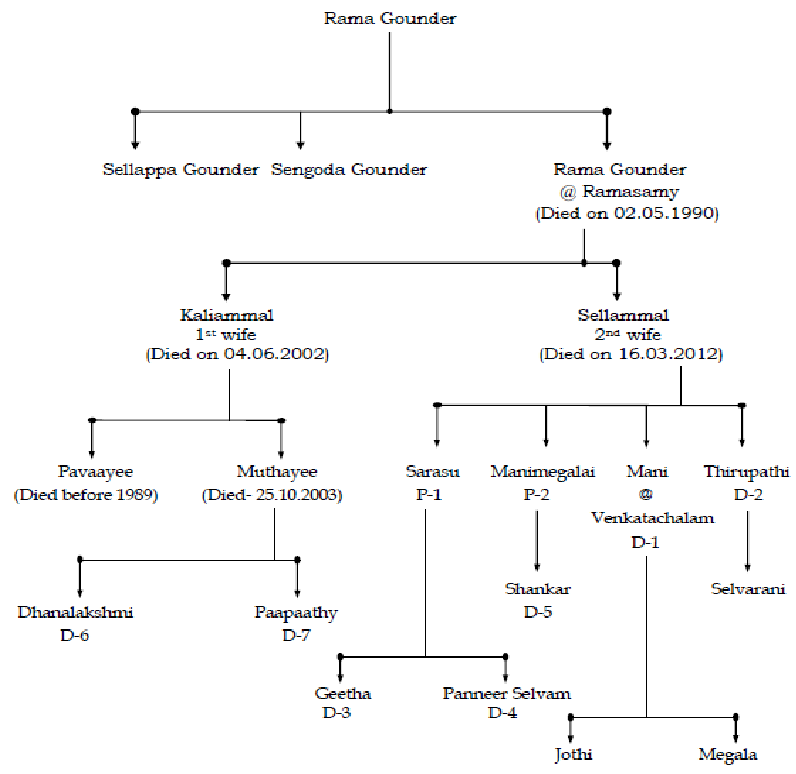
3.2. As regards Suit Item No.1, the entire extent of Suit Survey No.464 i.e., 10 Acre 75 Cents was originally owned by Rama Gounder. Post his demise, the entire extent of Survey No.464 fell into the hands of his three sons, namely Sellappa Gounder, Sengoda Gounder and 'Rama Gounder alias Ramasamy Gounder' [hereinafter 'Ramasamy Gounder' for brevity]. One of his sons, namely Sellappa Gounder sold his 1/3 common share in the entire extent of Survey No.464 to his two brothers - Sengoda Gounder and Ramasamy Gounder, on February 12, 1947. Thereafter, Sengoda Gounder and Ramasamy Gounder entered into a registered Partition Deed dated July 06, 1954, whereby they divided the entire extent of Survey No.464 equally. In other words, 'A' Schedule Property described therein consisting of an extent of 5 Acre 37 ½ Cents in Survey No.464 was allotted to Sengoda Gounder, and 'B' Schedule Property described therein, which consists of the remaining extent of 5 Acre 37 ½ Cents in Survey No.464, was allotted to Ramasamy Gounder. The said property allotted to Ramasamy Gounder is Suit Item No.1.
3.3. Suit Item No.2 is Ramasamy Gounder's ancestral entitlement.
3.4. Ramasamy Gounder passed away on May 02, 1990. He had two wives, namely Kaliammal (1st wife) and Sellammal (2nd wife). Through his 1st wife - Kaliammal, he had two daughters namely Pavaayee and Muthayee. Pavaayee died without any issues prior to 1989. Muthayee passed away on October 25, 2003, whose legal heirs are Defendants 6 and 7. The Plaintiffs and the Defendants 1 and 2 are daughters and sons of 2nd wife - Sellammal respectively.
3.5. The Plaintiffs are entitled to share in the suit properties in view of 'the Hindu Succession Act, 1956 ' [henceforth 'H.S. Act'] as amended by 'the Hindu Succession (Amendment) Act, 2005 (Act No.39 of 2005)' [henceforth '2005 H.S. Amendment Act']. After the demise of Kaliammal and Muthayee (1st wife and one of the two daughters of Ramasamy Gounder born through 1st wife), the Plaintiffs and the Defendants 1 and 2 (being sons and daughters of Ramasamy Gounder born through 2nd wife) are each entitled to 1/5 share in the suit properties, while the Defendants 6 and 7 (being the children of said daughter - Muthayee) are jointly entitled to 1/5 share in the suit properties. The Plaintiffs and the Defendants are in joint possession and enjoyment of the suit properties.
3.6. Sellammal, the 2nd wife of Ramasamy Gounder during her lifetime executed a Settlement Deed in favour of the Defendants 3 to 5 in respect of suit properties. Hence, the Defendants 3 to 5 were added as necessary parties. Further, the 2nd Defendant filed O.S. No.824 of 2004 in his capacity as a co-owner of suit properties, seeking permanent injunction against the 8th De
Daughters are recognized as coparceners under amended Hindu Succession Act, with entitlements to ancestral property shares, emphasizing distinctions between ancestral and separate properties.

Unmarried daughters are recognized as coparceners in ancestral properties under the amended Hindu Succession Act, leading to equal rights in joint family assets.
The court affirmed that items 1 and 2 of suit properties are ancestral, and items 3 to 11 are self-acquired, highlighting the plaintiffs' burden to prove family property claims.
The court affirmed that admissions made during trial are binding, and ancestral properties cannot be dismissed based on a registered Partition Deed that does not negate the rights of coparceners.

The presumption of joint family status in Hindu law requires clear evidence to establish prior partition; the Appellate Court allowed partition of one property acquired post-partition while dismissin....
Daughters are coparceners by birth under the amended Hindu Succession Act, entitled to equal shares in ancestral properties.
The main legal point established in the judgment is the distinction between ancestral property and self-acquired property in a partition suit, and the requirement for evidence to support claims of jo....
The judicial presumption of joint ownership requires proof of a family nucleus, and mere existence of a joint family does not automatically classify all properties as joint.
A partition suit must include all necessary parties; their absence renders the suit incompetent and affects the plaintiff's claims.



An indispensable Tool for Legal Professionals, Endorsed by Various High Court and Judicial Officers
Please visit our Training & Support
Center or Contact Us for assistance

Scan Me!
India’s Legal research and Law Firm App, Download now!


For Daily Legal Updates, Join us on :



 Back to top


