
 Back
Back





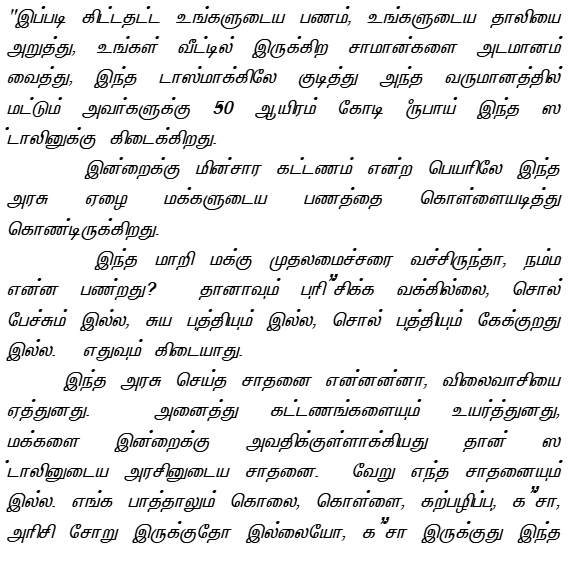
IN THE HIGH COURT OF JUDICATURE AT MADRAS
G.K.Ilanthiraiyan, J.
C.Ve.Shanmugam - Petitioner
Versus
The Public Prosecutor, Villupuram District and Sessions Court - Respondent
Crl.O.P.No.9691 of 2025 and Crl.M.P.Nos.6415 and 6416 of 2025
Decided On : 25-04-2025
| Table of Content |
|---|
| 1. complaint filed for allegedly defamatory speech. (Para 1 , 2) |
| 2. petitioner's right to dissent and critique government. (Para 3 , 4 , 5 , 6) |
| 3. critical speech in a democracy does not equal defamation. (Para 8 , 9 , 10 , 11 , 12) |
| 4. no prima facie case for defamation established. (Para 13) |
| 5. proceedings quashed; petition allowed. (Para 14) |
ORDER :
G.K.Ilanthiraiyan, J.
This Criminal Original Petition has been filed to quash the proceedings in C.C.No.02 of 2024 pending on the file of the Principal Sessions Judge, Villupuram.
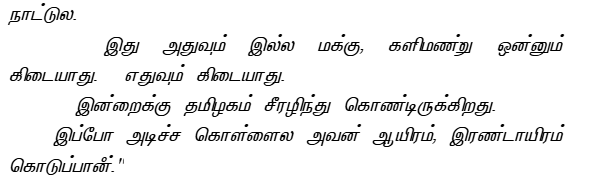
2. The respondent, herein, filed a private complaint under Section 199(2) of the Code of Criminal Procedure, 1973, for the offence under Section 499 of the IPC, punishable under Section 500 of the IPC. The crux of the complaint is that on 16.09.2023, the petitioner, during a public meeting held near Koliyanur Bazaar Street within the jurisdiction of Valavanur Police Station, delivered a speech before an audience of about 250 persons, through a public address system, containing allegedly derogatory and defamatory remarks against the Hon’ble Chief Minister of Tamil Nadu and the Government of Tamil Nadu. Pursuant to the said speech, the respondent, Public Prosecutor, Villupuram, filed the present complaint upon receiving sanction from the Government of Tamil Nadu, vide G.O.Ms. No.114 dated 02.02.2024, issued under clause (a) of sub- section (4) of Section 199 of Cr.P.C., authorizing the Public Prosecutor to lodge a complaint in respect of the impugned speech.
3. The learned Senior Counsel appearing for the petitioner submitted that the petitioner is a Member of Parliament (Rajya Sabha) representing Tamil Nadu and an active member of the principal opposition party. As such, he has every right and duty, in a democratic set-up, to express dissent and highlight the shortcomings and failures of the ruling government. The right to criticize policies and actions of the Government and its representatives is a core tenet of a functional democracy. It was further submitted that the petitioner’s speech merely reflects criticism of governance and does not constitute defamation under Section 499 of IPC. The speech targeted perceived administrative inaction and inflationary trends and did not contain any per-se defamatory imputation against the State itself. That apart, the respondent, who filed the complaint, is not an eyewitness to the alleged speech and has relied solely on transcripts and media reports. The respondent’s dual role as both the complainant and a witness undermines the objectivity required for a proceeding under Section 199(2) of Cr.P.C., which demands strict scrutiny.
4. It was also contended that the complaint fails to distinguish the roles envisaged under Section 199(2) and Section 199(6) of Cr.P.C., and that the order taking cognizance is non-speaking, cryptic, and reflects non-application of judicial mind. It was further argued that in the absence of any direct and personal knowledge of the alleged defamatory statement by the complainant, the Court should not have proceeded to take cognizance.
5. The learned Senior Counsel further submitted that the speech delivered by the petitioner is protected under Article 19(1)(a) of the Constitution of India, which guarantees to every citizen the fundamental right to freedom of speech and expression. In a democratic society, this right includes the freedom to express opinions, criticisms, and dissent against governmental actions or public figures occupying constitutional offices. It was argued that the right to dissent, express disapproval, and question the actions of the State or its leaders is not only constitutionally protected but is also essential for the functioning of a vibrant democracy. The petitioner, being a Member of Parliament representing the principal opposition party, was exercising this constitutionally guaranteed right in a public forum. In support of this contention, he relied upon several judgments.
6. Per contra, the learned Governmen
AI
Criticism of government policies, when expressed as political dissent, does not constitute defamation under Indian law unless it crosses the threshold of malicious intent as defined in the IPC.

Criticism of government actions by opposition members is protected speech and does not constitute defamation unless it meets the legal thresholds of malicious intent as outlined in IPC.
The right to dissent and criticize public officials is protected under freedom of speech, and such speech does not constitute defamation unless it disrupts public order.


Calling a person corrupt is per se defamatory and cannot be justified by resorting to Article 19 of the Constitution of India.
The Court must carefully consider whether the statements/imputations made constitute defamation as defined under Section 499 of the IPC and whether the defamatory statement has a direct and reasonabl....



An indispensable Tool for Legal Professionals, Endorsed by Various High Court and Judicial Officers
Please visit our Training & Support
Center or Contact Us for assistance

Scan Me!
India’s Legal research and Law Firm App, Download now!


For Daily Legal Updates, Join us on :



 Back to top


