
 Back
Back





IN THE HIGH COURT OF JUDICATURE AT MADRAS
N. SATHISH KUMAR, R. SAKTHIVEL, JJ.
S. Santhosh Kumar – Appellants
Versus
M. Sivabackiam Mylathal (deceased) – Respondents
A.S.No.463 of 2024 and C.M.P.Nos.16661 of 2024, 16291 & 16292 of 2025
Decided On : 23-02-2026
| Table of Content |
|---|
| 1. claim of ancestral property rights. (Para 3 , 4) |
| 2. defendants' responses regarding property ownership. (Para 5 , 6 , 7 , 8 , 9 , 10) |
| 3. issues framed for trial. (Para 11 , 12) |
| 4. trial court's findings on property claims. (Para 14 , 15 , 18) |
| 5. arguments presented by appellants. (Para 17) |
| 6. observations on property inheritance. (Para 19 , 20 , 21) |
| 7. analysis of property ownership claims. (Para 22 , 23 , 26 , 27) |
| 8. validity of will and its implications. (Para 28 , 29 , 30 , 31) |
| 9. conclusion and equitable distribution of property. (Para 32) |
JUDGMENT :
N. SATHISH KUMAR, J.
1.Challenging the judgment and decree of the learned I Additional District Judge, Coimbatore, dated 30.08.2023, passed in O.S.No.164 of 2015, granting (i) preliminary decree for partition and allotting one half share in favour of the 1st respondent/plaintiff and one half share to respondents 2 and 3/defendants 2 and 3; (ii) decree of permanent injunction; and (iii) declaring the sale deed dated 22.02.2007 in favour of the 2nd appellant/5th defendant as null and void, the defendants 4 and 5 in the suit have filed the above Appeal.
2. For the sake of convenience, the parties will be referred to as per their rank before the trial Court.
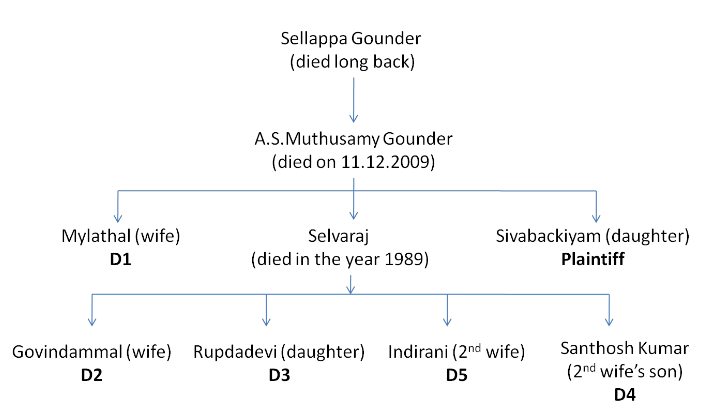
3. The plaintiff is the daughter of one A.S. Muthusamy Gounder. The 1st defendant is the wife of A.S. Muthusamy Gounder. Muthusamy Gounder had a son namely Selvaraj. The 2nd defendant is the wife of Selvaraj and the 3rd defendant is his daughter. According to the plaintiff, the 4th defendant is the illegitimate son of Selvaraj born through the 5th defendant.
4. It is the case of the plaintiff that Item No.1 of the suit properties was allotted to one Sellappa Gounder, father of Muthusamy Gounder, by virtue of a Partition Deed dated 08.12.1919. The said Sellappa Gounder died in the year 1950, leaving behind his only son Muthusamy Gounder. According to the plaintiff, Item No.1 of the suit properties is the ancestral property. Item Nos.2 to 4 were purchased by Muthusamy Gounder as kartha of the joint family out of the joint family nucleus and the properties have been in joint possession and enjoyment of Muthusamy Gounder, his son Selvaraj, the plaintiff and defendants 2 and 3. According to the plaintiff, the 5th defendant was brought to home by Selvaraj claiming to be his second wife, along with her son, the 4th defendant herein. To avoid further complications, the parents of the plaintiffs had allowed the defendants 4 and 5 to stay along with them. It is the contention of the plaintiff that, when she demanded partition in the year 2006, she realised that her father Muthusamy Gounder was not keeping good mental faculties and he was having senility and he was not in a position to take any decision. Therefore, the plaintiff dropped the idea of seeking partition at that time. Later, the father Muthusamy Gounder died on 11.12.2009, leaving behind the plaintiff and the defendants 1 to 3 as legal heirs. Hence, it is the contention of the plaintiff that the plaintiff and defendants 1 to 3 are in joint possession and are entitled to share in the suit properties. After the death of Muthusamy Gounder, on verification, the plaintiff came to know that the entire property stands in the name of the 4th defendant and the revenue records also have been mutated in his name. It is the case of the plaintiff that the 4th defendant has surreptitiously brought out some alleged documents, which are not valid in the eye of law. Therefore, according to the plaintiff, she is entitled to 1/3rd share in the suit properties and thereby, she has filed the present suit for partition and for other reliefs.
5. The 1st defendant, the wife of A.S.Muthusamy Gounder, has filed a written statement. Admitting the relationship between the parties, it is her contention that Item No.1 of the suit properties has been allotted to Sellappa Gounder, who died in the year 1950, leaving behind his only son A.S.Muthusamy Gounder. According to the 1st defendant, her husband M
The ancestral nature of property was affirmed, and a Will executed by a deceased patriarch in favor of an illegitimate child was recognized as valid for 1/3rd share, pending partition.

The court affirmed that ancestral property rights under the Hindu Succession Act grant a daughter the right to claim partition; a Will must be proven validly to be binding.
A claimant must prove the ancestral nature of properties to claim entitlement under the amended Hindu Succession Act; mere assertions without evidence are insufficient.
The court clarified that properties must be inherited or acquired from a joint family nucleus to be classified as ancestral under Hindu law, rejecting claims based solely on joint acquisition.

Court ruled that ancestral property retains its character despite prior partition and upheld the validity of a Will despite exclusion of a natural heir.
The amendment of co-parcenery rights retroactive effects and joint possession presumption prevent claims of ouster without substantial evidence.



An indispensable Tool for Legal Professionals, Endorsed by Various High Court and Judicial Officers
Please visit our Training & Support
Center or Contact Us for assistance

Scan Me!
India’s Legal research and Law Firm App, Download now!


For Daily Legal Updates, Join us on :



 Back to top


