
 Back
Back





IN THE HIGH COURT OF JUDICATURE AT MADRAS
V. Lakshminarayanan, J.
Lakshmi Ammal - Appellant
Versus
S.Bakthavatsalu Naidu - Respondent
S.A.No.544 of 2000
Decided On : 20-02-2026
| Table of Content |
|---|
| 1. second appeal procedural context (Para 1 , 2) |
| 2. plaintiff's ownership claim over a and b schedule property (Para 3 , 4) |
| 3. defendants' challenge to plaintiff's ownership and claims (Para 5 , 6 , 7 , 8 , 9) |
| 4. issues framed for trial court consideration (Para 10) |
| 5. appointment of advocate commissioner (Para 11 , 12) |
| 6. trial court's findings based on evidence and judgments (Para 13 , 14) |
| 7. substantial questions of law for appellate consideration (Para 15 , 18) |
| 8. defendant's rights over property and cultivation (Para 19 , 24) |
| 9. plaintiff's attorney argument on property extent and possession (Para 20 , 21 , 22) |
| 10. burden of proof relies on plaintiff's claims (Para 32 , 33 , 34) |
| 11. court's rejection of assumptions without evidence (Para 39 , 40 , 41) |
| 12. conclusion on legal errors and judgment restoration (Para 42 , 43) |
JUDGMENT :
V. Lakshminarayanan, J.
The present second appeal arises against the judgment and decree of the court of the learned Principal District Judge, Chengalpet, in Civil Regular Appeal Suit No.47 of 1999 dated 14.10.1999 in reversing the judgment and decree of the learned District Munsif at Chengalpet in O.S.No.126 of 1985 dated 30.03.1999 and thereby, decreeing the suit for declaration of title, recovery of possession of B schedule mentioned property and also granting of injunction restraining the defendants from putting up any constructions over the B schedule and for costs.
2. The appellants before this Court are the defendants in the suit. For the sake of convenience, the parties shall be referred as per their ranks in the suit.
Case of the plaintiff is as follows:
3. The plaintiff claimed that he is the absolute owner of the A schedule mentioned property. B schedule is on eastern portion of the A schedule. He claimed that he purchased A schedule property from one Savithri Ammal by way of a registered sale deed dated 29.07.1977. Savithri Ammal had purchased the said property from one Venkatathri on 24.04.1965. Venkatathri had acquired title to the property by virtue of a partition deed, between his father, himself and his siblings. The partition deed is a registered document dated 24.06.1951. The plaintiff alleged that after the purchase, he had put up a rice mill over the portion of A schedule property. B schedule property was kept vacant by him.
4. On 20.11.1984, the defendants trespassed into the B schedule property and raised paddy. Upon coming to know of this fact, the plaintiff protested against such encroachments. The defendants agreed to vacate and hand over possession after harvesting paddy. After the harvest, when the plaintiff sought the defendants to vacate and hand over possession, the defendants refused the request of the plaintiff and threatened that they were going to put up a touring talkies over the B schedule property. He pleaded that the defendants have no right, title or interest over the B schedule property. Since the defendants had denied the title of the plaintiff, he came forth with the suit for the aforesaid relief. In addition to the claim of title by way of purchase dated 29.07.1977, the plaintiff also pleaded that he and his predecessors-in-title had crystallised a right in them by virtue of adverse possession.
5. Summons were issued in the suit. The defendants entered appearance. Defendants 1 and 2 are husband and wife. They filed a detailed written statement. According to the written statement, they pleaded as follows:
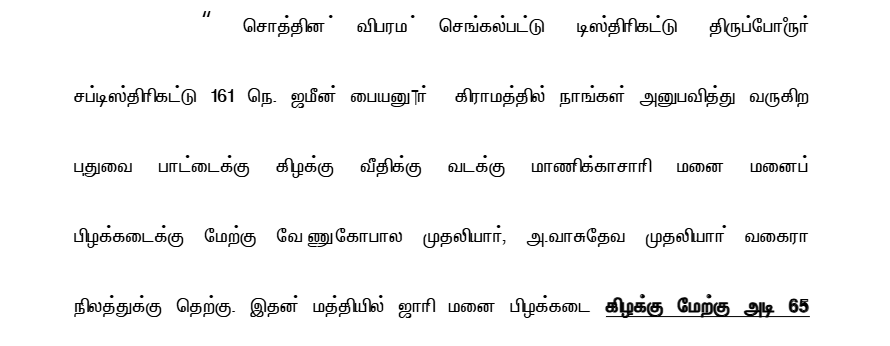
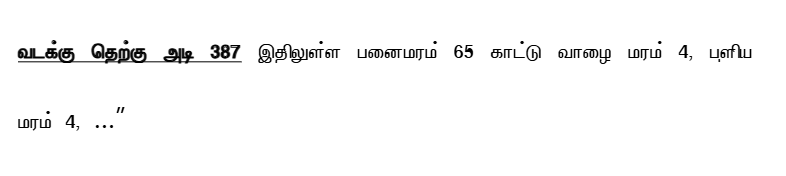
The plaintiff is not an exclusive owner of the A schedule mentioned property. They denied the tracing of title by the plaintiff. They pleaded that an extent of 65 feet East-West and 387 feet North-South in S.No.335/3 of Payanoor Village, Chengalpet Taluk belonged to one Thangathammal and Namasivaya Mudaliar. These persons had sold the property in favour of Manicka Mudaliar on 11.12.1919. The said Manicka Mudaliar was the father of the second defendant, viz., Varadharaja Mudaliar. Apart from him, Manicka Mudaliar had two other sons namely Narayanasamy Muda
Ownership rights cannot exceed what is originally conveyed in property transactions, substantiating claims requires clear and convincing evidence.
Claimants must provide valid title documents and evidence of ownership in property disputes; reliance on non-title documents like patta is insufficient.
Party to family partition as minor is estopped from disputing its measurements post-majority without challenge, after acting upon it; plaintiff must prove title independently beyond allotted share, n....
Plaintiffs failed to demonstrate ownership or possession over the ancestral property, while defendants proved their title through documented evidence, leading to suit dismissal.

The court upheld that an unregistered partition deed can provide context in disputes regarding possession, especially when substantiated by oral evidence of long-term use under Section 9 of the U.P. ....

Possession established under Section 9 of the U.P. Z.A. & L. R. Act, with admissibility of partition deeds for evidential purposes despite non-signatory status.
The burden of proof lies on defendants in property disputes involving claimed oral partitions; failure to adequately prove exclusive entitlement resulted in dismissing their claims.



An indispensable Tool for Legal Professionals, Endorsed by Various High Court and Judicial Officers
Please visit our Training & Support
Center or Contact Us for assistance

Scan Me!
India’s Legal research and Law Firm App, Download now!


For Daily Legal Updates, Join us on :



 Back to top


