
 Back
Back





IN THE HIGH COURT OF JUDICATURE AT MADRAS
N.SATHISH KUMAR, R.SAKTHIVEL, JJ.
Thillainayagam (Died) – Appellant
Versus
Anjammal – Respondent
A.S. No. 21 of 2017, C.M.P. No. 745 of 2017
Decided On : 17-02-2026
| Table of Content |
|---|
| 1. appeal filed against trial court's judgment (Para 1 , 2) |
| 2. factual background of the property dispute (Para 3 , 4) |
| 3. arguments of the plaintiffs regarding property ownership (Para 10) |
| 4. arguments of defendants refuting plaintiffs' claims (Para 11) |
| 5. court's comprehensive analysis of title and possession (Para 12 , 13 , 14 , 15 , 16 , 17 , 18 , 19 , 20 , 21 , 22 , 23 , 24) |
| 6. conclusion: appeal dismissed (Para 26) |
JUDGMENT :
R. SAKTHIVEL, J.
1. Feeling aggrieved by the Judgment and Decree dated August 8, 2016, passed in O.S. No.54 of 2015 on the file of 'the II Additional District Court, Chidambaram' ('Trial Court' for short), the plaintiffs therein have filed this Appeal Suit under Section 96 read with Order XLI Rule 1 of the Code of Civil Procedure, 1908 praying to allow the Appeal, set aside the Judgment and Decree, and decree the Suit as prayed for in the plaint.
2. For the sake of convenience, henceforth, the parties to this Appeal Suit will be referred to as per their array in the Original Suit.
PLAINTIFFS' CASE
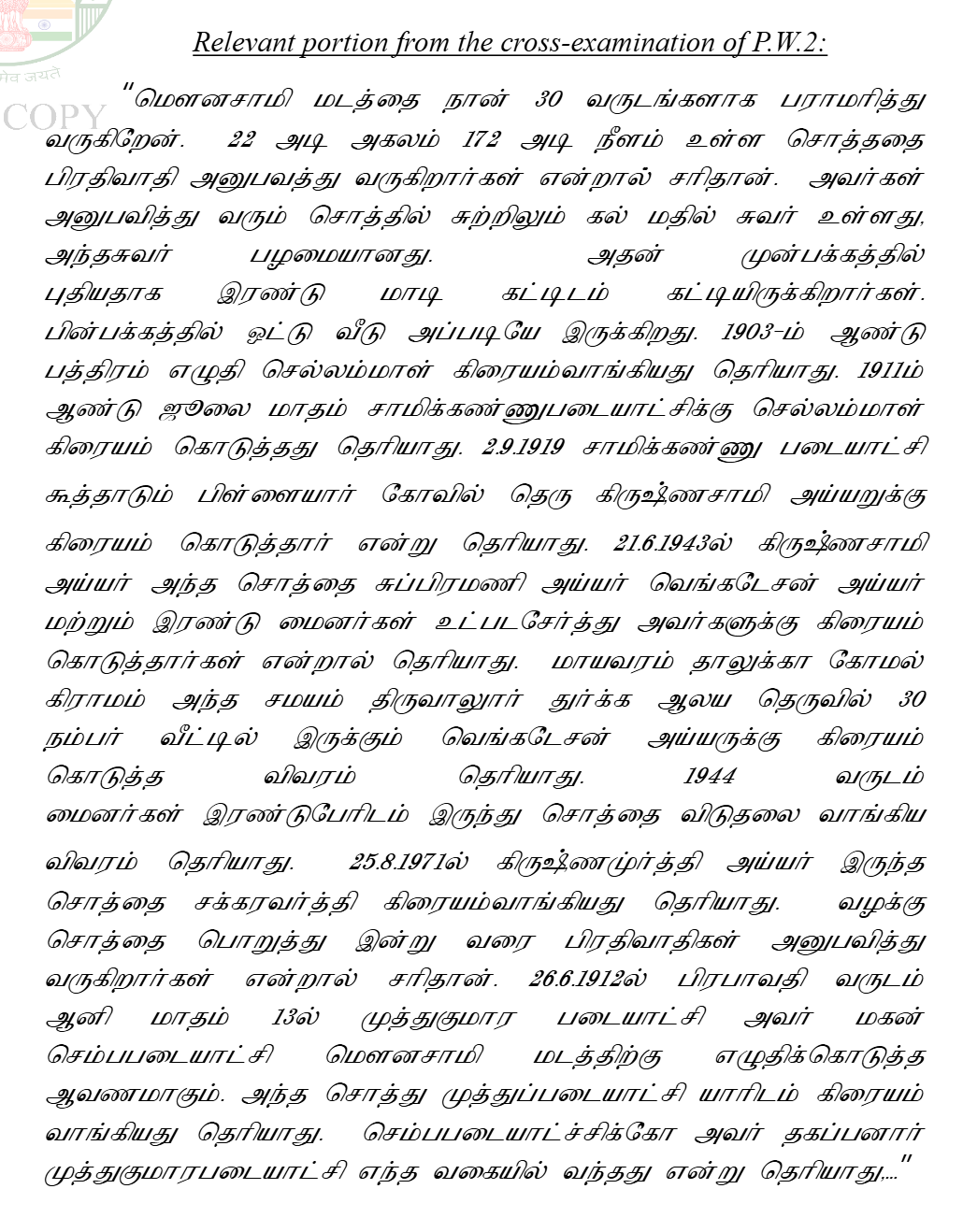
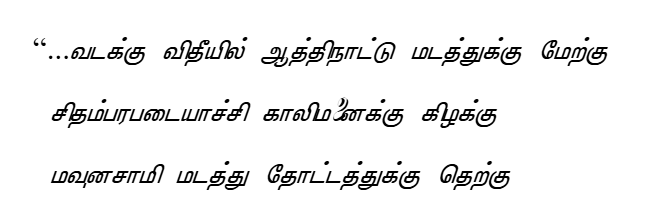
3. The suit properties consist of 'A' and 'B' schedules of properties. The Suit 'A' schedule property measures 22 feet east-west and 172 feet north-south and it lies within the specific four boundaries. The Suit 'B' schedule property, measuring 11 feet east-west and 172 feet north-south, constitutes the western half portion of the Suit 'A' schedule property. In other words, the Suit 'B' schedule property forms a part and parcel of the Suit 'A' schedule property.
3.1. The Suit 'A' schedule property originally belonged to Muthu Padayatchi and his son - Semba Padayatchi as their ancestral entitlement and each were entitled to undivided ½ share. There existed a tiled house towards the middle of the Suit 'A' schedule property, with its major portion lying on the eastern side. There also existed a 6 feet north-south lane within Suit 'A' schedule property on its western side. The property abutting the northern boundary of Suit 'A' schedule property belongs to the Math of Mouna Guru Manickavasaga Swamigal. Semba Padayatchi sold his undivided half share in the Suit 'A' schedule property to Manickavasaga Swamigal vide Sale Deed dated June 26, 1912, registered on June 27, 1912, under Document No.1446. Pursuant to the sale, Manickavasaga Swamigal was in possession and enjoyment of the western half of Suit 'A' schedule property, which is the Suit 'B' schedule property.
3.2. Thereafter, under his Will dated December 17, 1921, Manickavasaga Swamigal created a religious trust, and inter-alia dedicated the property purchased by him through the aforesaid Sale Deed under Document No.1446, to the said trust for religious charitable purposes. Further, under the said Will, Manickavasaga Swamigal appointed Ambalavana Pillai, Murugesan Pillai and their santhathi (descendants), as trustees to manage and continue the administration of the said trust.
3.3. Ambalavana Pillai and Murugesan Pillai discharged their duties as trustees until their respective deaths. Thereafter, Murugesan Pillai's son - Ponnambala Pillai, acted as trustee and was in possession and enjoyment of the Suit 'B' schedule property. During his lifetime, a portion of the tiled house in the 'B' Schedule property collapsed. Ponnambala Pillai died about 30 years prior to the Suit, and since then the plaintiffs, being his sons, have been in possession and enjoyment of the Suit 'B' schedule properties as trustees.
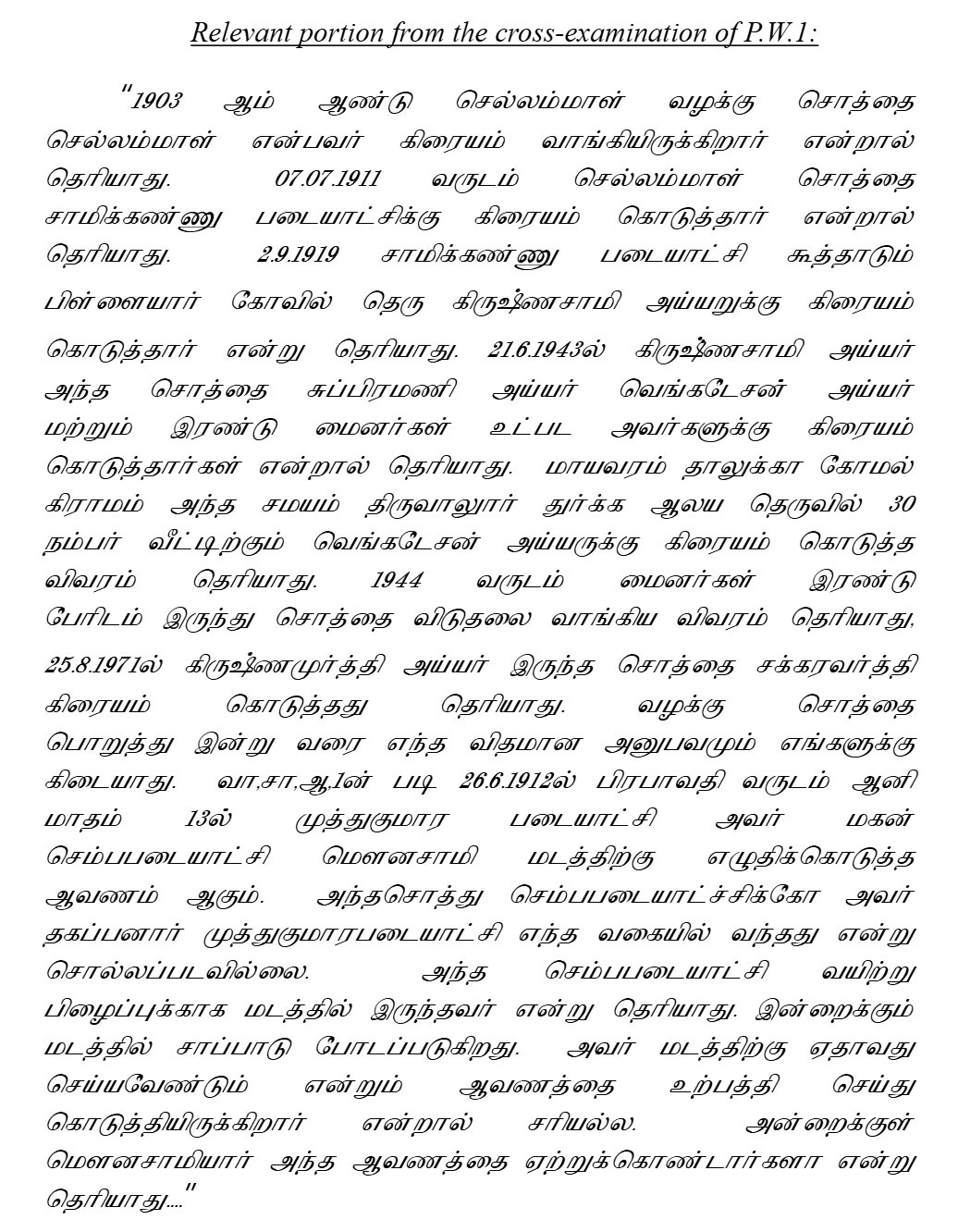
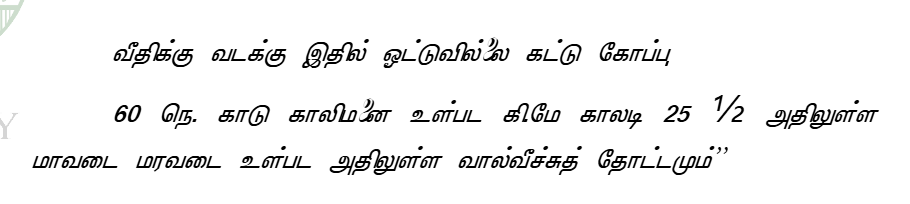
3.4. That being so, the first defendant is the mother of the second defendant and widow of one Chakravarthy. Said Chakravarthy died about four to five years prior to the Suit. Around the year 2009, Chakravarthy encroached upon the southern portion of Suit 'B' schedule property to an extent of 10 feet X 10 feet. Chakravarthy claimed that he had purchased the said portion from Venkatarama Iyer, son of Krishnamurthy Iyer in 1971. The plaintiffs subsequently came to know that Krishnamurthy Iyer had allegedly purchased the property from Krishnasamy Iyer on June 21,

Plaintiffs failed to demonstrate ownership or possession over the ancestral property, while defendants proved their title through documented evidence, leading to suit dismissal.

The appellate court determined that the First Appellate Court erred in not properly evaluating the ownership evidence, resulting in incorrect distribution of property rights and affirming the Plainti....
Ownership rights cannot exceed what is originally conveyed in property transactions, substantiating claims requires clear and convincing evidence.
The First Appellate Court correctly reversed the trial court's decree due to insufficient evidence from the plaintiffs to establish title over the suit property.
Claimants must provide valid title documents and evidence of ownership in property disputes; reliance on non-title documents like patta is insufficient.
A plaintiff must establish clear title and precise boundaries to maintain a suit for declaratory relief regarding property ownership.



An indispensable Tool for Legal Professionals, Endorsed by Various High Court and Judicial Officers
Please visit our Training & Support
Center or Contact Us for assistance

Scan Me!
India’s Legal research and Law Firm App, Download now!


For Daily Legal Updates, Join us on :



 Back to top


