Back
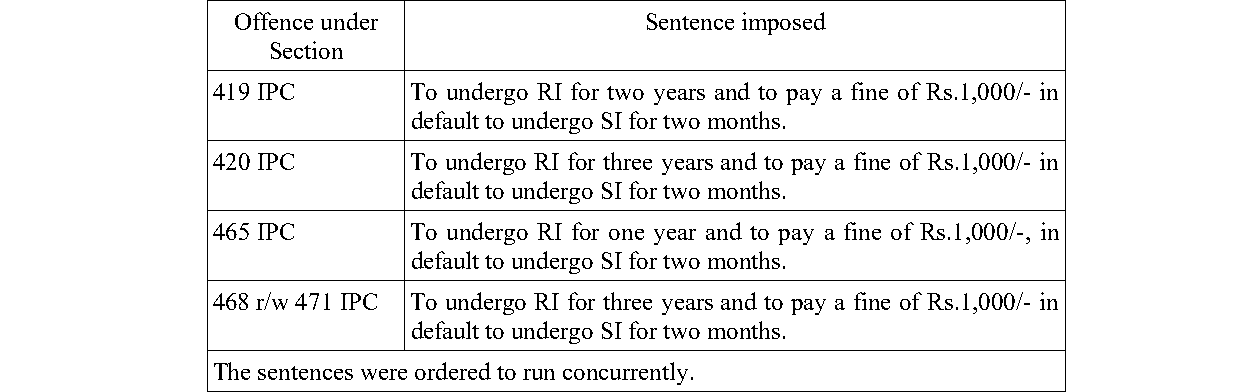
Back





2026 Supreme(Mad) 144
IN THE HIGH COURT OF JUDICATURE AT MADRAS
SUNDER MOHAN, J.
Miah Mamun – Appellant
Versus
The Inspector of Police, Chennai – Respondent
Crl. Appeal No. 1567 of 2025
Decided On : 17-02-2026
For the Appellant : V. Krishnamoorthy
For the Respondent: S. Rajakumar
The prosecution must prove the authenticity of documents and testimony to sustain convictions related to forgery; failure to do so results in acquittal.
Headnote:(A) Indian Penal Code - Sections 419, 420, 465, 468, and 471 - Conviction for offences related to forgery and fraud - Accused challenged convictions based on alleged use of forged marriage certificates. The prosecution failed to prove the forgery of certificates; thus, the conviction could not be sustained. (Paras 3, 10, 11)
(B) Criminal Procedure Code - Section 207 - Compliance with procedural requirements during trial. The appellant's guilt could not be established without substantive evidence against him, particularly concerning the supposed connection to the victims. (Paras 3, 10, 11)
Facts of the case:
The prosecution alleged the appellant facilitated the trafficking of minors using forged documentation while attempting to secure employment in Malaysia. Despite multiple witnesses and evidence provided, no conclusive proof of forgery was presented, and critical victim testimonies were absent.
Findings of Court:
There was no established evidence that undermined the appellant's claims; thus the judgment could not stand.
Issues: The core issues involved the genuineness of the marriage certificates and the relevance of victim testimonies in establishing guilt.
Ratio Decidendi: The court emphasized the necessity for the prosecution to provide compelling proof of both the falsehood of the documentation and of the witnesses' statements.
Result: Appeal allowed, conviction and sentence set aside, appellant acquitted.
Key Points: - The prosecution must prove the authenticity of documents and testimony to sustain convictions related to forgery; failure to do so results in acquittal [p_?]. - The trial court’s conviction under IPC sections 419, 420, 465, 468 r/w 471 could not be sustained due to lack of proven forgery of the marriage certificates and absence of victim testimony (!) (!) . - The two victims not being examined and lack of Bangladeshi authorities’ confirmation on the forged certificates undermined the prosecution’s case (!) (!) (!) . - The High Court allowed the Criminal Appeal, set aside the judgment of conviction and sentence, and acquitted the appellant on all charges; bail/bonds/recovery statuses to be adjusted accordingly (!) . - The appellant, a Bangladeshi national, is to be detained in a camp and deported to Bangladesh within three months from the date of the judgment, following compliance with relevant provisions (!) .
What is the standard of proof required for forgery and fraud convictions in relation to forged documents, and what happens if authenticity is not proven?
What are the conclusions regarding the genuineness of the marriage certificates and the testimonies of victims in sustaining convictions under IPC sections 419, 420, 465, 468 r/w 471?
What is the outcome of the appeal and the subsequent directions for the appellant’s release and deportation?
| Table of Content |
|---|
| 1. summary of charges and procedural history. (Para 1 , 2) |
| 2. arguments regarding the appellant's involvement. (Para 3 , 4) |
| 3. assessment of evidence and prosecution's claims. (Para 6 , 7 , 8 , 9 , 10) |
| 4. conclusion and order for acquittal and deportation. (Para 11 , 12) |
JUDGMENT :
SUNDER MOHAN, J.
1. This Criminal Appeal has been filed by the accused, challenging the judgment dated 24.09.2025 in S.C. No.154 of 2022 on the file of the learned Additional District Judge, Chengalpattu, by which he was convicted for the offence under Section 419 , 420, 465 and 468 r/w 471 of the IPC and sentenced as follows:
2. (i) The case of the prosecution is that the first accused brought the appellant/A2 and two minor victims, who were aged 17 years from Myanmar; that two victims were brought by using forged passports; that the first victim was shown as the wife of the first accused and the second victim was shown as the wife of the appellant; that two forged marriage certificates were produced at the immigration; that the first accused brought those girls with intent to indulge them in prostitution; that the appellant was brought to secure a job for him in Malaysia and hence, the first accused committed the offences under Sections 370 (ii),(iii),(iv), 419, 420, 465 and 468 r/w 471 of the IPC and the appellant committed the offences under Sections 419 , 465 and 468 r/w 471 of the .
(ii) On the complaint [Ex.P1] given by the Immigration Officer [PW1], an FIR [Ex.P36] was registered by the Sub-Inspector of Police [PW13]. Thereafter, the Inspector of Police [PW14] took up the investigation and after examining the witnesses filed the final report against the accused for the offences under Sections 419 , 420, 465, 468, 471, 370(2), 370(3) and 370(4) of the IPC , before the learned Judicial Magistrate No.1, Alandur, which was taken on file as PRC No.27 of 2022.
(iii) On the appearance of the accused, the provisions of Section 207 Cr.P.C., were complied with, committed to the Court of Sessions i.e., Principal Sessions Court, Chengalpattu and was made over to the learned Additional District Judge, Chengalpattu, for trial, which was taken on file as S.C.No.154 of 2022. The trial Court had framed charges under Sections 370 (ii),(iii),(iv), 419, 420, 465 and 468 r/w 471 of the IPC against the first accused and under Sections 419 , 465 and 468 r/w 471 of the against the appellant/A2 and when questioned, the accused pleaded 'not guilty'.
(iv) Before the trial Court, the prosecution had examined 14 witnesses as P.W.1 to P.W.14 and marked 44 exhibits as Ex.P1 to Ex.P44, besides four material objects, i.e., M.O.1 to M.O.4. When the accused were questioned, u/s.313 Cr.P.C., on the incriminating circumstances appearing against them, they denied the same. The accused neither examined any witness nor marked any document on their side.
(v) On appreciation of oral and documentary evidence, the trial Court acquitted the first accused for the offence under Sections 370 (ii), (iii) and (iv) of the IPC and found both the accused guilty for the offence under Sections 419 , 420, 465 and 468 r/w 471 of the and convicted both the accused. The appellant/A2 was sentenced as stated in paragraph No.1 of this judgment. Aggrieved by the said conviction and sentence, the accused/A2 had preferred the instant appeal.
3. The learned counsel for the appellant would submit that admittedly the appellant had no connection with the first accused; that he was introduced to first accused by an agent in Bangladesh; that the only allegation against the appellant is that he had produced a marriage certificate [Ex.P7] which was forged; that the prosecution had not established that the said marriage certificate is forged as the investigating officer had admitted in his cross examination that the marriage certificate [Nikkanama] was sent to Bangaladesh and the respondent had not received any information from the Bangaladesh authorities as regards the genuineness of the said certifi