
 Back
Back





BEFORE THE MADURAI BENCH OF MADRAS HIGH COURT
G.K.ILANTHIRAIYAN, R.POORNIMA, JJ.
Manickam – Appellant
Versus
The State Rep. by its the Inspector of Police, Kulithalai Police Station – Respondent
Crl. Appeal (MD) No. 168 of 2023
Decided On : 05-02-2026
| Table of Content |
|---|
| 1. conviction for murder based on assault facts. (Para 1 , 2 , 5) |
| 2. analysis of evidence presented in trial. (Para 4 , 10 , 11) |
| 3. doubt on witness credibility and prosecution's case. (Para 6 , 7 , 8 , 12 , 13) |
| 4. assessing liability under sections 302 and 304 ipc. (Para 14 , 15 , 16) |
| 5. failure of prosecution to establish unlawful assembly. (Para 20 , 21 , 22 , 23) |
| 6. modification of sentences and partial allowance of appeal. (Para 24 , 25 , 26) |
JUDGMENT :
G.K. ILANTHIRAIYAN, J.
1. This appeal has been filed as against the Judgment passed in S.C.No.2 of 2021, dated 20.01.2023, on the file of the Principal Sessions Court / District Court, Karur, thereby, convicting the appellants 1 to 4 for the offences punishable under Sections 148, 302 r/w 149 of IPC and convicting the fifth appellant for the offences punishable under Sections 147, 294(b) and 302 r/w 149 of IPC.
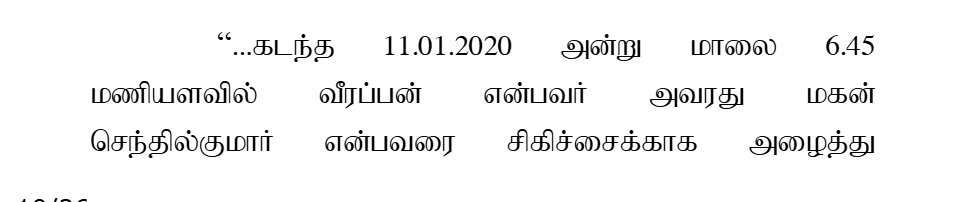
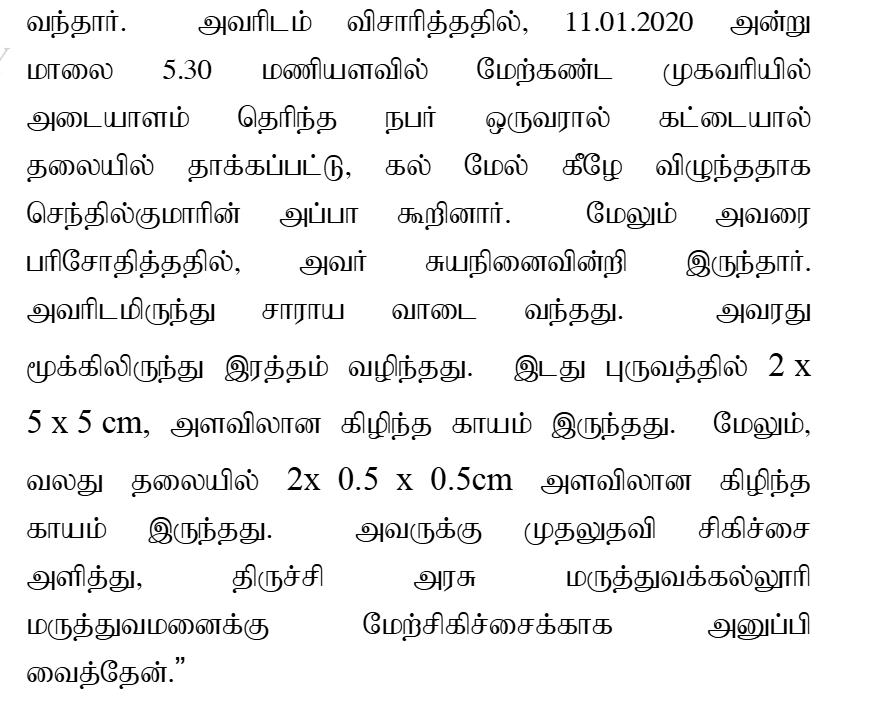
2. The case of the prosecution is that due to previous motive, on 11.01.2020 at about 17.30 hours all the accused unlawfully assembled in front of the deceased's house and the first accused attacked the deceased on the backside of his head with wooden log, the second accused attacked the deceased with stone and hit on the forehead of deceased. The third accused attacked the deceased on the Mandible part. The fourth accused also attacked the deceased with stone and hit on the left side of the head. Immediately, the deceased was taken to the Government Hospital, Kulithalai and thereafter, he was referred to the Government Hospital, Trichy. He was admitted as Inpatient and died on 14.01.2020 due to the injuries sustained by him.
3. On the basis of the complaint, initially, the respondent police registered an FIR in Cr.No.12 of 2020 for the offences punishable under Sections 147, 148, 294(b), 324 r/w 307 of IPC and thereafter, the case has been altered into, 149, 294(b), 302 r/w 149 of IPC. After completion of investigation, the respondent filed a final report and the same has been taken cognizance by the Trial Court.
4. On the side of the prosecution, in order to bring the charges to home, they examined P.W.1 to P.W.17 and Exs.P1 to P24 were marked. The prosecution also produced Material Objects M.O.1 to M.O.3. On the side of the accused, D.W.1 was examined and Ex.D1 was marked.
5. On perusal of the oral and documentary evidence, the trial Court found the accused Nos.1 to 4 guilty for the offences punishable under Sections 148 and 302 r/w 149 of IPC and found the fifth accused guilty for the offences punishable under Sections 147, 294(b) and 302 r/w 149 of IPC. The accused Nos.1 to 4 were sentenced to undergo six months simple imprisonment and was imposed a fine of Rs.1,000/-, in default, to undergo one month simple imprisonment for an offence punishable under Section 148 of IPC. They were further sentenced to undergo Life Imprisonment and were imposed a fine of Rs.2,000/-, in default, to undergo six months simple imprisonment for an offence punishable under Section 302 r/w 149 of IPC. The accused No.5 was sentenced to undergo three months simple imprisonment and was imposed a fine of Rs.500/- in default, to undergo fifteen days simple imprisonment for an offence punishable under Section 147 of IPC. She was further sentenced to undergo one month simple imprisonment for an offence punishable under Section 294(b) of IPC. She was also sentenced to undergo life imprisonment and was also imposed a fine of Rs.2,000/-, in default, to undergo six months simple imprisonment. Aggrieved by the same, the present appeal has been filed by the appellant.
6. The learned counsel appearing for the appellants submit that even according to the prosecution, the occurrence took place in front of the house of the deceased. When the deceased came to his house, due to simple quarrel between them, they attacked the deceased. The presence of P.Ws.1,2,5 & 6 in the scene of occurrence is highly doubtful as their evidences are totally contrary to each other. The prosecution has failed to exam
The court established that intent and premeditation are crucial to determine murder charges, and lack of such elements may warrant a conviction for lesser culpable homicide under Section 304 Part II.

The main legal point established in the judgment is the application of Section 149 IPC to determine the common object of the unlawful assembly and the vicarious liability of the accused, as well as t....

The main legal point established in the judgment is the liability of members of an unlawful assembly under the Indian Penal Code, particularly the application of Sections 141, 143, 144, 146, and 149 ....


The evidence must establish a premeditated intent to commit murder and the existence of an unlawful assembly with the common object of committing murder to support a conviction for murder under Secti....

The absence of premeditated intent and evidence of rioting with deadly weapons negates the applicability of Sections 148 and 149, allowing modification of convictions under Section 323 IPC.

A conviction for culpable homicide requires establishing intent, which was lacking in this case, leading to a revised charge under Section 304 Part II IPC.
The court ruled that the assault was unintentional due to sudden provocation, warranting conviction under Section 304 Part II IPC instead of murder under Section 302 IPC.

The main legal point established in the judgment is the requirement to prove the constitution of an unlawful assembly and the applicability of vicarious liability under Section 149 of IPC.



An indispensable Tool for Legal Professionals, Endorsed by Various High Court and Judicial Officers
Please visit our Training & Support
Center or Contact Us for assistance

Scan Me!
India’s Legal research and Law Firm App, Download now!


For Daily Legal Updates, Join us on :



 Back to top


