
 Back
Back





BEFORE THE MADURAI BENCH OF MADRAS HIGH COURT
P. VADAMALAI, J.
E. Jayachandran - Appellant
Versus
E.Veldhurai – Respondent
S.A(MD)No.81 of 2020, C.M.P(MD)No.1138 of 2020
Decided On : 08-01-2026
| Table of Content |
|---|
| 1. establishes the factual background of the property dispute. (Para 1 , 2 , 3 , 4 , 5 , 6) |
| 2. court's observation on ownership and rights after partition. (Para 9 , 11 , 12 , 21 , 23) |
| 3. outlines the respective legal arguments of the parties. (Para 10 , 14 , 15 , 18) |
| 4. affirms individual ownership and rights post-partition. (Para 22) |
| 5. dismisses the appeal and confirms lower court decisions. (Para 25) |
JUDGMENT :
P. VADAMALAI, J.
This Second Appeal is filed against the judgment and decree, dated 23.01.2019 passed in A.S.No.130 of 2017 on the file of the Sub Court, Tiruchendur by confirming the judgment and decree, dated 12.02.2013 passed in O.S.No.90 of 2008 on the file of the District Munsif Court, Sathankulam.
2. The appellant is the plaintiff in O.S.No.90 of 2008 on the file of the District Munsif Court, Sathankulam. The respondents are the defendants in that suit.
3. The appellant/plaintiff filed the suit for partition and permanent injunction in respect of the suit properties.
4. For the sake of convenience, the parties are referred as plaintiff and defendants as arrayed in O.S.No.90 of 2008 on the file of the District Munsif Court, Sathankulam.
5. Case of the plaintiff:
The 1st defendant/Essakkimuthu Nadar, is the father of the plaintiff and the defendants 2 and 3. The suit properties are ancestral properties of Arunachala Nadar, who is the father of the 1st defendant. Arunachala Nadar died several years back, leaving 1st defendant and the other two legal heirs. Some other properties were given to the said other two legal heirs by Arunachala Nadar. The plaintiff and the defendants derived the suit properties and enjoyed the same as joint family properties. The 1st defendant had four daughters, Kattithangam, Arumugakani, Kasithangam and Jeyarani and they had executed release deed in respect of their shares. Rajakili Ammal, who was the wife of the 1st defendant and the mother of plaintiff and defendants 2 and 3 was died 20 years back. The plaintiff developed the suit properties by spending his own money and has been cultivating the properties. Whileso, the defendants 1 and 3 attempted to sell the suit properties as if the suit properties are their absolute properties. The plaintiff came to know that the 1st defendant executed a settlement deed, dated 14.10.2008, in favour of the 3rd defendant in respect of the suit properties, suppressing the plaintiff’s share over the suit properties. So, the said settlement deed is not a valid one. Hence, the plaintiff has filed the suit seeking for ¼ share in the suit properties and to declare the settlement deed, dated 14.10.2008 as null and void.
6. Case of the Defendants (as per Written Statement and Additional Written Statement)
The suit properties originally belonged to Arunachalam Nadar. He died intestate in the year 1958. The suit properties devolved upon his sons, namely the 1st defendant and other two legal heirs. After demise of Arunachalam Nadar, the 1st defendant and his two legal heirs orally partitioned the properties. The 1st defendant became the absolute owner of the suit properties and his name was mutated in the revenue records. The 1st defendant dig well in the suit properties and got electricity connection in his name. The 1st defendant obtained mortgage loan from the Agricultural Cooperative Bank, Chokkankudiyiruppu and the loan was utilized for the development of the scheduled properties. Due to love and affection towards the 3rd defendant, the 1st defendant executed settlement deed, dated 14.10.2008, in favour of the 3rd defendant. From the date of settlement, the 3rd defendant is in possession and enjoyment of the suit properties. The plaintiff knew well about the settlement deed even prior to the legal notice, dated 24.11.2008.Since the prayer for amendment to declare the settlement deed as void is made after three years, the same is barred by limitation. So, the suit is liable to be dismissed.
7. The trial Court/District Munsif Court, Sathankulam, framed the

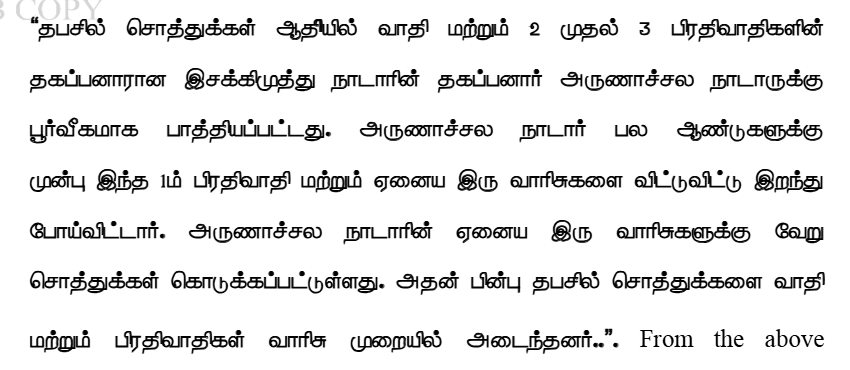

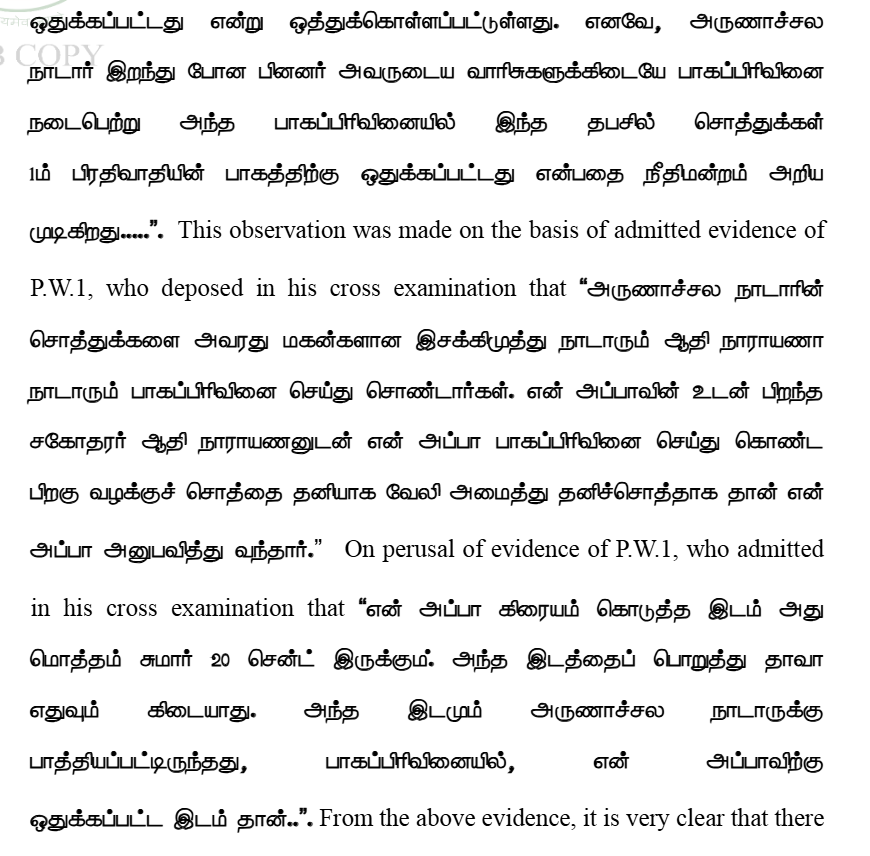

In property disputes, properties obtained through partition are considered self-acquired, affirming the right of absolute ownership and the validity of subsequent transfers unless proven otherwise.
The court established the principle that under the Tamil Nadu Amendment Act 1/1990, a daughter is entitled to her share in ancestral property, and any disposition or alienation without her consent is....
A claimant must prove the ancestral nature of properties to claim entitlement under the amended Hindu Succession Act; mere assertions without evidence are insufficient.

The main legal point established in the judgment is the importance of evidence in establishing the nature of the suit property and the entitlement to seek relief by way of partition, as well as the i....
The court ruled that an oral partition established the properties as separate and self-acquired, barring claims for partition after 18 years and validating a gift deed executed by the coparcener.
The court affirmed that items 1 and 2 of suit properties are ancestral, and items 3 to 11 are self-acquired, highlighting the plaintiffs' burden to prove family property claims.
The main legal point established in the judgment is that properties derived by the father through a partition deed are to be treated as his self-acquired properties, as per Section 8 of the Hindu Suc....
The judicial presumption of joint ownership requires proof of a family nucleus, and mere existence of a joint family does not automatically classify all properties as joint.



An indispensable Tool for Legal Professionals, Endorsed by Various High Court and Judicial Officers
Please visit our Training & Support
Center or Contact Us for assistance

Scan Me!
India’s Legal research and Law Firm App, Download now!


For Daily Legal Updates, Join us on :



 Back to top


