Back
Back





2026 Supreme(Mad) 562
IN THE HIGH COURT OF JUDICATURE AT MADRAS
V.LAKSHMINARAYANAN, J.
Radhakrishnan @ Krishnamurthy Naidu (Died) – Appellant
Versus
Pandurangan – Respondent
S.A.No.119 of 1999
Decided On : 22.01.2026
For the Appellants : Mr. A.R.Sakthivel
For the Respondents: Mr. Ruban Chakravathy, for Mr. S.Kaithamalai Kumaran
In family property disputes, the onus lies on claimants to prove joint ownership; properties recorded in female names are presumed to be theirs unless specifically evidenced otherwise.
Headnote:(A) Prohibition of Benami Property Transactions Act, 1988 - Section 4(3) - Joint family properties - Partition suit - The appellate court affirmed the trial court's decision in granting 29/49th share of 'A' schedule properties while dismissing claims on 'B' schedule properties due to lack of evidence showing joint family ownership - The plaintiffs failed to prove that properties purchased by Alamelu Ammal were joint family properties, and the burden of proof lies firmly on them, as the presumption against female ownership was clarified in previous case law. (Paras 30-40 and 56)
(B) Appeal - Onus of Proof - In cases of claims to joint family properties, the onus is on the party asserting such claims to provide evidence, particularly with properties held in the name of female members which cannot be assumed as joint family property without corroborative evidence. (Paras 36-39)
Facts of the case:
Plaintiffs challenge the dismissal of their partition suit by claiming that properties in 'B' schedule are family assets while the defendants asserted Alamelu Ammal's ownership and right to alienate - Raju Naidu, the father, was heavily indebted and executed sales to pay debts, with plaintiffs alleging undue influence and coercion without sufficient evidence.
Findings of Court:
The trial and appellate courts found that the plaintiffs had not sufficiently proven their claims over the 'B' schedule properties, clearing Alamelu Ammal's ownership.
Issues: The main issues were whether the Benami Property Transactions Act applies to joint family properties and whether the onus of proof shifts to defend claims for properties purchased in the names of female family members.
Ratio Decidendi: The court concluded that claims to properties in the names of female family members are not presumed to be joint family properties without evidence; hence, the appeal was dismissed as the plaintiffs failed to meet their burden of proof.
Result: The second appeal stands dismissed with cost throughout.
| Table of Content |
|---|
| 1. challenging previous judgments (Para 1 , 2) |
| 2. background of property disputes (Para 3 , 4 , 5 , 6) |
| 3. defendant's position on family property (Para 7 , 8) |
| 4. claims on property ownership and alienation (Para 9 , 10 , 11 , 12 , 13) |
| 5. legal defense against claims (Para 14 , 15) |
| 6. trial court's judgment details (Para 18 , 19 , 20 , 21) |
| 7. appeal against trial court's decision (Para 22 , 23) |
| 8. arguments presented in appeal (Para 26 , 27) |
| 9. application of benami transactions act (Para 30 , 31 , 32) |
| 10. burden of proof in property claims (Para 38 , 40 , 41 , 42) |
| 11. legal consequences of prior debts (Para 45 , 50 , 51) |
| 12. final dismissal of the appeal (Para 57) |
JUDGMENT :
V.LAKSHMINARAYANAN, J.
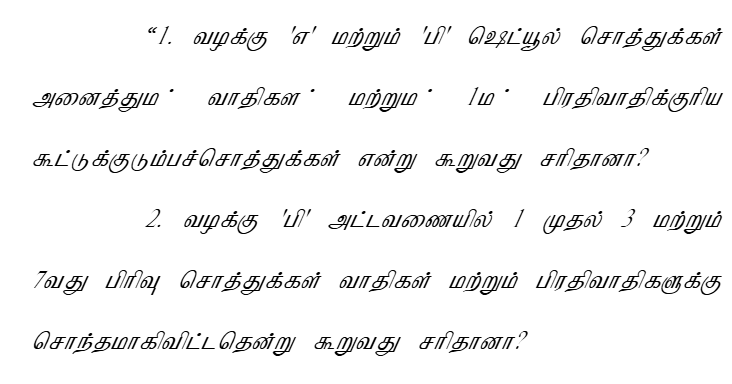
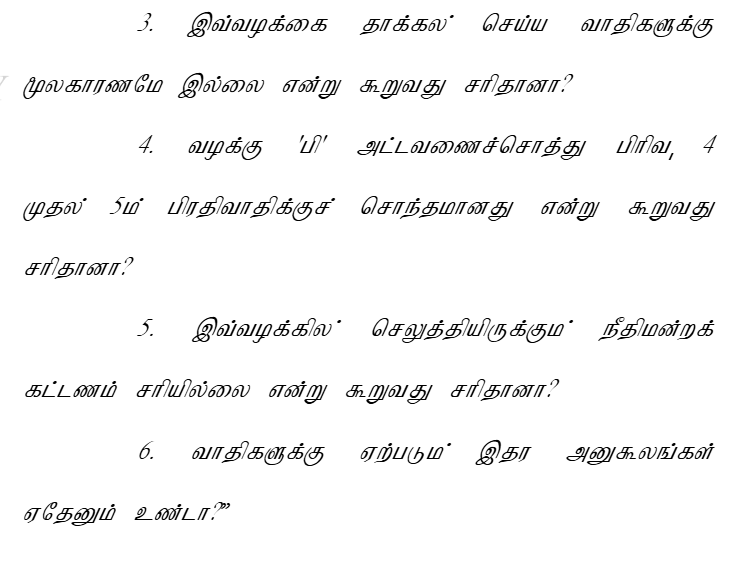
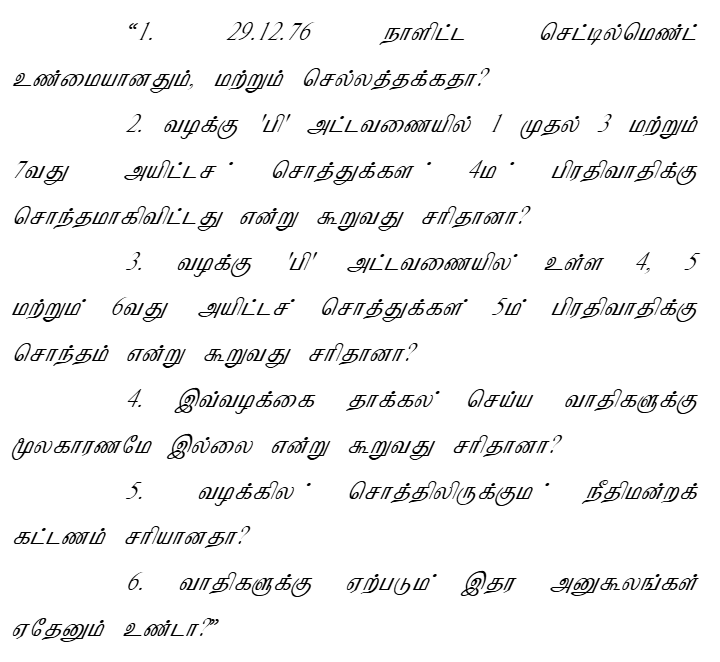
The plaintiffs challenge the judgment and decree of the learned District Judge, Villipuram in A.S.No.90 of 1997 date to 28.07.1998 in confirming the judgment and decree of the learned Subordinate Judge at Tindivanam in O.S.No.7 of 1989 dated 31.01.1997.
2. For the sake of convenience, the parties will be referred to as per their ranks in the suit.
3. O.S.No.7 of 1989 is a suit for partition and separate possession. The suit schedule mentioned properties have been earmarked as 'A' schedule and 'B' schedule. Insofar as 'A' schedule properties are concerned, there is no dispute. The trial court decreed the suit declaring 29/49th share in 'A' schedule mentioned property and passed preliminary decree. It dismissed the suit with respect to 'B' schedule mentioned property. The defendants did not prefer an appeal, insofar as the first part of the trial court decree is concerned. It was only the plaintiffs, who had preferred an appeal, aggrieved by the dismissal of the suit with respect to 'B' schedule. The appellate court agreed with the judgment and decree of the trial court with respect to 'B' schedule. Hence, this second appeal.
4. The plaintiffs 1 to 4, defendants 2 to 4 are the children of the first defendant, Raju Naidu and Alamelu Ammal. The fifth defendant is the wife of the second defendant and the daughter-in-law of the said Raja Naidu and Alamelu Ammal.
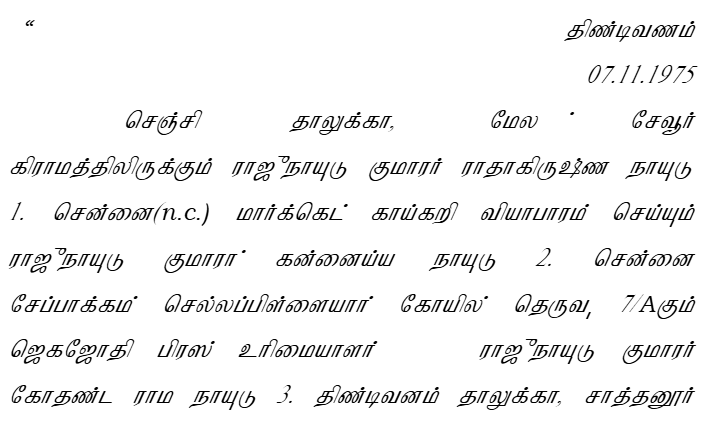
5. For ready reference, the admitted genealogy is setforth hereunder:
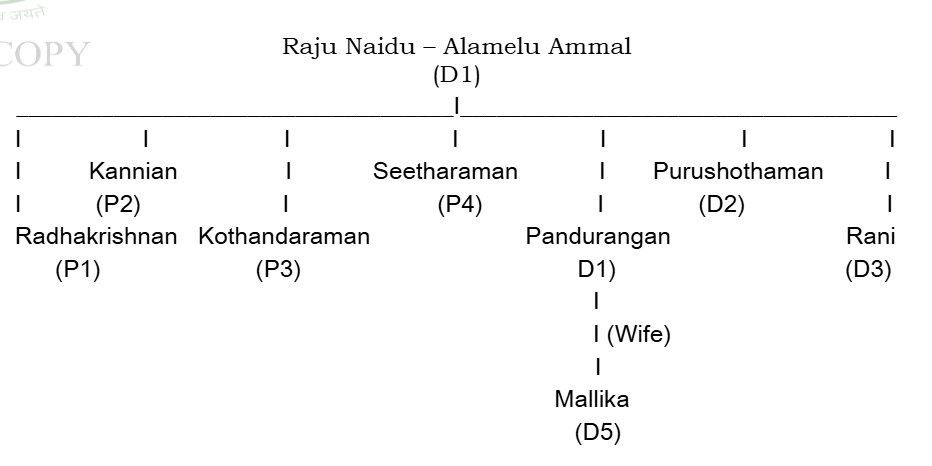
6. The case of the plaintiffs is that 'A' schedule mentioned properties are joint family properties. Items 1 to 3 and 7 are the properties purchased by Raju Naidu in the name of his wife, Alamelu Ammal. Similarly, items 4, 5 and 6 are also properties, which belonged to the joint family. According to them, the plaintiffs had left their native village and had gone elsewhere for the purpose of their avocation. They sent monies to Raju Naidu, who was residing in the native place along with one son. The properties specified in the 'B' schedule were purchased by Raju Naidu, from and out of the funds, available in the joint family pooling it with the contributions of the plaintiffs. Raju Naidu did not have any independent right over the property nor did Alamelu Ammal. Alamelu Ammal settled the property in favour of the plaintiffs' sibling, Rani.
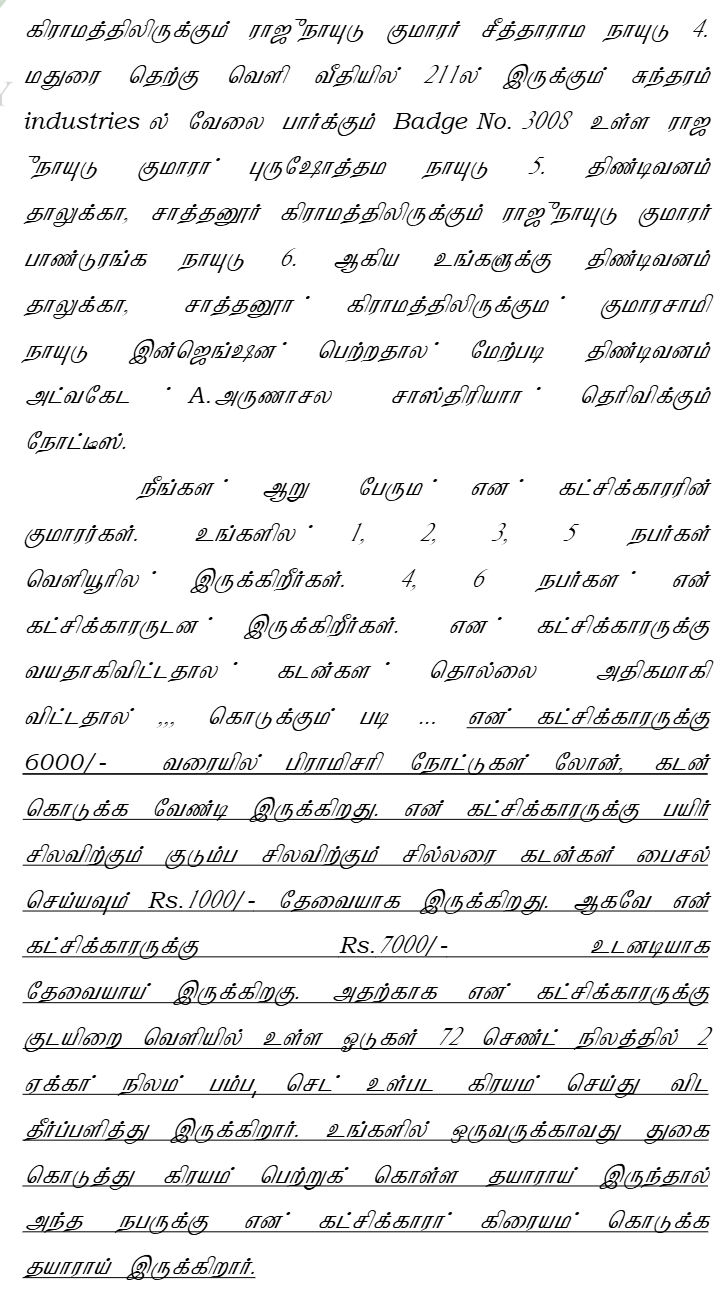
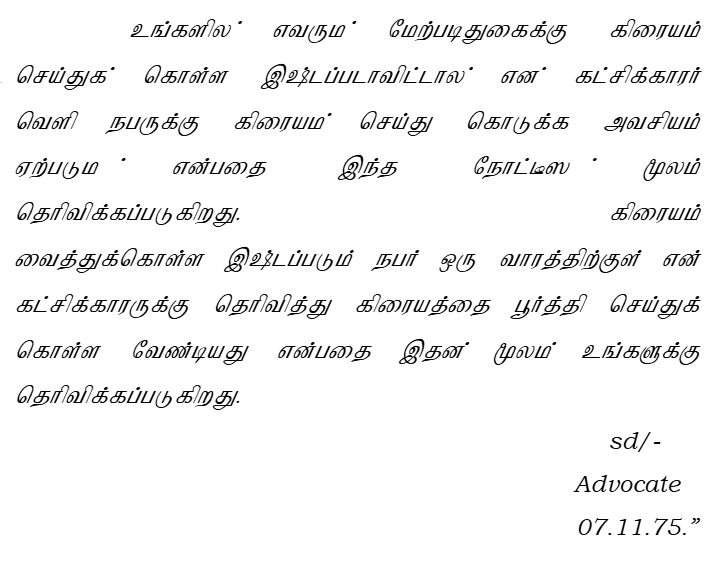
7. As Alamelu Ammal herself did not have right, the execution of the settlement deed does not bind the plaintiffs. Similarly Raja Naidu had sold the properties covered in items 4, 5 and 6 in favour of Mallika, his daughter-in-law. As Raju Naidu did not have any right over the property, the alienation will not bind the plaintiffs. The plaintiffs further pleaded that whatever debts that had been incurred by the father, viz., the first defendant had been repaid and the property was debt free. As amicable partition was not possible, they came forth with the present suit for partition.
8. Pending the suit, Raju Naidu passed away. As his legal heirs were already on record, no further action had to be initiated nor was initiated. The siblings of the plaintiffs, Pandurangan and Purushothaman were served with summons, but remained exparte. The sister of the plaintiffs, 4th defendant, on being served with summons, filed a written statement and with the permission of the court, she also filed a