
 Back
Back





IN THE HIGH COURT OF JUDICATURE AT MADRAS
V. LAKSHMINARAYANAN
Ramachandran – Appellant
Versus
C. Mayilsamy - Respondent
S.A.No.321 of 1995
Decided On : 08-01-2026
| Table of Content |
|---|
| 1. introduction of interlinked property suits. (Para 1 , 2 , 3) |
| 2. arguments for adverse possession. (Para 30 , 31 , 32 , 34) |
| 3. court analysis on adverse possession requirements. (Para 36 , 40 , 41) |
| 4. application of res judicata principles. (Para 48 , 49) |
| 5. final ruling on appeal dismissal. (Para 50 , 51) |
JUDGMENT :
Three suits had been presented inter se the plaintiff and the defendant. The first of the suit was O.S.No.803 of 1985 on the file of the Principal District Munsif at Coimbatore. It was a suit for permanent injunction. The second suit was filed by the plaintiff in the first suit. It was in O.S.No.1524 of 1988 filed for foreclosure of a mortgage dated 18.08.1973. The defendant in this suit was the defendant in O.S.No.803 of 1985. Subsequently, another suit came be presented by the defendant in O.S.No.803 of 1985 and O.S.No.1524 of 1988 against the plaintiff and two others. This suit was numbered as O.S.No.1828 of 1989. This is a suit for declaration of title, recovery of possession and mense profits. All the three suits were tried together by the learned I Additional District Munsif at Coimbatore.
2.By a judgment dated 08.01.1991, the suit in O.S.No.1828 of 1989, for declaration of title and recovery of possession was decreed, the suit for injunction in O.S.No.803 of 1985 was dismissed and the suit in O.S.No.1524 of 1988 for foreclosure was also decreed. Aggrieved by the decreetal order passed in O.S.No.1828 of 1989, the defendants preferred an appeal in A.S.No.95 of 1991. This appeal came to be dismissed by the learned Principal Subordinate Judge at Coimbatore on22.07.1993, against which the present second appeal.
3.For the sake of convenience, the parties shall be referred to as per their ranks in the suit in O.S.No.1828 of 1989. The appellants will be designated as the defendants and the deceased first respondent will be designated as the plaintiff.
4.The case of the plaintiff is that the suit schedule mentioned property is an ancestral property of his father, one Venkatrama Gounder. Venkatrama Gounder was allotted this property under a registered partition deed dated 05.10.1951. This partition deed had been entered into between Venkatrama Gounder and his brothers.
5.Venkatrama Gounder married one Karuppakkal. This wedlock resulted in the birth of the plaintiff. Karuppakkal passed away leaving behind Venkatrama Gounder and the plaintiff. Venkatrama Gounder also died on 12.10.1984. Hence, the property devolved on the plaintiff and he became the absolute owner of the property.
6.Venkatrama Gounder, after the death of Karuppakkal, was living separately. The first defendant, who was also a widow with two children, started living with Venkatrama Gounder. She created documents as if Venkatrama Gounder had entered into an agreement of sale on 08.12.1972 with her. She also created another document, namely, a mortgage deed dated 18.07.1973, as if Venkatrama Gounder had mortgaged the property in her favour, after receiving a sum of Rs.1500/-.
7.The plaintiff pleaded that the documents are either forged or had been obtained by exerting undue influence on Venkatrama Gounder and as such, they are void ab initio. The plaintiff further pleaded that since the property is ancestral in nature and as the plaintiff has half share in the property, Venkatrama Gounder had no authority to execute any document with respect to the entirety of the property. He pleaded that as the mortgage deed had become time barred, the same is not binding on the plaintiff and he is entitled to ignore the same.
8.The plaintiff alleged that he came to know of the documents and the claim of the defendants only when the suit in O.S.No.803 of 1985 had been presented before the II Additional Subordinate Judge at Coimbatore. Hence, he came forward with the suit for the aforesaid reliefs.
9.Summons were served on the defendants. The defendants filed a common written statement. They pleaded that the present suit in O.S.No.1828 of 1989 is an offshoot of the li
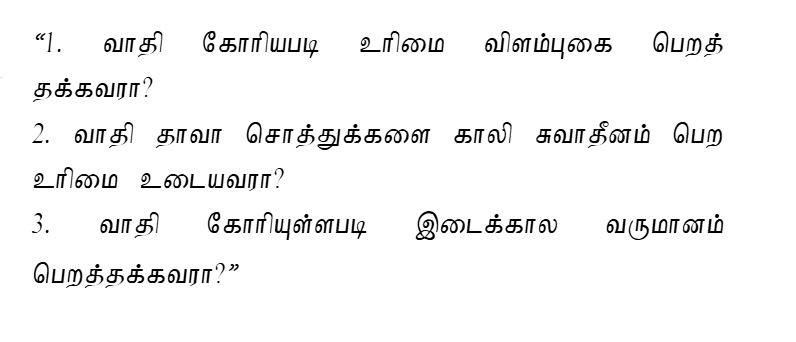
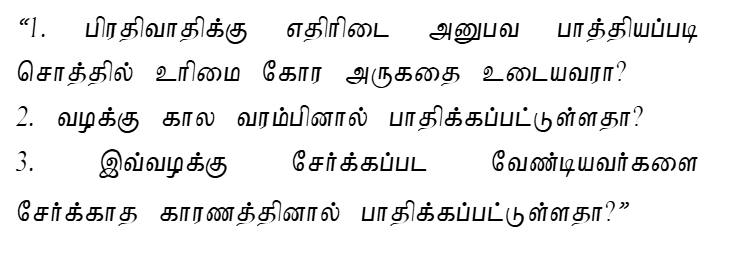
Adverse possession requires clear demonstration of hostile intent and long-term possession, not merely time alone, alongside the issues of res judicata affecting the current claim.

to approach the Civil Court for adjudicating the title in issue and when the defendant's patta had been cancelled during 1995 merely on the production of certain electricity bills and house tax recei....

Long possession without clear evidence of hostile intent does not equate to adverse possession, and permissive possession cannot turn adverse without communication of hostility.

The Benami Transactions (Prohibition) Act, 1988 bars claims of benami ownership, and adverse possession requires clear evidence of hostile possession, which must be specifically pleaded and proven.


Claim of adverse possession requires open, continuous possession with knowledge to the rightful owner. Plaintiffs failed to provide sufficient evidence, resulting in dismissal.
When there is a denial of title or a challenge raising a cloud, parties should file a suit for declaration of title, and adverse possession requires hostile possession denying the true owner's title.



An indispensable Tool for Legal Professionals, Endorsed by Various High Court and Judicial Officers
Please visit our Training & Support
Center or Contact Us for assistance

Scan Me!
India’s Legal research and Law Firm App, Download now!


For Daily Legal Updates, Join us on :



 Back to top


