Back





2026 Supreme(Mad) 960
IN THE HIGH COURT OF JUDICATURE AT MADRAS
G. JAYACHANDRAN, SHAMIM AHMED, JJ.
K. Abathasagayam S/o G. Krishnaswamy – Appellant
Versus
The State of Tamil Nadu – Respondent
W.P. No. 14073 of 2004, W.M.P. No. 16589 of 2004
Decided On : 02-06-2026
Important Points
Subject
Land Laws - Ceiling on Land Holdings
Act Referred
CONSTITUTION OF INDIA : Art.226
CIVIL PROCEDURE CODE : S.115
REGISTRATION ACT : S.47
STAMP ACT : S.35, S.37, S.54
Headnote
(B) Registration Law - Section 47 - Operation of registered documents - Retroactive effect of registration does not validate transactions established as being created with a mala fide intent to circumvent statutory land ceiling limits. (Paras 17, 23, 25)
(C) Suo Motu Revision - Powers of appellate authorities - No specific statutory time limit prescribed - Power can be exercised within a reasonable timeframe when it involves preventing the defeat of statutory legislative purpose. (Paras 11, 15, 32)
Facts of the case:
Ceiling limit proceedings were initiated against a landholder. The landholder executed two settlement deeds in favor of family members between the dates of the act's commencement and notification. These deeds remained unregistered for several months. Upon review, it was found that the settlement deeds were produced on old, third-party stamp papers, raising suspicion that they were antedated to evade ceiling limits. The authorities initiated a suo motu revision to include the settled land in the surplus holdings, which the successor to the landholder challenged, citing the earlier acceptance of these settlements and the retroactive effect of registration.
Findings of Court:
The court observed that the documentation methods—specifically the use of old stamp papers purchased by unconnected third parties—indicated a fabrication intent to reduce surplus land. The law provides that any transfer, regardless of bona fide status, is void if its effect is to defeat the legislative purpose of setting a ceiling on land holdings.
Issues: Whether land transfers executed between the commencement and notification dates of an act are void if intended to reduce surplus land, and whether the revisionary authority is restricted by a specific limitation period when invoking powers to address such transfers.
Ratio Decidendi: If the transfer of land occurring between the commencement and notification of legislation is proven, through circumstantial evidence such as suspicious stamp paper usage, to be intended to defeat the ceiling provisions, the transfer is declared void, and the land must be considered part of the owner's total holdings despite registration dates.
Result: Petition dismissed.
For the Appellant : V.K. Vijayaragavan
For the Respondent: D. Ravichandar
| Table of Content |
|---|
| 1. initial ceiling proceedings and disputes over samudhaya land inclusion. (Para 1 , 2 , 3 , 4 , 5 , 6 , 7 , 8) |
| 2. tribunal's suo motu review of potentially fraudulent settlement deeds. (Para 9 , 10 , 11 , 12 , 13 , 14) |
| 3. parties' arguments on limitation, section 22 retrospective effect, and stamp paper legitimacy. (Para 15 , 16 , 17 , 18 , 19 , 20 , 21) |
| 4. judicial assessment of settlement deeds created to defeat land reform ceiling limits. (Para 22 , 23 , 25 , 26 , 27 , 28 , 29 , 30 , 31) |
| 5. illegal land transfers intended to defeat the act are void; petition dismissed. (Para 32 , 33) |
ORDER :
1. The Writ Petitioner is the grandson of Late Gurumoorthy Iyer. Proceedings under the provisions of the Tamil Nadu Land Reforms (Fixation of ceiling on Land) Act, 58 of 1961, as amended by Act 17 of 1970, was initiated by the Settlement Officer on being prima facie satisfied that, as on 15.02.1970, the said Gurumoorthy Iyer holding acquirable surplus land.
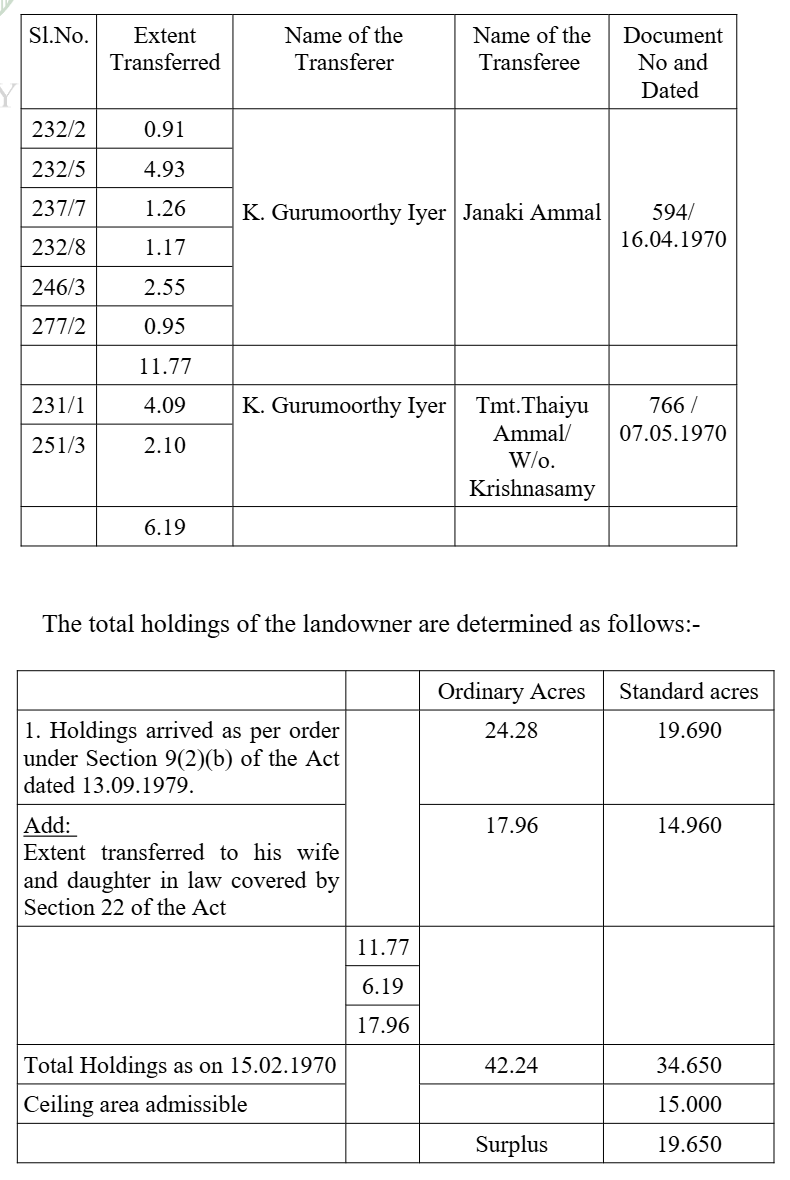
2. The nature and extent of land identified as owned by the said late Gurumoorthy Iyer are as below:-

3. The return in Form No. 2 filed by the landowner and the revenue records were verified by the Authorised Officer, positively considered the claim of the landowner to exclude 17.96 acres of land settled to his wife Janakiammal and his daughter-in-law, Thiyu Ammal, under deeds dated 01.01.1970 and 01.02.1970 respectively. However, the Authorised Officer rejected his claim to exclude the share of Gurumoorthy Iyer in the Samudhaya land, it being a patta land and the kist was being paid by him. The proceedings of the Authorised Officer in MRI/16G/17-70, dated 13.09.1979 under Section 9(2)(b) of the Act, concluded as below:-
“It is seen from the report of the Special Deputy Tahsildar and the Karnam of Mudikondan that the land owner is paying kist etc., regularly for the entire extent of 8.96 acres of Samudayam lands. Therefore the land owner is the owner of the above lands with reference to Section 3(33)(a)(i) of T.N.L.R Act and the above lands are ordered to be included in the holdings of the land owner and kept in the retainable extent with reference to Section 10(4) proviso.
As detailed the net holding of the land owner is 19.67 std of and he is eligible to hold 15 std. acre. He is requested to furnish the details of Survey number for the surplus extent of 4.57 std acres within 10 days from the date of receipt of this order failing which the surplus lands will be determined under Section 10(3) of the Act and further action will be taken.”
4. As against the proceedings of the Authorised Officer, Gurumoorthy Iyer preferred an appeal under Section 78 of the Act before the Tribunal, headed by the District Revenue Officer, challenging the inclusion of Samudhaya land along with the personal land held by the landowner to determine the surplus.
5. Pending appeal, Gurumoorthy Iyer died. His wife and son got impleaded and contested the appeal. The appeal was dismissed with the following observations:
“Admittedly it is not the case of the appellant that he did not owned any share in the Samuthayam lands. As far as the title to the property in question he is the owner of an extent of 3.80 Ac. of wet lands and 5.16 Ac. of dry lands in this Samuthayam lands. Though the lands are owned in common with other persons and in common enjoyment and common management the right of the appellant for partitioning his proportionate share can not be denied or objected by anyone. In as much as the appellant is the owner of the Samuthayam Lands, including his proportionate share interest along with his holdings for determining the total extent of lands.
It is, however, contended by the learned counsel for the petitioner that the petitioner should be given an opportunity to surrender the Samuthayam land is surplus land. The proceedings disclosed that the stage for exercising option for surrender of land and retention of the land has not yet been reached. At the stage when the petitioner will be called upon to ex