
 Back
Back





BEFORE THE MADURAI BENCH OF MADRAS HIGH COURT
N. ANAND VENKATESH, P. DHANABAL, JJ.
Govindaraj – Appellant
Versus
The Inspector of Police, All Women Police Station, M. Pudupatti Police Station – Respondent
Crl. Appeal (MD) No. 1045 of 2023
Decided On : 10-03-2026
| Table of Content |
|---|
| 1. factual background of the case (Para 3) |
| 2. arguments regarding lack of evidence (Para 4 , 5) |
| 3. court analysis of circumstantial evidence (Para 7 , 8 , 9 , 10 , 11) |
| 4. reasoning for acquittal based on evidence (Para 12) |
| 5. final conclusion and order (Para 13) |
JUDGMENT :
P. DHANABAL, J.
1. Challenging the conviction and sentence rendered by the Fast Track Mahila Court, Virudhunagar District at Srivilliputhur in SC No.240 of 2016 dated 30.08.2023, the present criminal appeal has been filed by the appellant.
2. The trial Court has convicted the appellant as follows:
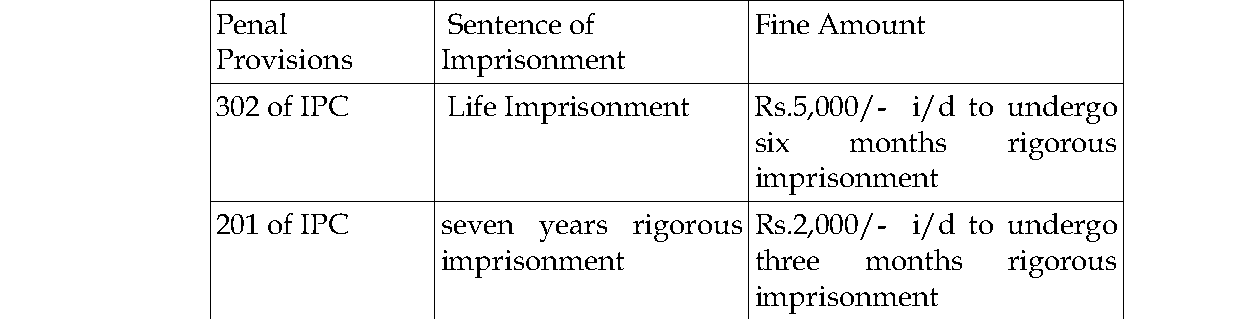
3. The case of the prosecution is that on 26.01.2016 at about 6.00 p.m., after consuming alcohol the appellant herein picked up quarrel with his wife and strangulated her neck and thereafter hanged her and thereby committed murder and caused disappearance of the evidence of offence, thereby charged for the offence under Section 302 and 201 of IPC.
3.1. PW.1 who is the mother of the deceased lodged complaint/Ex.P.1 before the respondent police and based on the said complaint P.W.8 registered First Information Report/Ex.P.7 in Crime No.9 of 2016 for the offence under Section 174 of Cr.PC., and thereafter the case was altered to Section 302 of IPC. The investigation officer/P.W.13 investigated the case, went to the place of occurrence, prepared observation mahazhar/Ex.P.8 and rough sketch/Ex.P.9. Thereafter the appellant himself gave extra judicial confession before the Village Administrative Officer/P.W.6 and thereafter PW.6 handed over the appellant to the investigation officer and thereafter the appellant gave confession statement in the presence of P.W.6 and based on the confession statement the investigation officer recovered M.O.1 to M.O.3 in the house of the appellant and the same was recovered through mahazhar/Ex.P.4 Further the Investigation Officer conducted inquest on the body of the deceased and prepared inquest report/Ex.P.6 and thereafter P.W.13 was transferred to some other place. P.W.14 had taken over further investigation and he sent the parts of the body of the deceased to forensic lab and also he examined the witnesses and he also altered the offences from of to Sections 498 (A),352,302 and201 of IPC and thereafter he filed final report as against the appellant.
3.2. On the appearance of the appellant, the provisions of Section 207 of Cr.P.C. were complied with, and the case was committed to the Court of Session, where it was taken on file in in SC No.240 of 2016 and made over to the Fast Track Mahila Court, Virudhunagar District at Srivilliputhur for trial.
3.3. After receipt of case papers, the trial Court has framed charges for the offence under Sections 302 and 201 of IPC The above charges were read over and explained to the appellant. The appellant denied the charges and claimed to be tried.
3.4. The prosecution examined P.W. 1 to P.W.16 and marked exhibits Ex.P.1 to P.13 and three material objects were produced. After completion of prosecution witnesses the appellant was questioned under Section 313 (1)(b) of Cr.P.C. with regard to the incriminating circumstances appearing against him, he denied the same as false. On the side of the appellant no one was examined and no documents were marked.
3.5. After analyzing the evidence and upon hearing both sides, the trial Court has convicted the appellant for the offences as stated supra. Aggrieved by the said judgment of conviction the present appeal has been filed by the appellant.
4. The learned counsel appearing for the appellant would submit that in this case the deceased died by hanging and the appellant has been falsely roped in this case simply because he is the husband of the deceased. In this case there is no eye witness and it is a case of circumstantial evidence and there is no chain linking the appellant with the crime. P.W.1 who is the mother of the victim in her chief examination has stated that
 There is suspicion that the appellant had assaulted the deceased. Further no injuries f
Circumstantial evidence must provide clear connections to convict; mere suspicion and lack of motive are insufficient for establishing guilt.

Circumstantial evidence and extrajudicial confessions require robust corroboration; lack of eyewitnesses and motive resulted in acquittal.


(1) Section 106 of Evidence Act does not directly operate against either a husband or wife staying under same roof and being last person seen with deceased.(2) In a case of circumstantial evidence, m....
The prosecution must prove guilt beyond reasonable doubt in homicide cases, relying on clear circumstantial evidence while providing plausible alternative explanations.


The central legal point established in the judgment is the requirement for the prosecution to prove the case beyond all reasonable doubts. The judgment emphasizes the importance of credible and relia....

The central legal point established in the judgment is the requirement for cogent and unerring circumstantial evidence to establish guilt in cases based on such evidence, and the burden on the prosec....

The court affirmed the conviction under Section 302 IPC, emphasizing the necessity of a complete chain of circumstantial evidence and the burden on the accused to explain circumstances surrounding th....



An indispensable Tool for Legal Professionals, Endorsed by Various High Court and Judicial Officers
Please visit our Training & Support
Center or Contact Us for assistance

Scan Me!
India’s Legal research and Law Firm App, Download now!


For Daily Legal Updates, Join us on :



 Back to top


