
 Back
Back





IN THE HIGH COURT OF JUDICATURE AT MADRAS
V.LAKSHMINARAYANAN, J.
M.Srinivasa Rao - Petitioner
Vs.
The Chennai Metropolitan Development Authority & Ors. - Respondent
WP No. 23403 of 2023 and WMP Nos. 22940 & 22941 of 2023
Decided On : 27-02-2026
No legal document content was provided in
| Table of Content |
|---|
| 1. petitioner challenges planning permission. (Para 1 , 2 , 3 , 4 , 5 , 6 , 7) |
| 2. respondents' counter affidavits and defenses. (Para 8 , 9 , 10 , 11 , 12 , 13 , 14 , 15 , 16 , 17 , 18 , 19 , 20 , 21 , 22) |
| 3. court analysis of jurisdiction and applicable regulations. (Para 23 , 24 , 25 , 26 , 27 , 28 , 29 , 30 , 31 , 32 , 33 , 34 , 35 , 36 , 37 , 38 , 39 , 40 , 41 , 42) |
| 4. writ petition dismissed with restrictions. (Para 43) |
ORDER :
V.LAKSHMINARAYANAN, J.
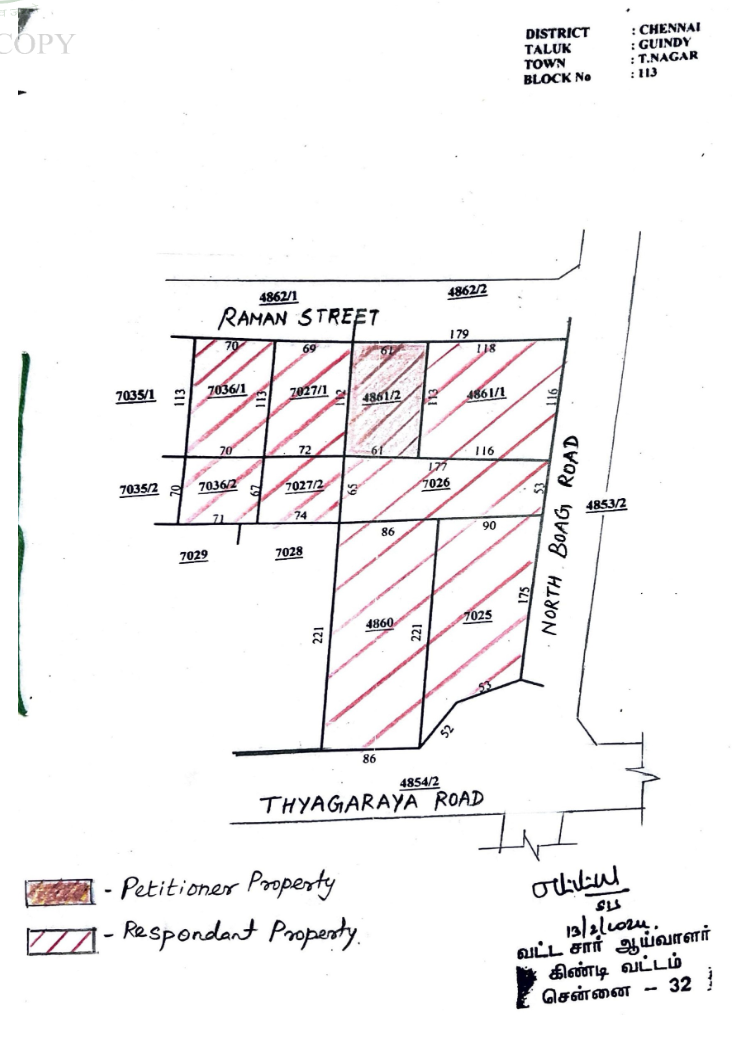
The petitioner challenges the planning permission issued by the 1st respondent to the 3rd respondent with respect of the property situated in T.S.No.4860, 7025, 7026 and 4861/1, 7036/1 and 2, 7027/1 and 2 in Block No.113 of T.Nagar Village.
2. The petitioner states that the 3rd respondent is running a hotel under the name and style of ‘Residency Towers’ at T.S.No.4861, 7025, 7026, 7028 on Thyagaraya Road. The 3rd respondent subsequently purchased the property at T.S.No.7036/1, 7036/2, 7027/1 and 7027/2 on Raman Street from the erstwhile owners. The petitioner states that, in terms of the Master Plan, Raman Street is a residential area and there are no commercial establishments in the said area. It states as per the Master Plan, Raman Street is classified as a Primary Residential Zone. It is alleged that in utter violation of the zoning regulations, the 1st respondent had permitted the 3rd respondent to construct a hotel with lodging rooms, convention halls, etc., measuring 20,000 Sq.m.
3. The petitioner relies upon Rule 33 of the Tamil Nadu Combined and Development Building Rules, 2019 [hereinafter referred to as 'the TNCDBR'] read with Annexure XVIII. It urges that as Raman Street is a Primary Residential Use Zone; hotels and lodging houses exceeding 500 Sq.m are not permissible. As the 3rd respondent’s construction spread over 20,000 Sq.m, it is a violation of the aforesaid regulations.
4. The petitioner further states that misleading the respondents 1 and 2, the 3rd respondent had shown the properties as one on Thyagaraya Road, when they are, in fact, located on the Raman Street. It adds that Raman Street is an 11 meter wide colony road and it does not permit construction as proposed by the 3rd respondent.
5. The petitioner further submits that if construction as attempted by the 3rd respondent is permitted, builders would purchase properties in residential areas and convert the same for commercial use. Thereby, defeating the very purpose for which zoning regulations are brought forth.
6. The petitioner alleges that from the start of the construction activities from October 2022, the 3rd respondent has been using Raman Street as the entry and exit route for its construction, which has restricted the ingress and egress of the persons residing in Raman Street to their property. Furthermore, as the construction activities are carried on through the night, it results in noise and air pollution, and also cause significant inconvenience to the children who are attending Holy Angel’s Anglo Indian Higher Secondary School, situated at one end of Raman Street.
7. Having obtained building permission for Door No.115, Thyagaraya Road, the 3rd respondent is illegally constructing on the property at Door No.19, Raman Street. The petitioner states that if the construction is permitted, it would lead to over-stressing of traffic and other civic amenities in the area. He states that drainage and water supply lines on Raman Street are not designed to cater to large, multi-storied commercial hotels, like the one proposed by the 3rd respondent. Hence, on the aforesaid grounds, the petitioner seeks the impugned planning permission to be quashed.
8. This Court entertained the writ petition on 10.08.2023. Respondents 1 and 3 have filed their counter affidavits.
9. It is the stand of the 1st respondent that the 3rd respondent applied for planning permission for Group Development with two blocks. It detained permission for Block No.1, at Door No.115, Thyagaraya Road comprised in T.S.No.4860, 7025
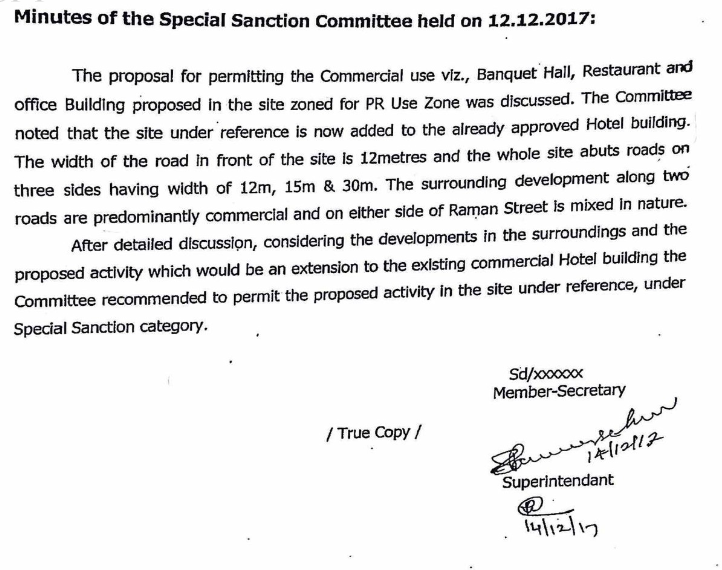
Writ petitions challenging planning permissions are maintainable if jurisdictional issues arise, and compliance with zoning regulations validates construction, despite potential public nuisance.

The main legal point established in the judgment is that the authorities cannot retrospectively apply zoning regulations to completed constructions.

Point of law: Rule which has to be applied is the one which is in force at the time of issuance of the permit and not the rule that was in force at the time of submission of the application.

The judgment emphasized the citizens' rights to property and residence, and the binding nature of previous court orders on the authorities.


The legislative authority for land and planning matters resides exclusively with the State, requiring adherence to state-specific planning laws, with necessary consents from all stakeholders for rede....


Plot under development/redevelopment affected due to Nalla, Nallah/river buffer, road widening, height restriction due to statutory restriction as per these Regulations such as railway buffer, height....



An indispensable Tool for Legal Professionals, Endorsed by Various High Court and Judicial Officers
Please visit our Training & Support
Center or Contact Us for assistance

Scan Me!
India’s Legal research and Law Firm App, Download now!


For Daily Legal Updates, Join us on :



 Back to top


