
 Back
Back





IN THE HIGH COURT OF ORISSA AT CUTTACK
A.C. BEHERA, J.
Babaji Charan Sahu (Since Dead through his LRs) – Appellants
Versus
Basanta Kumar Palei and Others – Respondents
S.A. No. 246 of 1993
Decided On : 17-09-2025
| Table of Content |
|---|
| 1. family dispute over property partition (Para 1 , 2 , 3 , 4 , 6) |
| 2. arguments on possession and validity of claims (Para 7 , 9 , 11) |
| 3. trial court's initial rulings favoring the plaintiff (Para 8 , 10 , 12) |
| 4. substantial question of law for the appeal (Para 14 , 15) |
| 5. legal propositions regarding re-purchase rights under partition act (Para 17 , 19) |
| 6. court's observations undermining lower court's decision (Para 20 , 21) |
| 7. final decision on partition and future directives (Para 22 , 23) |
JUDGMENT :
A.C. BEHERA, J.
1. This second appeal has been preferred against the reversing judgment.
2. The appellant in this second appeal was the sole plaintiff before the Trial Court in the suit vide T.S. No.130 of 1983 and respondent No.1 before the First Appellate Court in the First Appeal vide T.A. No.71 of 1989.
The respondent Nos.3 to 7 & 9 to 11 in this 2nd appeal were the defendant Nos.1 to 8 before the Trial Court in the suit vide T.S. No.130 of 1983 and respondent Nos.2 to 9 before the 1st Appellate Court in the 1st appeal vide T.A. No.71 of 1989.
The respondent Nos.1, 2 & 8 in this 2nd appeal were the defendant Nos.10, 11 & 9 before the Trial Court in the suit vide T.S. No.130 of 1983 and appellants and respondent No.10 before the 1st Appellate Court in the 1st appeal vide T.A. No.71 of 1989.
3. The suit of the plaintiff (appellant in this 2nd appeal) before the Trial Court vide T.S. No.130 of 1983 against the defendants (respondents in this second appeal) was a suit for partition and re-purchase under Section 4 of the PARTITION ACT , 1893.
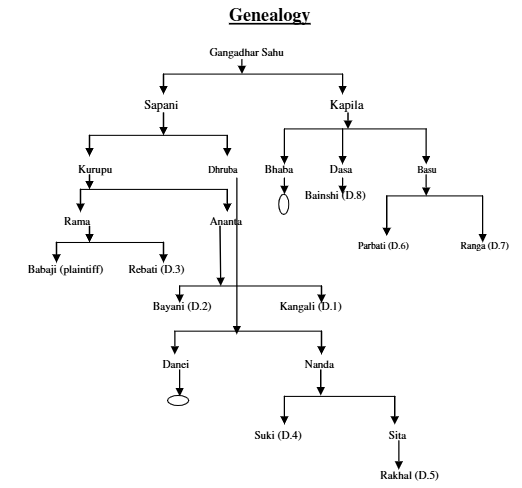
4. As per the averments made in the plaint of the plaintiff, the case of the plaintiff was that, he (plaintiff) and the defendant Nos.1 to 8 belong to one family hailing from their one common ancestor Gangadhar Sahoo.
5. In order to have a better appreciation, the genealogy (family pedigree), which was given by the plaintiff in Para No.1 of his plaint is depicted hereunder for an instant reference:-
6. The defendant Nos.9 to 12 are the stranger purchasers. As such, they (defendant Nos.9 to 12) are not the family members of plaintiff and defendant Nos.1 to 8.
The properties described in three lots in Schedule ‘A’ of the plaint are the joint and undivided properties of the plaintiff and defendant Nos.1 to 8 and the same are the suit properties. The said suit properties have not been divided/partitioned between them (plaintiff and defendant Nos.1 to 8) at any time as yet through any metes and bounds partition.
The suit plot Nos.2249, 2251 & 2252 are the joint and undivided dwelling house of the plaintiff and defendant Nos.1 to 8. The suit plot No.2250 had/has been using by them (plaintiff and defendant Nos.1 to 8) as Rasta to their aforesaid joint and undivided dwelling house situated on plot Nos.2249, 2251 & 2252. The suit plot No.2247 is their joint and undivided Gadia (Pond) of the plaintiff and defendant Nos.1 to 8. Their ancestral house was over suit plot No.2248, which was collapsed in the last cyclone of the year 1982.
When, the stranger defendant Nos.9 to 12 tried to enter into their undivided dwelling house vide Plot Nos.2247, 2248 & 2250 claiming that, their predecessor Jagabandhu Palei had purchased the same from defendant No.1 (Kangali Sahu) and as the defendant Nos.9 to 12 have no right to enter into and possess the joint and undivided dwelling house of the plaintiff and defendant Nos.1 to 8, then without getting any way, the plaintiff approached the Civil Court by filing the suit vide T.S. No.130 of 1983 praying for partition of his legitimate share along with the shares of the defendant Nos.1 to 8 from the suit properties and also prayed for passing a decree entitling him (plaintiff) to re-purchase the properties, those were sold by the defendant No.1 from plot Nos.2247, 2248 & 2250 to the predecessor of the defendant Nos.9 to 12 i.e. Jagabandhu Palei along with other reliefs, to which, he (plaintiff) is entitled for.
7. Having been noticed from the Trial Court in the suit vide T
AI
A co-sharer cannot invoke the right to repurchase under Section 4 of the Partition Act without the stranger purchaser instituting a partition suit.

The conditions for claiming benefits under Section 4 of the Partition Act require a dwelling house to be in existence at the time of transfer, which the appellant failed to establish.

Joint ownership claims persist until partition; rights in a partition suit are not bound by limitation, and the burden to prove legal necessity for property transfer lies with the transferee.
The character of a property as a dwelling house under the Partition Act is retained even with temporary use for commercial purposes, necessitating fresh adjudication of related applications.

A plaintiff must prove interest in joint family property to maintain a partition suit; failure to do so results in dismissal.


Point of Law : In terms of Section 4, the duty is cast upon Court to determine the valuation of the share of the stranger purchaser.



An indispensable Tool for Legal Professionals, Endorsed by Various High Court and Judicial Officers
Please visit our Training & Support
Center or Contact Us for assistance

Scan Me!
India’s Legal research and Law Firm App, Download now!


For Daily Legal Updates, Join us on :



 Back to top


