
 Back
Back





IN THE HIGH COURT OF ORISSA AT CUTTACK
A.C.Behera, J.
Khetrabasi Sahu - Appellant
versus
Smt. Laxmi Sahu and others - Respondents
S.A. No.112 of 2001
Decided On : 11-12-2023
| Table of Content |
|---|
| 1. plaintiff's genealogical background and property claim (Para 1 , 2 , 3) |
| 2. defendants' counterarguments against plaintiff's claims (Para 4 , 5) |
| 3. trial court's findings against the plaintiff (Para 6 , 7) |
| 4. witness testimony supporting defendants' position (Para 12 , 13) |
| 5. legal principles regarding partition claims under partition act (Para 14) |
| 6. court's conclusion on property ownership and appeal dismissal (Para 15 , 16 , 17) |
| 7. final judgment confirming dismissal of the plaintiff's appeal (Para 18) |
JUDGMENT :
A.C. Behera, J.
This 2nd appeal has been preferred against the confirming judgment.
2. The appellant of this 2nd appeal was the sole plaintiff in the suit vide O.S. No.270 of 1985-I and he was the appellant in the 1st appeal vide T.A. No.42 of 1992.
The respondents of this 2nd appeal were the defendants in the suit vide O.S. No.279 of 1985-I and they were the respondents in the 1st appeal vide T.A. No.42 of 1992.
The suit of the plaintiff vide O.S. No.279 of 1985-I was a suit for partition and re-purchase of the suit properties.
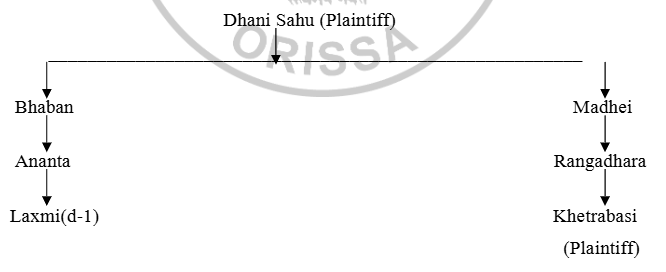
3. The case of the plaintiff in the suit vide O.S. No.279 of 1985-I was that, their common ancestor was Dhani Sahu. Dhani Sahu died leaving behind his two sons, i.e. Bhaban and Madhei. Bhaban died leaving behind his only son Ananta. Ananta died leaving behind his wife Laxmi (defendant no.1).
The 2nd son of Dhani Sahu, i.e., Madhei died leaving behind his son Rangadhara. Rangadhara died leaving behind his son Khetrabasi (plaintiff).
The aforesaid family pedigree of the plaintiff stated by him in his plaint is depicted hereunder for an instance reference:-
According to the plaintiff, the two sons of Dhani Sahu, i.e., Bhaban, Madhei along with their respective sons, i.e., Ananta and Rangadhara were staying jointly. The suit properties were recorded in the sabik settlement in the name of Ananta and Madhei jointly. But in the major settlement, the suit properties were recorded jointly in the name of Ananta and the plaintiff (Khetrabasi). Their ancestral dwelling house is situated over C.S. Plot No.386 and their tank is on C.S. No.466. He(plaintiff) has half share over the suit properties and the defendant no.1 (Laxmi Sahu) has half share. Till yet, the suit properties have remained as their joint and undivided dwelling house without any metes and bounds partition of the same between them. The defendant no.2 Baishnaba Sahu and as well as his successors, i.e. defendant no.2(ka) to 2(gha) are the strangers to the family of the plaintiff and defendant no.1 and they are also strangers to the suit properties. Till yet, neither the defendant no.2 Baishnaba Sahu nor his successors, i.e., defendant nos.2(ka) to 2(gha) were/are in possession over any portion of the suit properties. But after major settlement operation, when the plaintiff came to know that, the defendant no.2 (Baishnaba Sahu) has purchased Ac.0.10 decimals out of the suit properties from the husband of the defendant no.1, then, he(plaintiff) requested the defendant no.1 on dated 16.11.1985 for metes and bounds partition of the suit properties, to which, she (defendant no.1) refused. So, he (plaintiff) approached the civil court being the plaintiff by filing the suit vide O.S. No.279 of 1985- I against the defendant no.1 Laxmi Sahu arraying defendant no.2 (so- called purchaser from Antanta Sahu), praying for partition of the suit properties and also to re-purchase of the same from the defendant no.2 through a direction of the court according to Section 4 of the Partition Act, 1893, as he (defendant no.2) is a stranger to their family, for which, he (defendant no.2) cannot have his joint possession of the suit properties with them, because, the suit properties are their joint and undivided dwelling house.
When, during the pendency of the suit, the defendant no.2 Baishnaba Sahu expired, then his legal heirs, i.e., defendant nos.2(ka) to 2(gha) were substituted in his place.
4. Having been noticed from the court in O.S. No.279 of 1985-I, the
AI
The conditions for claiming benefits under Section 4 of the Partition Act require a dwelling house to be in existence at the time of transfer, which the appellant failed to establish.

A co-sharer cannot invoke the right to repurchase under Section 4 of the Partition Act without the stranger purchaser instituting a partition suit.

Joint ownership claims persist until partition; rights in a partition suit are not bound by limitation, and the burden to prove legal necessity for property transfer lies with the transferee.
A plaintiff must prove interest in joint family property to maintain a partition suit; failure to do so results in dismissal.
In partition suits under the Hindu Succession Act, successors are entitled to equal shares regardless of prior unauthorized mutations in land records, affirming co-ownership rights.
Widow's remarriage does not strip her of inheritance rights, and married daughters have equal entitlement to family property under the amended Hindu Succession Act.
An arbitration award without court recognition lacks binding legal effect in partition disputes concerning jointly owned family properties under Hindu Law.

The burden of proof lies with the plaintiff to establish a property as benami, which was not satisfied in this case.



An indispensable Tool for Legal Professionals, Endorsed by Various High Court and Judicial Officers
Please visit our Training & Support
Center or Contact Us for assistance

Scan Me!
India’s Legal research and Law Firm App, Download now!


For Daily Legal Updates, Join us on :



 Back to top


