
 Back
Back





IN THE HIGH COURT OF ORISSA AT CUTTACK
SASHIKANTA MISHRA, J.
Raj Kumar Yadav - Election Petitioner
Versus
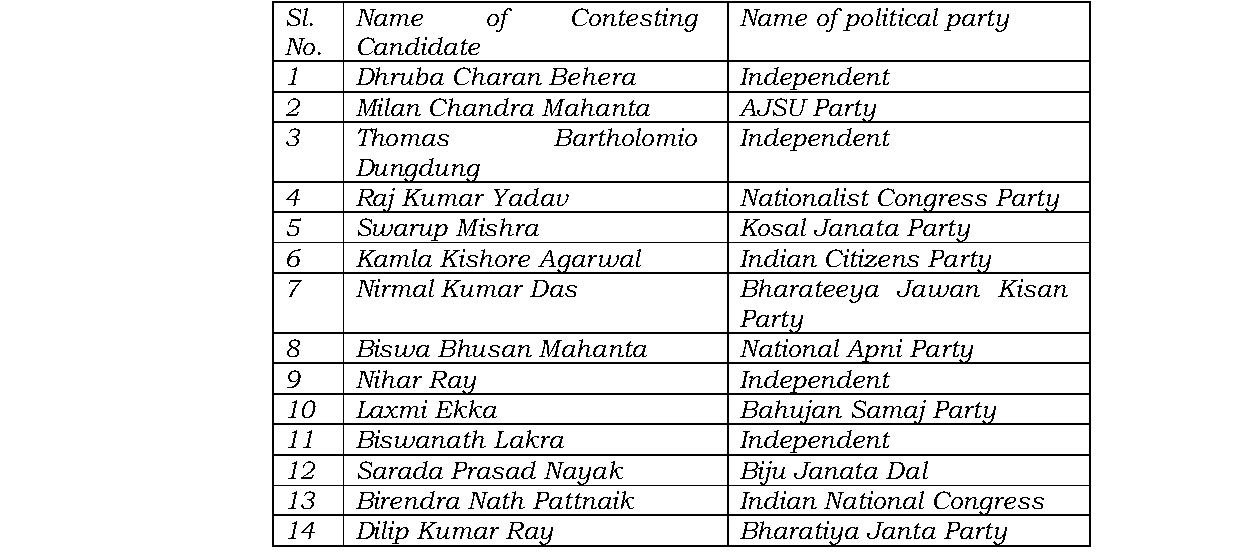
Sarada Prasad Nayak - Respondent
I.A No. 109 of 2024, (ARISING OUT OF ELPET No.-1 of 2024)
Decided On : 06-02-2026
| Table of Content |
|---|
| 1. challenge to election based on nomination issues. (Para 1 , 2 , 3) |
| 2. election petitioner's locus standi questioned. (Para 6 , 7) |
| 3. arguments on status of election petitioner. (Para 10 , 11) |
| 4. interpretation of 'candidate' under the act. (Para 13 , 14 , 15) |
| 5. locus standi requirements under the act. (Para 19 , 20 , 21) |
| 6. election petition dismissed for lack of locus standi. (Para 23 , 24) |
JUDGMENT :
SASHIKANTA MISHRA, J.
The present application has been filed by the sole Respondent of the Election Petition under Section 86 of the Representation of the People Act, 1951 read with Order VI Rule 16, Order VII Rule 11, and Section 151 of the Code of Civil Procedure. By way of this application, the Respondent has prayed for striking out the pleadings contained in Paragraphs 8(A) to 8(G) of the Election Petition and for rejection/dismissal of the Election Petition in its entirety at the threshold in terms of Section 86 of the said Act. It has been urged on behalf of the Respondent that the averments sought to be struck off are wholly irrelevant, frivolous, and scandalous in nature, and amount to gross abuse of the process of the Court. It is further contended that the Election Petition is devoid of the essential material facts and particulars, fails to disclose a complete cause of action, and does not give rise to any triable issues, thereby rendering it liable to be dismissed at the preliminary stage.
2. The Election Petition has been instituted by the Election Petitioner seeking (a) a declaration that the election of the Respondent, Sarada Prasad Nayak, from 12- Rourkela Assembly Constituency to the Odisha State Legislative Assembly be declared void, and (b) a consequential direction for re-election/fresh poll in the said Constituency.
3. The election of the Respondent has been principally challenged on the ground of improper acceptance of his nomination by the Returning Officer.
(i) It is alleged that while filing his nomination papers, the Respondent failed to disclose material particulars in the affidavit in Form–26, specifically:
(a) non-disclosure of pending criminal cases; and
(b) non-disclosure of joint property holdings.
(ii) According to the Petitioner, such non-disclosure and suppression of material facts amount to violation of the mandatory requirements under Section 33-A of the Act read with Rule 4-A of the Conduct of Election Rules, 1961, thereby rendering the acceptance of the nomination papers of the Respondent by the Returning Officer improper within the meaning of Section 100(1)(d)(i) of the Act.
4. Pursuant to notice, the Respondent entered appearance and filed his written statement. The Respondent has further filed the present application raising certain preliminary grounds, which shall be adverted to in the subsequent paragraphs. The Election Petitioner, in turn, has filed detailed objections traversing and controverting the averments made therein.
5. For convenience, the parties are referred to as per their original status in the Election Petition.
6. In the present application, the Respondent at the threshold has urged that although the Election Petitioner claims that 14 persons, including him, had filed nomination papers, his own nomination was rejected and such rejection has not been assailed in the petition. It is further pointed out that the Election Petitioner has neither pleaded that he contested the election nor that he has instituted the petition in the capacity of an elector. In the absence of such averments, it is contended that the Election Petitioner lacks locus standi to maintain the present petition and, therefore, is liable to be dismissed in limine. Along with the above, the Respondent has also contended that the copy of the Election Petition served upon him is defective inasmuch as it contains two separate pages bearing the same page number “26” with different contents, which, according to him, does not constitute a true and attested copy of the petition filed before this Court, thereby
AI
An election petition may be dismissed if the petitioner fails to establish their locus standi as either a candidate or elector, leading to a lack of substantive legal foundation for the claim.
Non-joinder of a candidate accused of corrupt practices in an election petition results in its mandatory dismissal under Section 86 of the Representation of the People Act, 1951.

An election petition must disclose material facts to establish a cause of action; vague allegations are insufficient for dismissal, and substantial compliance with procedural rules is mandated.


An election petition must disclose material facts and particulars; vague allegations without evidence do not establish a cause of action.

Election petitions must plead concise material facts under Section 83(1)(a) RP Act to disclose cause of action; deficient, vague pleadings warrant dismissal under Order VII Rule 11 CPC without trial.

An election petition must contain concise material facts and particulars as per the Representation of Peoples Act, 1951; failure to do so results in dismissal.
Election petitions must contain concise statements of material facts; omission of a single material fact leads to dismissal for lack of cause of action.

Election petitions must contain substantial material facts to establish a cause of action, failing which they can be dismissed at the outset.



An indispensable Tool for Legal Professionals, Endorsed by Various High Court and Judicial Officers
Please visit our Training & Support
Center or Contact Us for assistance

Scan Me!
India’s Legal research and Law Firm App, Download now!


For Daily Legal Updates, Join us on :



 Back to top


