
 Back
Back





IN THE HIGH COURT OF ORISSA AT CUTTACK
S.K.PANIGRAHI, J.
Biswaranjan Sahoo and another - Petitioners
Versus
Bijay Kumar Sahoo and others -Respondent
W.P.(C) No.33760 of2022
Decided On : 29-10-2024
| Table of Content |
|---|
| 1. factual background of the case. (Para 1 , 2) |
| 2. arguments from petitioners against exclusion from suit. (Para 3 , 4) |
| 3. court's observations on the necessity of all parties in settlement. (Para 5 , 6 , 8 , 9 , 10 , 11 , 12) |
| 4. importance of hearing all stakeholders. (Para 13 , 14) |
| 5. conclusion allows petition and remands for reconsideration. (Para 15 , 16 , 17) |
Judgment :
S.K. Panigrahi, J.
1. In this Writ Petition, the petitioner challenges the order dated 14.05.2022 passed in C.S. No.521 of 2022 by the learned Senior Civil Judge, Dhenkanal on compromise in National Lok Adalat.
I. FACTUAL MATRIX OF THE CASE
2. The brief facts of the case are as follows:
(i) Bijaya Kumar Sahoo (present Opposite Party No. 1), as Plaintiff, filed C.S. No. 521 of 2021 before the Senior Civil Judge in Dhenkanal against present Opposite Party Nos. 2 to 6, who were defendants in the case. The suit was filed for the partition of certain joint family property. Notably, the present petitioners, despite being co-sharers, were not included as parties in the suit for reasons unknown to them.
(ii) Thereafter, a compromise petition was prepared between the parties to the suit and filed before the learned Court below. Consequently, the suit was disposed of and decreed on 14.05.2022, based on the terms of the compromise during the National Lok Adalat. On the basis of said compromise decree, the parties to the suit mutated their respective shares before the Tahasildar, Dhenkanal.
(iii) The present petitioners were unaware of the aforementioned facts, as both reside outside the suit village. During the Raja Festival, the petitioners approached present Opposite Party Nos. 2 to 6 to request a partition of the joint family property so they could proceed with construction work. However, this proposal was rejected by the Opposite Parties, who stated that there had already been a partition of the joint holdings.
(iv) After learning the facts, the present petitioners consulted an advocate and inquired about the land records from both the Tahasil Office and the Civil Court. Upon obtaining all relevant documents, they discovered that the joint family properties had been partitioned among Opposite Party Nos. 1 to 6 without their knowledge and behind their back. They believe this was done through fraudulent practices, not only against them but also against the court.
(v) After obtaining all the documents, the petitioners contacted their counsel in Dhenkanal. The counsel, upon examining the documents, filed CMA No. 15/2022 under Section 151 of the CPC to set aside the compromise decree passed in C.S. No. 521/2021. Additionally, a Miscellaneous Case No. 78 of 2022 was filed under Order 39, Rules 1 and 2 of the for an injunction.
(vi) After hearing the counsels for both parties, the learned court below dismissed CMA No. 15 of 2022 by order dated 4.11.2022on the ground that the said CMA under Section 151 of the CPC was not maintainable.
II. SUBMISSIONS ON BEHALF OF THE PETITIONER
3. Learned counsel for the Petitioner earnestly made the following submissions in support of his contentions:
(i) At the properties described are the ancestral properties of the parties. One Hrushi Sahu and Laxmisahu were the recorded tenants with respect to the same.
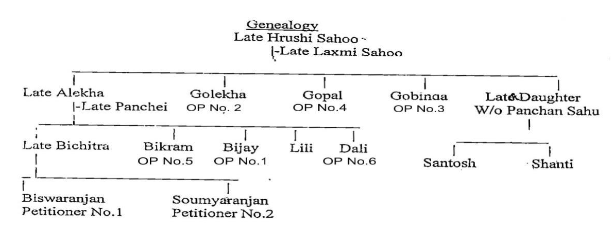
(ii) Hrushi Sahu and Laxmi Sahu were husband and wife, and they passed away leaving behind four sons: Alekha, Golekha, Gopala, and Govinda, along with one daughter, Tofani. Alekha, the eldest son, also died, leaving three sons—Bichitra, Bikram, and Bijaya—and two daughters, Lili and Dali. Bichitra, the eldest son of Alekha, passed away, leaving two sons, Biswa Ranjan and Soumya Ranjan, who are the present writ petitioners. The other three sons of Hrushi—Golekha, Gopala, and Govinda—are alive, while their only daughter, Tofani, has died, leaving one son/ Santosh/ and one daughter/ Shanti. Additionally/ Alekha’s two sons, Bikram and Bijaya, along with his daughters, Lili and Dali, are also alive.
(iii) The present Opposite Party No.
AI
A decree for partition reached without including all necessary parties is invalid; all stakeholders must consent to the compromise for it to be enforceable.

A party cannot challenge the validity of a compromise once executed, especially when affirmed in the presence of legal counsel.

Exclusion of necessary parties in settlement proceedings undermines legal rights, necessitating their inclusion to ensure just outcomes in family property disputes.

Lok Adalat compromise decrees, though final under Section 21, can be set aside in writ jurisdiction if vitiated by fraud like non-service of summons and misrepresentation to illiterate disabled party....


A minor can seek partition, but cannot challenge a compromise decree if not a party to it; Lok Adalat awards are binding unless proven otherwise.

A writ petition challenging a compromise decree entered before Lok Adalat by non-impleaded necessary parties is maintainable due to allegations of fraud and procedural irregularity.

(1) Compromise of suit – To recall a compromise that has been recorded would call for strong reasons. Terms of a compromise decree cannot be avoided, unless allegation of fraud has been proved.(2) Wh....
The finality and binding nature of awards passed by Lok Adalat, and the prohibition on filing suits to set aside a decree based on a compromise.



An indispensable Tool for Legal Professionals, Endorsed by Various High Court and Judicial Officers
Please visit our Training & Support
Center or Contact Us for assistance

Scan Me!
India’s Legal research and Law Firm App, Download now!


For Daily Legal Updates, Join us on :



 Back to top


