
 Back
Back





IN THE HIGH COURT OF ORISSA AT CUTTACK
MANASH RANJAN PATHAK, SASHIKANTA MISHRA, JJ.
Laxman Kumar Sahoo - Appellant
Versus
State of Odisha - Respondent
CRLA No.122 of 2004
Decided On : 12-03-2026
| Table of Content |
|---|
| 1. overview of trial and background of dowry death case. (Para 1 , 2) |
| 2. accused's complete denial of allegations. (Para 3 , 4) |
| 3. trial court's reliance on dying declaration. (Para 5 , 14) |
| 4. arguments regarding the credibility of the dying declaration. (Para 6 , 8) |
| 5. contradictions and lack of supporting witnesses. (Para 9 , 10 , 11) |
| 6. legal standards regarding the admissibility of dying declarations. (Para 12 , 18 , 19) |
| 7. conclusion regarding the sufficiency of evidence for conviction. (Para 16 , 20) |
| 8. order dismissing the appeal and confirming the conviction. (Para 21) |
JUDGMENT :
Sashikanta Mishra, J.
The appellant faced trial for committing dowry death/murder of his wife in Sessions Case No.228/1999 in the court of learned Sessions Judge, Ganjam-Gajapati at Berhampur and being convicted for the offence punishable under Section 302 I.P.C., he was sentenced to undergo rigorous imprisonment for life vide judgment dated 24.2.2004, which is impugned in the present appeal.
2. Prosecution case, briefly stated, is as follows;
The accused married one Gitanjali Palo, daughter of Prabhasini Palo, as per Hindu rites on 17.1.1999 at Jagannath Temple, Puri. It was agreed to pay Rs.2,00,000/- as dowry as demanded by the bridegroom. Prabhasini, paid Rs.50,000/-, gold ornaments, wearing apparels and several household articles. The accused used the said amount for purchasing articles for his stationary shop. The balance amount was agreed to be paid after marriage. The accused ill-treated his wife by physically and mentally torturing her demanding the balance amount. The couple was staying in a rented accommodation. On 23.3.1999, Prabhasini heard that the accused had set her daughter ablaze by pouring kerosene on her body. Hearing this, she rushed to the house of her daughter and found her with severe burn injuries all over the body with kerosene smell. Her daughter informed her that the accused had poured kerosene on her and set fire to her using a match stick. Prabhasini took her daughter on a rickshaw to the hospital with the help of others where she was treated in a critical condition. She reported the matter at Mahila P.S., Berhampur on the next date. Basing on such report, P.S. Case No.14 dated 24.3.1999 was registered under Section 498 -A/307 I.P.C. and Section 4 of the D.P. Act followed by investigation. In course of investigation, the victim having died, the case turned to Section 304 - B/302 of I.P.C. Charge sheet was accordingly submitted.
3. The plea of the accused is of complete denial.
4. To prove its case, prosecution examined 10 witnesses and proved 20 documents. Defence, on the other hand, did not adduce any oral evidence but exhibited two documents.
5. After analyzing the evidence on record, learned Sessions Judge held that the prosecution had well established its case against the accused. The dying declaration of the deceased and the evidence of the other witnesses including the informant were taken into consideration by the learned Sessions Judge in arriving at the above conclusion.
6. Heard Ms. Diptirekha Nanda, learned counsel for the appellant and Ms. Subhalaxmi Devi, learned Addl. Standing counsel for the State.
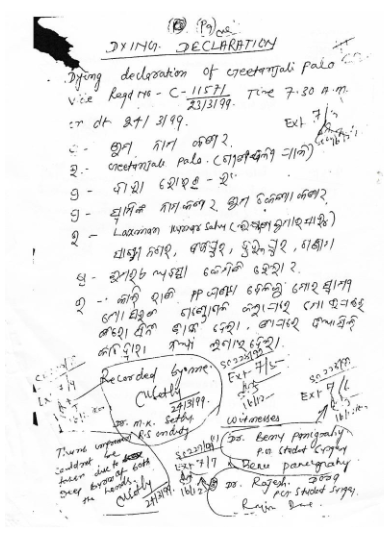
7. Ms. Nanda assails the impugned judgment of conviction on the ground that the presence of the appellant at the spot has not been proved nor his motive to cause death of the deceased. Reliance on the dying declaration is incorrect as there is no evidence to show that the deceased was in a fit state of mind to make such a statement. Prosecution never proved that the dying declaration was voluntary, truthful and free from tutoring. Though it has been alleged that there was a large gathering of people when the informant reached the spot, no one has stated about the dying declaration purportedly made by the deceased before her.
8. Per contra, Ms. Subhalaxmi Devi would contend that it is well settled that only because a person sustained 90% burn injuries does not automatically imply that he/she is not in a
A dying declaration can suffice for conviction if recorded by an independent medical professional, confirming the declarant's consciousness, regardless of the absence of direct eyewitnesses.

The Dying Declaration must be credible and corroborated; in this case, it was deemed unreliable due to contradictions and lack of supporting evidence.

The dying declaration of the victim was admissible in evidence as it was truthful, voluntary, and not a product of tutoring or prompting.

The evidentiary value of a dying declaration is undermined by doubts regarding the deceased's mental state and reliability during its recording, rendering conviction unsafe without corroborative evid....
The admissibility and reliability of dying declarations in establishing guilt in criminal cases.
The court emphasized the necessity of corroborating dying declarations and established that dowry-related cruelty leading to death constitutes an offence under Section 304B IPC.

Dying declarations can only support a conviction if consistent and made in a fit mental state; inconsistencies create reasonable doubt.
The court ruled that a dying declaration must be credible and recorded under proper conditions; discrepancies and lack of corroborative evidence led to the acquittal of the appellant.

Where there are more than one statement in the nature of dying declaration, one first in point of time must be preferred. Of course, if the plurality of dying declaration could be held to be trustwor....

: Conviction can be recorded solely on the basis of dying declaration and there is no need of corroborative evidence provided dying declaration is voluntary.



An indispensable Tool for Legal Professionals, Endorsed by Various High Court and Judicial Officers
Please visit our Training & Support
Center or Contact Us for assistance

Scan Me!
India’s Legal research and Law Firm App, Download now!


For Daily Legal Updates, Join us on :



 Back to top


