
 Back
Back





IN THE HIGH COURT OF ALLAHABAD
Arvind Singh Sangwan, Mohd. Azhar Husain Idrisi, JJ.
Dilawar Singh – Appellant
Versus
State of Uttar Pradesh – Respondent
Criminal Appeal No. - 5591 of 2019, Criminal Appeal No. - 5593 of 2019
Decided On : 09-08-2024
(A) Indian Penal Code, 1860 - Sections 498-A, 304-B - Dowry Prohibition Act, 1961 - Section 4 - Conviction of appellants for dowry death and cruelty - Conviction based solely on Dying Declaration, which was found unreliable due to contradictions and lack of corroboration from witnesses - All prosecution witnesses turned hostile, denying allegations of dowry demand or maltreatment - Appeal allowed, conviction set aside. (Paras 54-56)
(B) Dying Declaration - Admissibility and reliability - Must inspire confidence and be recorded in a fit mental state - In this case, the Dying Declaration was deemed suspicious due to lack of medical endorsement and contradictions with witness statements. (Paras 54-55)
JUDGMENT :
Arvind Singh Sangwan, J.
1. The present appeals have been filed against the judgment of conviction dated 9.7.2019 passed by Additional Sessions Judge, Court No. 8, Firozabad in ST No. 392 of 2012 (Case Crime No. 239 of 2012), Police Station – Utter, Firozabad by which the appellants were convicted of charge under Sections 498-A, 304-B IPC, read with Section ¾ of the Dowry Prohibition Act. Accused-appellant, Dilawar Singh, was sentenced to undergo life imprisonment under Section 304-B IPC whereas accused-Jagat Singh and Virendra Singh were sentenced to undergo 10 years of rigorous imprisonment. Under Section 498A of IPC, all the accused were awarded two years of imprisonment with fine of Rs. 5000/- each. In case of default of payment of fine, they were directed to further undergo imprisonment for one month each. Under Section 4 of the Dowry Prohibition Act, the appellants were directed to undergo two years imprisonment with fine of Rs. 5000/- each and in default of payment of fine, they have to undergo one month further imprisonment. All the sentences were ordered to run concurrently.
2. Heard Sri Yogesh Kumar Srivastava, learned counsel for the appellant, Sri Arun Kumar Singh, learned Amicus Curiae, and learned A.G.A. for the State.
3. This case is listed in the category of ‘Supreme Court Expedited Cases’ as in S.L.P. (Criminal) Diary No. 15422 of 2024 (Dilawar Singh Vs. State of U.P.), he Supreme Court has passed the following order on 26.04.2024, which read as under:
"Delay condoned.
We are not inclined to interfere with the impugned judgment and hence, the special leave petition is dismissed.
We request the High Court to take up Criminal Appeal no. 5591/2019 filed by the present petitioner- Dilawar Singh for hearing as expeditiously as possible.
In case the appeal is not taken up for hearing within six months from today for reasons not attributable to the petitioner or co-convicts, the petitioner - Dilawar Singh may file a fresh application for grant of bail, which will be considered in accordance with law.
We also observe that the counsel appearing for the petitioner - Dilawar Singh should be ready for arguments when Criminal Appeal no. 5591/2019 is taken up by the High Court for hearing.
Pending application(s), if any, shall stand disposed of."
4. Paper book is ready. Trial Court record is requisitioned and the arguments on main appeal is heard.
5. During pendency of the appeal, the accused-appellant Jagat Singh has died and this fact is verified by the Chief Judicial Magistrate, Firozabad. It is also worth noticing that appellant Virendra Singh was released on bail vide order dated 19.2.2020 as he was on bail during trial, however, the appellant Dilawar Singh is in continuous judicial custody since 29.4.2012 and has undergone 12 years and 5 months of actual custody and 13 years and 4 months of total custody including remission. Both the appellants have no criminal history.
6. Brief facts of the case are that on 29.02.2012, informant- Rambir Singh has given complaint vide Ex.Ka.1 on the basis of which chik FIR (Ex.Ka-3) was registered which read as under:
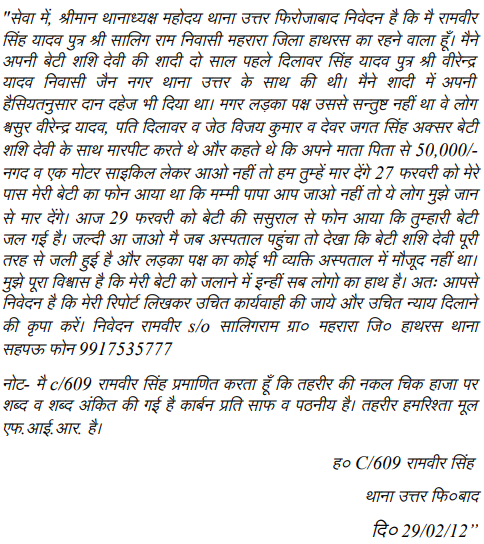
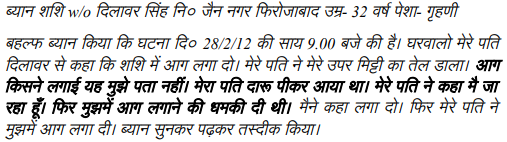
7. The investigation was carried out by the police. During the investigation, one Naib Tehsildar, who later on, appeared as PW-10, recorded the dying declaration of the victim. The operative part of the dying declaration (Ex.Ka.7) read as under:
“Certified that Smt. Shashi, aged about 25 years, w/o Dilawar Singh R/o Jaid Nagarm ACS North, Distt. Firozabad, is fully conscious and can give her Dying Declaration.
| g0 vi0 gkFk | fu0 v0 nkfguk |
| 29@2@12 | g0 vi0 |
| NT | 29/2/12 |
| Date 29/2/12 | NT |
| time 9.30 AM SNM Firozabad (U.P.) |
|
| Certified that Smt. Shashi w/o Dilawar Singh described above remained fully conscious throughout her dying declaration. | |
|
| g0 vi0 |
|
| 29/2/12 9.30AM EMO SNM Hospital FIROZABAD” |
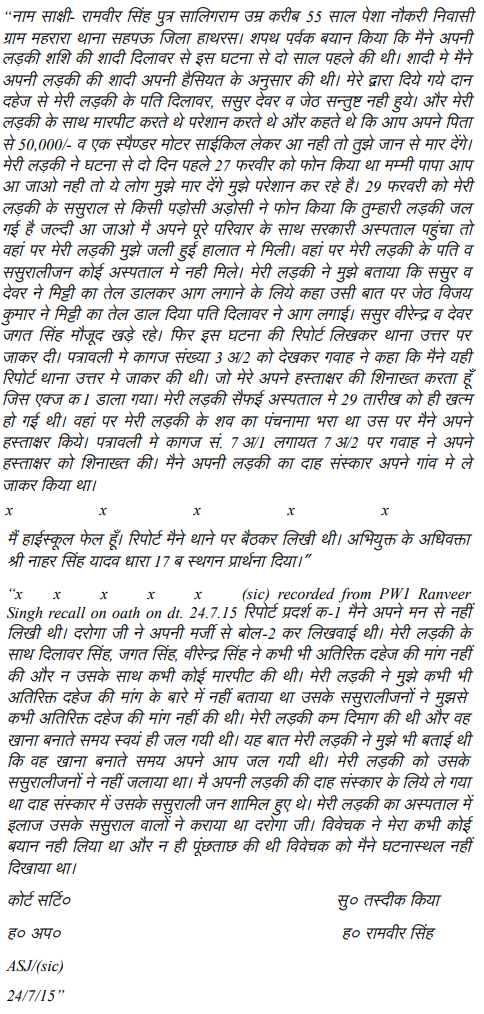
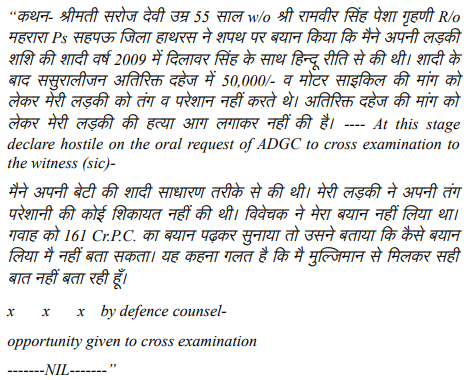
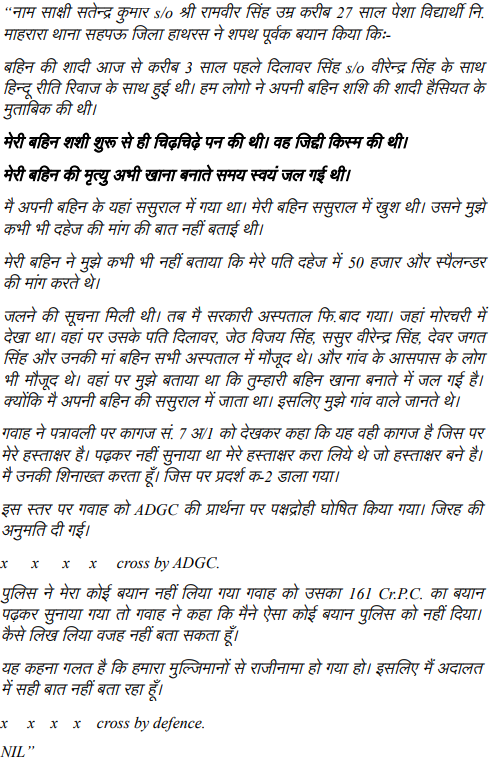
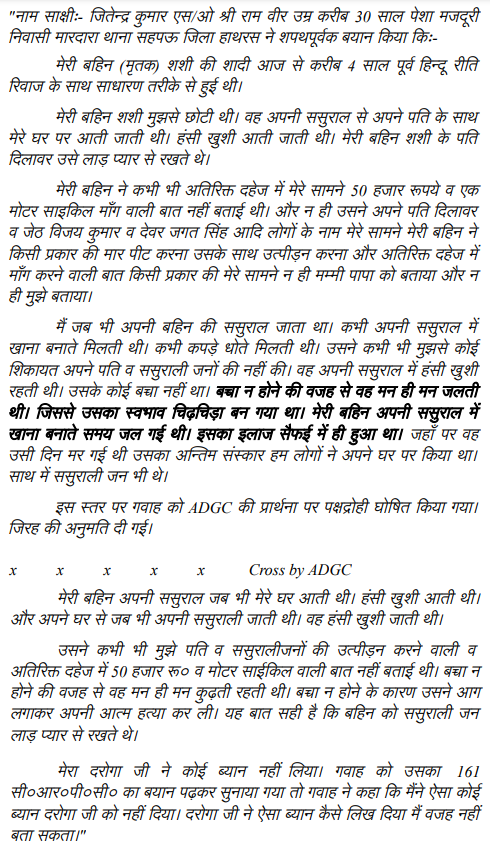
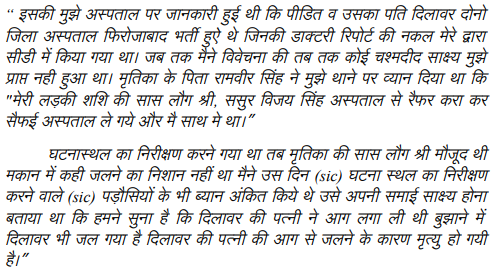
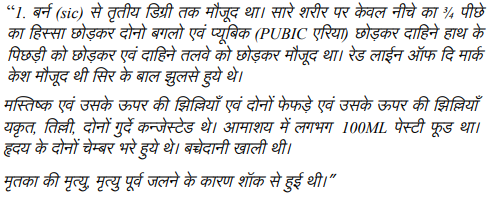
8. The police prepared a Panchayatnama in which it was decided that the post-mortem of the dead body should be conducted. Thereafter, the post-mortem of t
AI
The Dying Declaration must be credible and corroborated; in this case, it was deemed unreliable due to contradictions and lack of supporting evidence.
The court ruled that a dying declaration must be credible and recorded under proper conditions; discrepancies and lack of corroborative evidence led to the acquittal of the appellant.

The court ruled that a dying declaration must be corroborated by reliable evidence, and doubts regarding the victim's mental fitness undermine its credibility.
The court emphasized the necessity of corroborating dying declarations and established that dowry-related cruelty leading to death constitutes an offence under Section 304B IPC.

Where there are more than one statement in the nature of dying declaration, one first in point of time must be preferred. Of course, if the plurality of dying declaration could be held to be trustwor....

The evidentiary value of a dying declaration is undermined by doubts regarding the deceased's mental state and reliability during its recording, rendering conviction unsafe without corroborative evid....
Dying declarations must be coherent and trustworthy, free from influence to be valid for conviction; inconsistencies lead to benefit of doubt.

Dying declarations can only support a conviction if consistent and made in a fit mental state; inconsistencies create reasonable doubt.


witnesses of both the sides (prosecution and the defence) sail on the same boat both have to be given same treatment at par to appraise on the touchstone of credibility and truthfulness which has not....



An indispensable Tool for Legal Professionals, Endorsed by Various High Court and Judicial Officers
Please visit our Training & Support
Center or Contact Us for assistance

Scan Me!
India’s Legal research and Law Firm App, Download now!


For Daily Legal Updates, Join us on :



 Back to top


