


 Back
Back





2024 Supreme(All) 1398
IN THE HIGH COURT OF JUDICATURE AT ALLAHABAD
ARVIND SINGH SANGWAN, MOHD. AZHAR HUSAIN IDRISI, JJ.
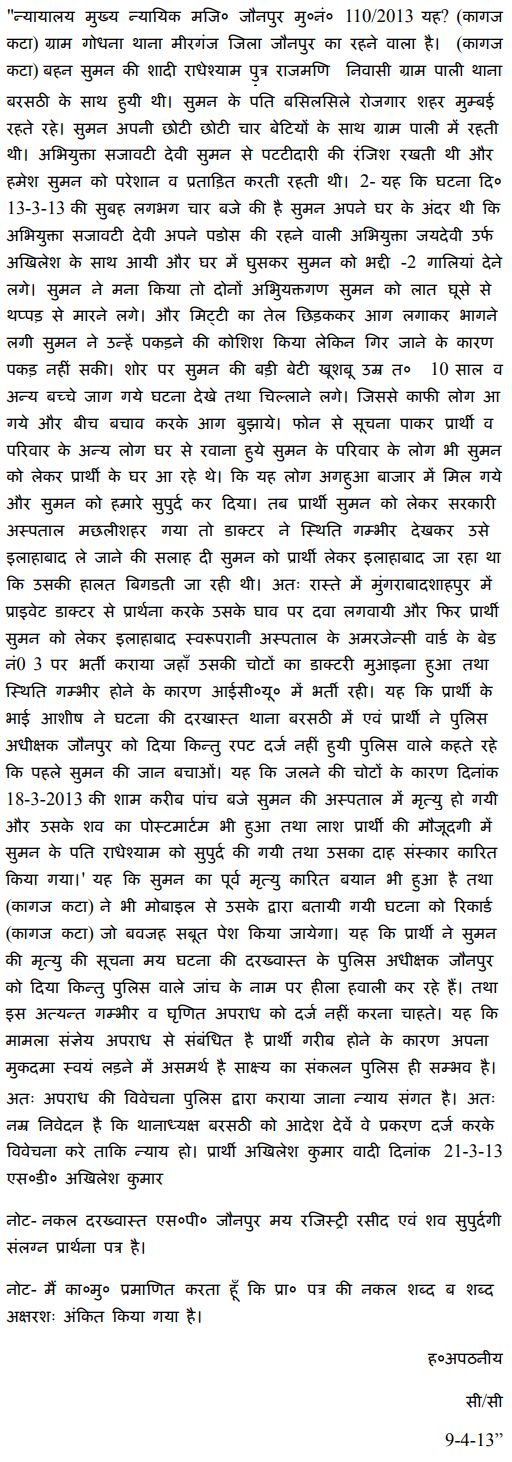
Smt. Jaydevi Saroj – Appellant
Versus
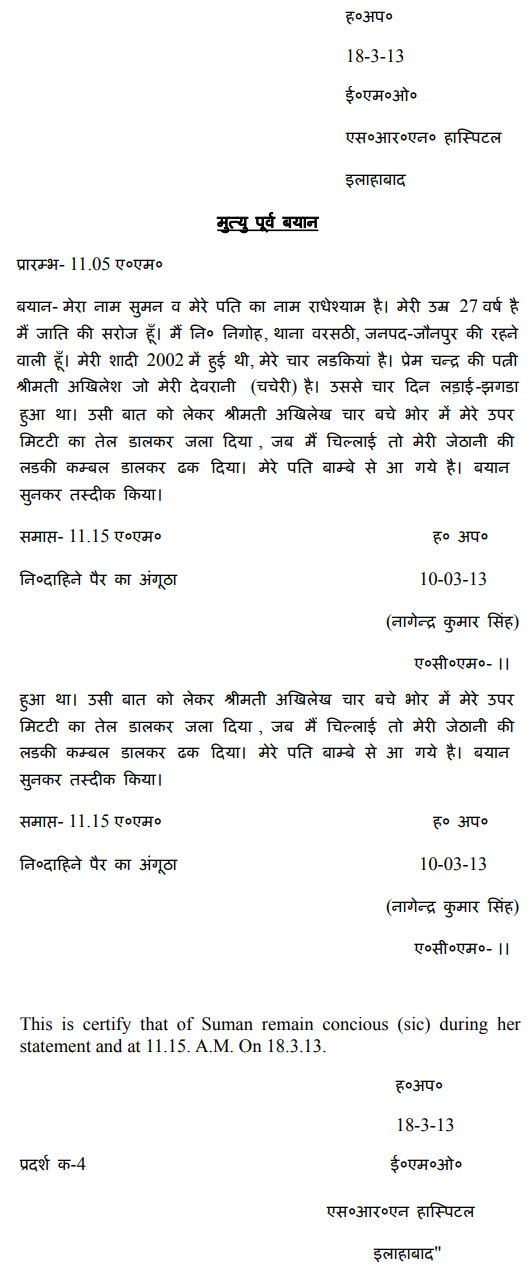
State of U.P. – Respondent
Criminal Appeal No.4739 of 2018
Decided on : 25-09-2024
Advocate Appeared:
For the Appellant : Hemant Kumar, Parmeshwar Kr. Chaudhary, Raj Kumar Yadav, Shamsher Singh, Shivbaboo, Vinod Kumar Yadav
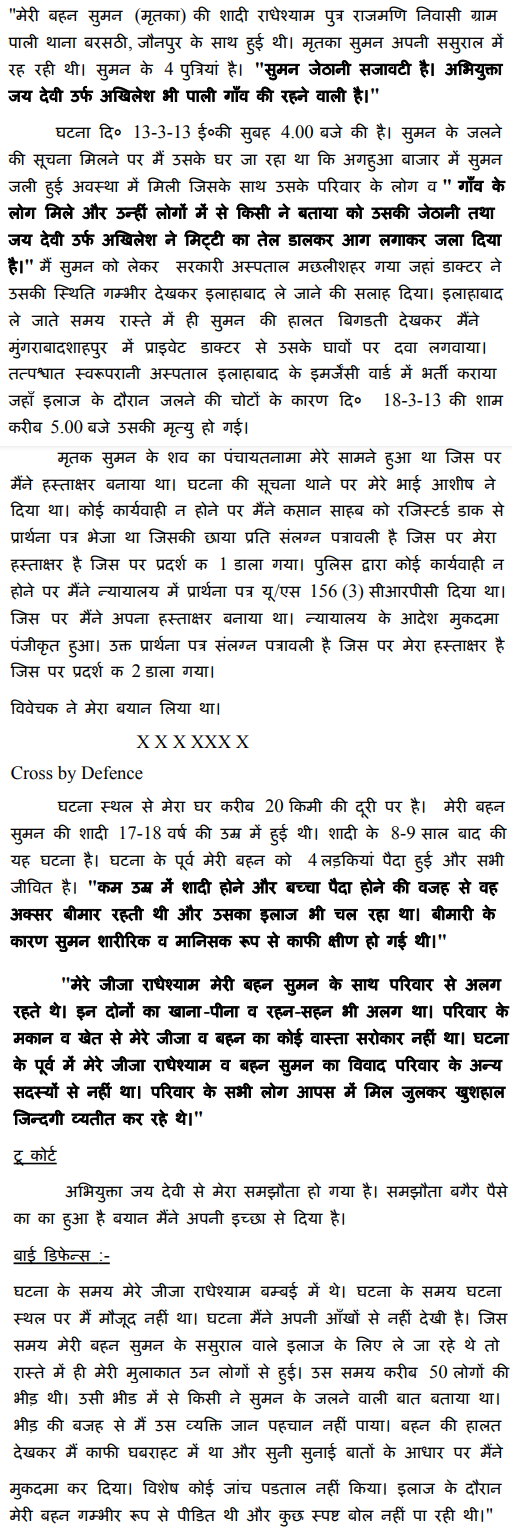
For the Respondent: G.A.
IMPORTANT POINT
The court ruled that a dying declaration must be credible and recorded under proper conditions; discrepancies and lack of corroborative evidence led to the acquittal of the appellant.
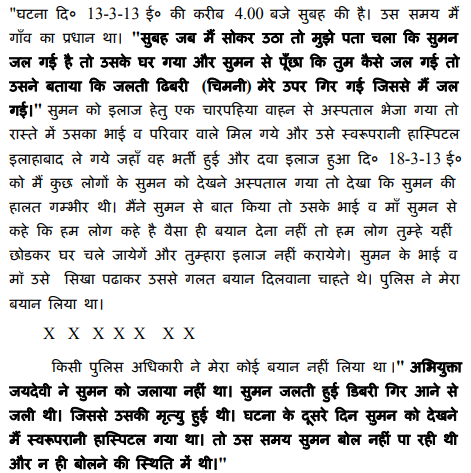
Headnote:
(A) Indian Penal Code, 1860 - Section 302 - Appeal against conviction for murder - The appellant was convicted and sentenced to life imprisonment for the murder of Suman, who died from burn injuries. The court found discrepancies in the dying declaration and lack of corroborative evidence, leading to doubts about the appellant's guilt. (Paras 1, 42, 43)
(B) Dying Declaration - Admissibility - The court emphasized that a dying declaration must inspire confidence and be recorded under proper conditions, which was not established in this case. (Paras 43(a), 43(b), 43(c))
(C) Delay in FIR - The court noted significant delays in the registration of the FIR and the lack of immediate action by the police, raising doubts about the prosecution's case. (Paras 9, 42)
(D)
Findings of Court:
The trial court's reliance on the dying declaration was deemed misplaced due to inconsistencies and lack of supporting evidence. (Paras 43, 44) (E)
Result: The appeal was allowed, and the appellant was acquitted of all charges. (Paras 45, 46)
JUDGMENT :
(Per Hon'ble Arvind Singh Sangwan,J.)
1. The present appeal has been filed challenging the judgment of conviction and order of sentence dated 01.08.2018, passed by learned Additional & Sessions Judge, Court No.2, Jaunpur in Sessions Trial No. 254 of 2013, arising out of Case Crime No. 133 of 2013, by which the appellant was held guilty of offence under Section 302 I.P.C. and awarded her life imprisonment along with a fine of Rs. 5,000/- and in default of payment of fine to further undergo one year rigorous imprisonment.
2. The Trial Court’s record is received and paper books are ready.
3. Heard Ms. Mary Puncha Sheeba Jose, Advocate assisted by Sri Mohd. Kalim, learned counsel for the appellant as well as learned AGA for the State and perused the record.
4. With the assistance of learned counsel for the parties, the entire evidence is re-scrutinized and re-appreciated.
5. The FIR dated 9.4.2013 was registered at the instance of informant-Akhilesh Kumar and read as under:
6. After registration of the FIR, the police started the investigation and recorded the statement of the witnesses.
7. One Nagendra Kumar Singh, S.D.M. recorded the statement/dying declaration of the victim, Ex.Ka.4 which read as under:
“This is certify that of Suman, w/o Radhe Shyam is concious... (sic)...oriented to (sic) place person at 11.05. A.M. On 18.3.13.
8. The deceased died on same day i.e. 18.3.2013 at about 5:00 PM and her post-mortem was conducted at MLN Hospital, Allahabad on 19.3.2013. The cause of death was due to septicemia as a result of ante-mortem burn injuries. The post-mortem report, Ex.Ka 3 stated that on the upper part of the body i.e. above neck, there was no injury and the deceased suffered the burn injury all over the upper chest, abdomen, left and right arms. However, no percentage of the burn injury was assessed. The police also prepared the Panchayatnama, Ex.Ka.5 in which as per the opinion of the Panches, the deceased died due to burn injuries. Thereafter, the police concluded the investigation and submitted the charge-sheet only against the accused-appellant Jaydevi @ Akhilesh.
9. It is worth noticing that the incident is dated 13.3.2013 at about 4:00 AM in the matrimonial home of deceased Suman, who is sister of the informant, however, no FIR was registered instantly and as per the prosecution, a complaint was given to the Superintendent of Police, i.e. Ex.Ka.1 but no action was taken and thereafter, a complaint was given to the Ilaka Magistrate under Section 156(3) of Cr.P.C. on 21.3.2013 (which is Ex.Ka.2). This complaint was filed against two accused persons, namely, Sajawati Devi and Jaydevi @ Akhilesh. The learned Magistrate passed an order and thereafter, the chik FIR was registered on 9.4.2013.
10. The police dropped the proceedings against Sajawati Devi and submitted the charge-sheet only against the appellant. The case was committed to the court of Sessions where charges under Section 302 I.P.C. were framed against the appellant on 1.8.2014.
11. The appellant did not plead guilty and claimed trial.
12. In prosecution evidence, informant- PW-1, Akhilesh Kumar appeared and deposed as under:
13. In cross-examination, this witness admitted that during the treatment his sister was not in a position to speak as she was seriously injured.
14. PW-2- Khushboo, aged about 10 years, who is daughter of the victim appeared and stated that she has no knowledge as to who has caused the burn injuries to her mother. No cross-examination was offered to this witness.
15. PW-3- Rajendra Prasad, Village Pradhan appeared and deposed as under:
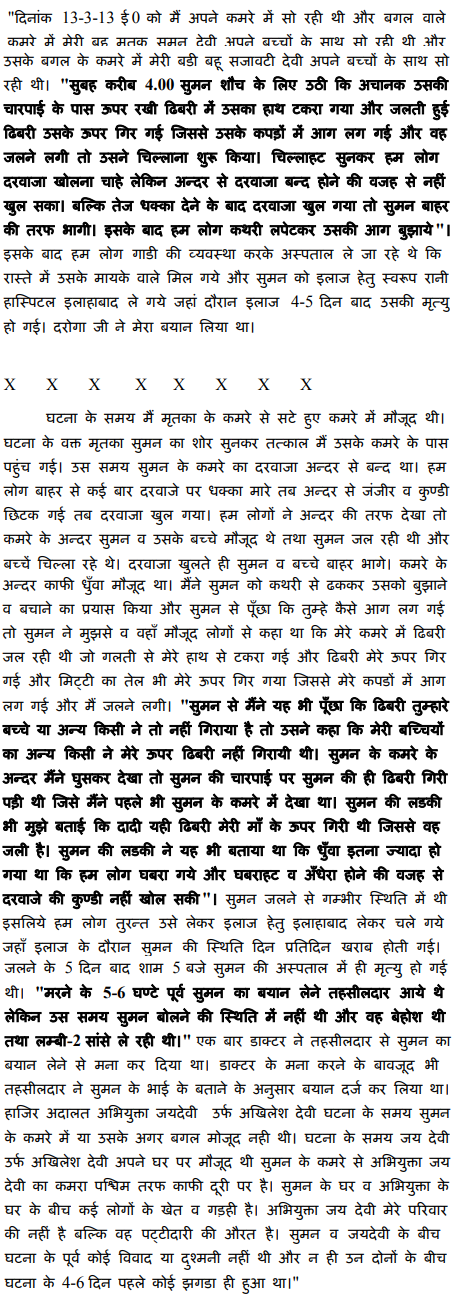
16. PW-4- Abhiraji Devi, mother-in-law of deceased Suman, stated as under:
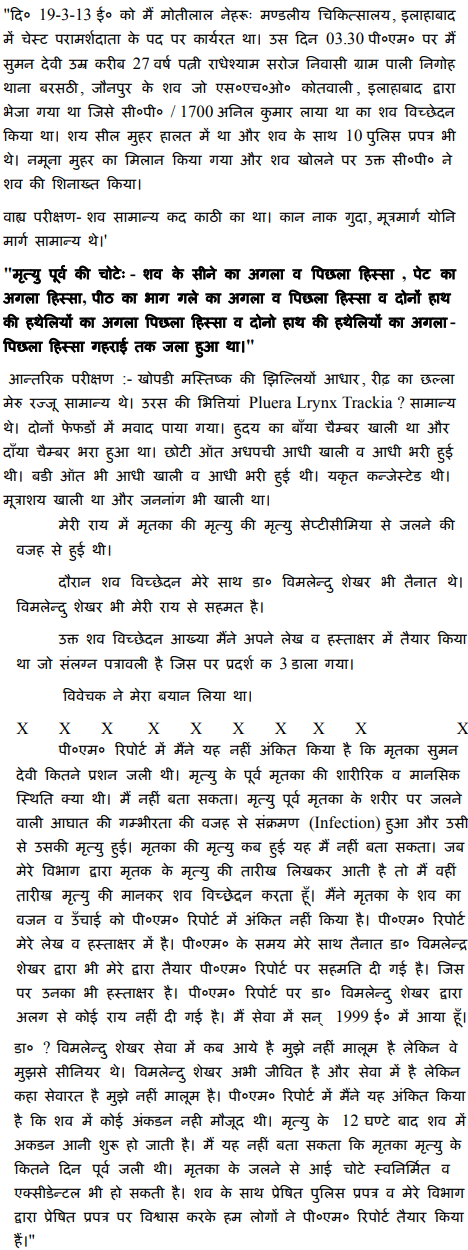
17. PW-5- Dr. Dayanand of Motilal Nehru Regional Hospital, Allahabad, who conducted the post-mortem, deposed as under:
18. PW-6- Nagendra Kumar Singh who recorded the dying declaration of the victim made following deposition as under:
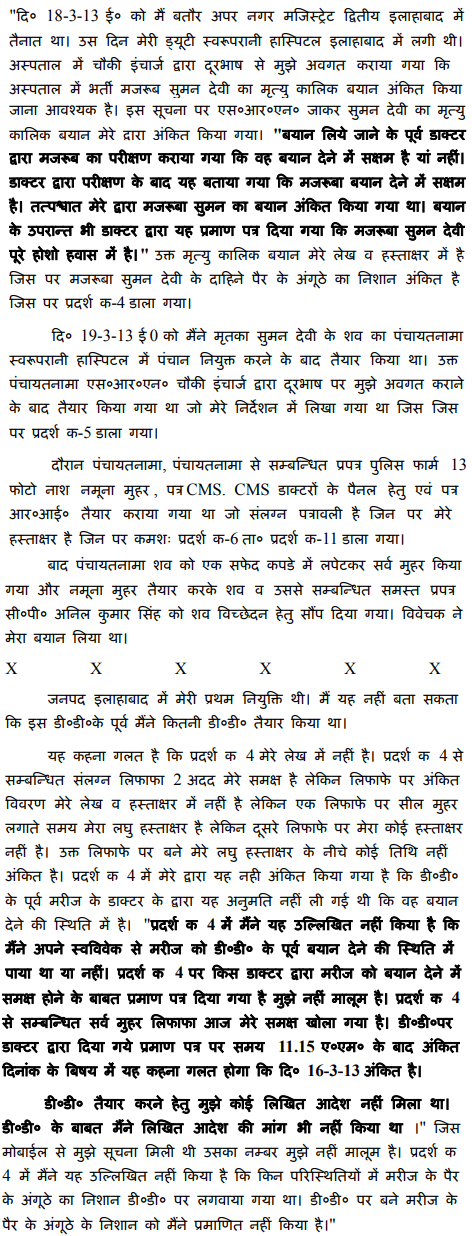
In further cross-examination, this witness stated that Panchayatnama, Ex.Ka.5 was not prepared by him.
19.












