
 Back
Back





THE HIGH COURT OF ORISSA AT CUTTACK
Sibo Sankar Mishra, J.
Pankaj Baliarsingh - Appellant
Versus
State of Orissa - Respondent
CRLA No.439 of 2005
Decided On : 26-02-2026
| Table of Content |
|---|
| 1. introduction of the appeal and court proceedings. (Para 1 , 2 , 3) |
| 2. summary of the prosecution's case and evidence. (Para 4 , 5) |
| 3. court's evaluation of evidence and conviction reasoning. (Para 6) |
| 4. defense arguments regarding witness examination and prosecution failures. (Para 7 , 8) |
| 5. analysis of evidence and implications of non-examination of key witnesses. (Para 9 , 10) |
| 6. legal principles on burden of proof and establishing reasonable doubt. (Para 11) |
| 7. conclusion and final order of acquittal. (Para 12 , 13) |
JUDGMENT :
S.S. Mishra, J.
The present Criminal Appeal, filed by the appellant under Section 374 of Cr.P.C. is directed against the judgment and order dated 19.09.2005 passed by the learned Additional Sessions Judge, Fast Track Court No.3, Bhubaneswar in S.T. Case No.9/419 of 2004/2003, whereby the appellant has been convicted for the offence under Section 324 of I.P.C. and on that count, he has been sentenced to undergo S.I. for two years.
2. The present appeal has been pending since 2005. When the matter was called for hearing, consistently none appeared for the appellant. Therefore, this Court requested Mr. Amit Prasad Bose, learned counsel, who was present in Court to assist the Court as Amicus Curiae. He has readily accepted the same and after obtaining entire record, assisted the Court very effectively. This Court records appreciation for the meaningful assistance rendered by Mr. Bose, learned counsel.
3. Heard Mr. Amit Prasad Bose, learned Amicus Curiae for the appellant and Mr. Ashok Kumar Apat, learned Additional Government Advocate for the State.
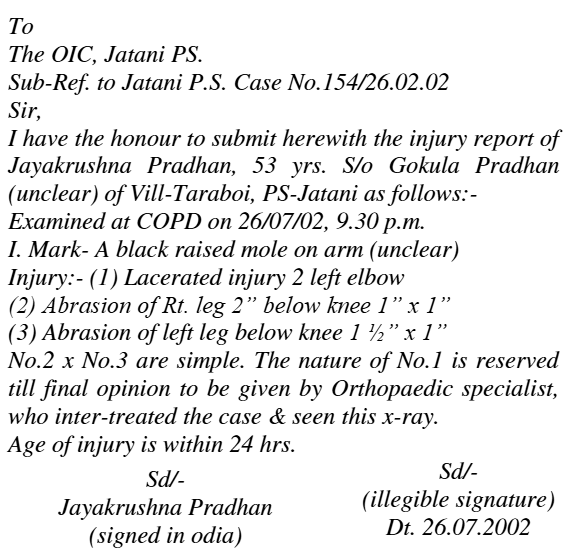
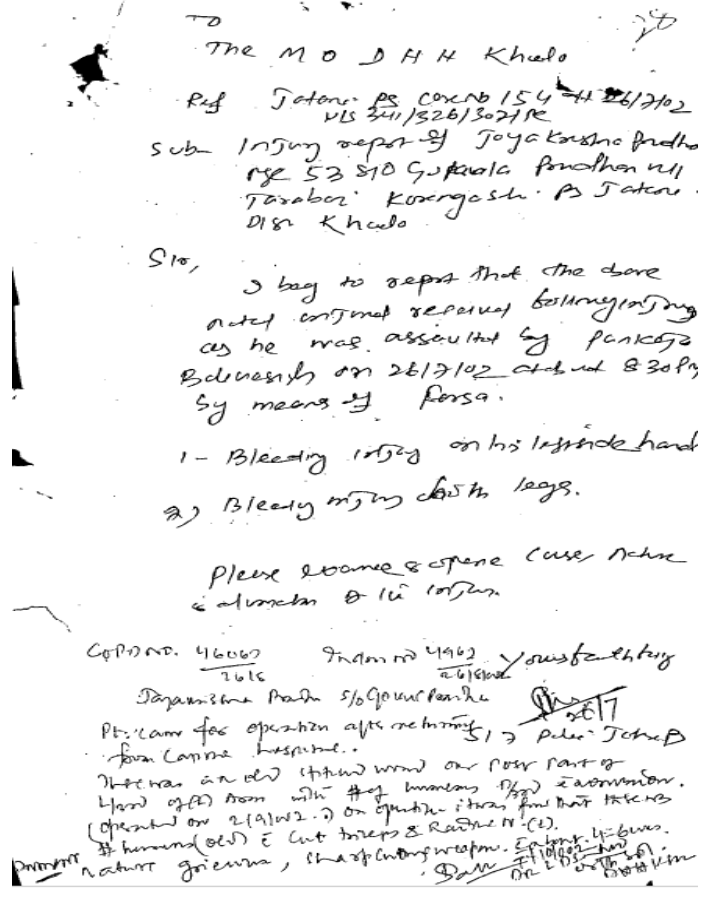
4. The prosecution case, in brief, is that the informant, Ashok Kumar Pradhan (P.W.1), lodged a report stating that on 26.07.2002 at about 8:30 P.M., upon returning to his home from the bazaar, he found that his elder father, Jayakrushna Pradhan (P.W.2), had been assaulted by the accused, Pankaj Baliarsingh, by means of a farsa. He learnt from his elder father that while he was conversing with Dhulishyam Jena near the house of Hrushikesha Samantaray (P.W.8), the accused suddenly arrived there armed with a farsa and, with the intention of taking his life, assaulted him on his left elbow and both legs, causing severe bleeding injuries. The informant further stated that, his elder father disclosed that the accused committed the assault on the allegation that Chitrasen, the son of his elder father, had misbehaved with the niece of the accused. The informant named, Dhulishyam Jena, Panchua Jena, and Santia Parida were witnesses to the occurrence. On the basis of the said report, the police registered the case, took up investigation, and upon completion thereof, submitted charge-sheet against the accused for the offences under Section 341 /324/326/307 of I.P.C. On the stance of complete denial and claim of trial, the appellant was put to trial.
5. In order to establish its case, the prosecution examined eight witnesses. Out of them, P.W.1, the informant, is the nephew (younger brother’s son) of the injured. P.W.2 is the injured. P.W.3 is the wife of the injured. P.W.4 and P.W.5, who were cited as eye witnesses, do not support the prosecution story. P.W.6 and P.W.7 were seizure witnesses, out of whom, P.W.6 admitted the seizure, whereas P.W.7 did not admit the seizure of the weapon in his presence. P.W.8, Hrusikesh Samantaray, has partly denied having any knowledge with regard to the occurrence.
6. The learned trial Court, upon evaluating the evidence available on record, particularly the testimonies of the informant (P.W.1), the injured witness (P.W.2), the wife of the injured (P.W.3), the occurrence witnesses (P.W.4, P.W.5 and P.W.8), along with other circumstantial evidence came to the conclusion that the provisions of Section 307 of the I.P.C. were not attracted in the present case, as no injury had been caused to any vital part of the body and the injuries were simple in nature. However, the Court found that the injuries sustained were sufficiently grave
AI
Non-examination of the Investigating Officer and critical medical witnesses raises doubts about the prosecution's case, necessitating acquittal due to insufficient evidence beyond a reasonable doubt.

Prosecution must provide reliable evidence, including original injury reports, to establish guilt beyond reasonable doubt; inconsistencies and lack of corroborating evidence may lead to acquittal.


The main legal point established in the judgment is that the testimony of witnesses, even if related to the deceased, should not be automatically discarded, and minor discrepancies in the evidence sh....

The prosecution must establish charges beyond reasonable doubt, and the failure to seal samples and examine the investigating officer can impact the credibility of the evidence.


The court emphasized the prosecution's burden to prove its case beyond reasonable doubt, highlighting inconsistencies and the absence of independent corroboration in witness testimonies.
The prosecution failed to prove the charges of attempted murder and grievous hurt due to lack of evidence regarding intent and the nature of injuries.



An indispensable Tool for Legal Professionals, Endorsed by Various High Court and Judicial Officers
Please visit our Training & Support
Center or Contact Us for assistance

Scan Me!
India’s Legal research and Law Firm App, Download now!


For Daily Legal Updates, Join us on :



 Back to top


