
 Back
Back





PUNJAB AND HARYANA HIGH COURT AT CHANDIGARH
MANJARI NEHRU KAUL, J.
Vinit Yadav - Appellant
Vs.
State Of Haryana - Respondent
IOIN CRM-M-41613-2023 and IOIN CRM-M-2775-2024
Decided On : 29-10-2024
Judgment :
Manjari Nehru Kaul, J.
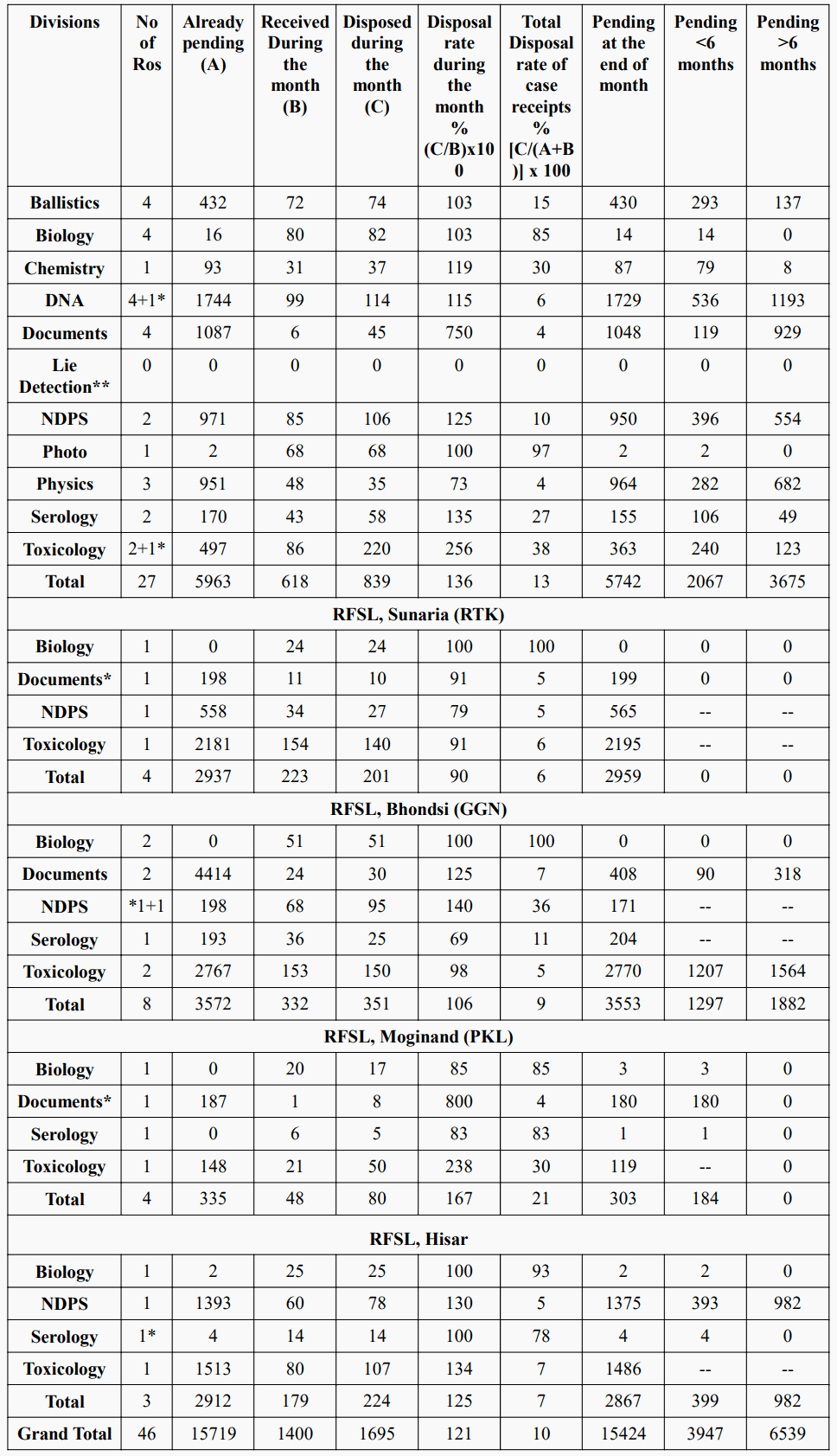
In the instant case, this Court was profoundly concerned over the significant delay in receipt of Forensic Science Laboratory (FSL) report, which consequently delayed the filing of the challan. The State of Haryana sought to justify this delay by pointing to deficiencies in infrastructure and technical resources.
2. However, this issue is not unique to the case at hand; rather, it is part of a broader, systemic problem that has repeatedly surfaced during various hearings before this Court. Notably, such delays are particularly prevalent in cases under the NDPS Act, where a prolonged timeline for filing FSL reports not only impedes the investigation but also significantly delays the completion of trials.
3. The right to a speedy trial, a fundamental safeguard enshrined under Article 21 of the Constitution of India, is one of the most significant constitutional rights available to citizens. This principle forms the bedrock of our criminal justice system, underscoring the need for prompt and efficient administration of justice. Inordinate delays in the trial infringe upon rights of under-trials and also results in hardships to victims, who must overcome substantial challenges merely to have their grievances heard in Courts. The issue at hand is, therefore, not merely procedural; it cuts to the heart of the fundamental right to speedy trial of a citizen.
4. Recognizing the gravity of these issues, this Court, vide order dated 29.02.2024, constituted Committees comprising of three IAS and three IPS Officers each for both the States of Punjab and Haryana. These Committees were entrusted with the responsibility of identifying the root administrative and technical causes underlying the delays in the preparation and despatch of FSL report. Their mandate also included recommending specific remedial measures to streamline this process and ensure the timely availability of FSL reports, which are crucial to the criminal justice system.
5. Subsequently, the Committees for Punjab and Haryana have submitted their respective reports, which this Court took on record vide order dated 15.07.2024. Upon an in-depth review of these reports, the Court has identified several critical issues hampering the prompt generation of FSL reports.
6. Common challenges highlighted in the reports of the Committees for the States of Punjab and Haryana:
(A). Infrastructural and technical shortcomings: Both States are grappling with severe infrastructural inadequacies within their Forensic Science Laboratories. In the State of Punjab, the FSL facility at Mohali is limited to two floors within a shared building, that also accommodates other departments including State Cyber Crime Offices. Regional FSLs (RFSLs) across State of Punjab face similar space constraints, and the Committee has provided comparative data on allotted spaces in other regions to underscore these disparities. For instance, the Central Forensic Science Laboratory (CFSL) in Chandigarh occupies a vast 75000 sq. ft., while the Directorate of Forensic Science (in the State of Himachal Pradesh) spans 45000 sq. ft. In stark contrast, the FSL in the State of Punjab has been allotted merely 21000 sq. ft., drastically limiting its capacity to establish new divisions to meet evolving forensic needs. In the State of Haryana, the spatial deficiency in various divisions of FSL is so severe that the DNA division is unable to accept fresh cases involving unidentified deceased persons, a situation that requires immediate remedial action from the State concerned. However, instead of addressing these pressing issues, the State has taken a piecemeal approach, continually deferring substantive action. Additionally, outdated equipment and frequent machinery breakdowns significantly delay the preparation of FSL reports. In Punjab, for instance, cases pending in the Biology and Serology Division have gone unexamined since February, 2024, due to the unavailability of a Human Blood Detection Kit.


The court ruled that the absence of ballistic evidence linking the firearm to the crime necessitates the granting of bail, emphasizing the critical role of timely forensic reporting in criminal justi....

The right to a speedy and fair trial is integral to Article 21 of the Constitution of India, and the court emphasized the importance of timely dispensation of justice.


The importance of timely examination of evidence by the Forensic Lab in criminal cases.

The main legal point established is that the right to speedy trial is a fundamental right of the accused, encompassing all stages of the legal process, and any inordinate delay in the legal proceedin....

Right to speedy trial flows from Article 21 of Constitution of India. Court can neither be a mute spectator to whims and fancies of investigating agency nor be a party to it.



An indispensable Tool for Legal Professionals, Endorsed by Various High Court and Judicial Officers
Please visit our Training & Support
Center or Contact Us for assistance

Scan Me!
India’s Legal research and Law Firm App, Download now!


For Daily Legal Updates, Join us on :



 Back to top


