
 Back
Back





IN THE HIGH COURT OF PUNJAB AND HARYANA AT CHANDIGARH
ALKA SARIN, J.
Oriental Insurance Company Limited – Appellant
Versus
Maya Devi and Others – Respondents
FAO No. 2661 of 2023
Decided On : 02-12-2025
| Table of Content |
|---|
| 1. factual background of the accident case. (Para 1 , 2) |
| 2. competing arguments regarding eyewitness and compensation. (Para 4 , 5) |
| 3. court's reasoning on evidentiary standards. (Para 6 , 7) |
| 4. assessment of income and applicable multiplier. (Para 8) |
| 5. dismissal of appeal. (Para 9 , 10) |
JUDGMENT :
ALKA SARIN, J.
1. The present appeal has been filed by the appellant-Insurance Company challenging the impugned award dated 04.01.2023 passed by the Motor Accident Claims Tribunal, Gurugram (hereinafter referred to as ‘Tribunal’) in a motor vehicle accident which occurred on 14.04.2020.
2. Since the factum of the accident is not in dispute, the facts are not being adverted to for the sake of brevity.
3. The Tribunal in the present case had awarded the following compensation :
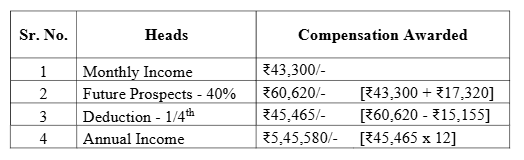
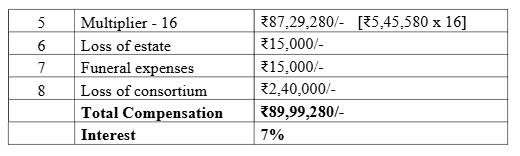
4. Learned counsel for the appellant-Insurance Company would contend that in the present case the claimants have not examined any eyewitness to prove the accident and hence the finding of the Tribunal on issue No.1 is erroneous. Learned counsel would further contend that the compensation awarded by the Tribunal is highly excessive inasmuch the accident had taken place in the year 2020 and the Tribunal has wrongly taken income of the deceased as per the ITR for the assessment year 2019-2020. Learned counsel would further contend that the age of the deceased was more than 35 years at the time of the accident and a multiplier of ‘15’ ought to have been applied instead of ‘16’.
5. Per contra learned counsel for the claimants would contend that the Tribunal has rightly assessed the compensation vide the impugned award and there is no scope of any interference therein.
6. I have heard the learned counsel for the parties.
7. The argument of the learned counsel for the appellant-Insurance Company that the claimants have not examined any eye witness to prove the accident and that the finding of the Tribunal on issue No.1 is erroneous, deserves to be rejected inasmuch as in the present case the accident admittedly had taken place on 14.04.2020 and FIR No.218 dated 14.04.2020 under Sections 279 and 304-A of the Indian Penal Code, 1860 was also registered on the same day against the driver of the offending vehicle (respondent No.7 herein), who also faced trial before the Illaqa Magistrate. Further, it is not necessary that there would be an eyewitness in such type of motor vehicle accident cases and merely due to non-examination of an eyewitness the impugned award passed by the Tribunal can be faulted. Hon’ble Supreme Court in the case of Anita Sharma & Ors. vs. The New India Assurance Co. Ltd. & Anr. 2021 (1) RCR (Civil) 200 has held as under :
“22. Equally, we are concerned over the failure of the High Court to be cognizant of the fact that strict principles of evidence and standards of proof like in a criminal trial are inapplicable in MACT claim cases. The standard of proof in such like matters is one of preponderance of probabilities, rather than beyond reasonable doubt. One needs to be mindful that the approach and role of Courts while examining evidence in accident claim cases ought not to be to find fault with non-examination of some best eyewitnesses, as may happen in a criminal trial; but, instead should be only to analyze the material placed on record by the parties to ascertain whether the claimant's version is more likely than not true. A somewhat similar situation arose in Dulcina Fernandes v. Joaquim Xavier Cruz, (2013) 10 SCC 646. wherein this Court reiterated that:
"7. It would hardly need a mention that the plea of negligence on the part of the first respondent who was driving the pickup van as set up by the claimants was required to be decided by the learned Tribunal on the touchstone of preponderance of probabilities and certainly not on the basis of proof beyond reasonable doubt. [Bimla Devi v. Himachal RTC, (2009) 13 SCC 530 : (2009) 5 SCC (Civ) 189 : (2010) 1 SCC (Cri) 1101]" (Emphasis supplied)
23. The observation of the High Court that the author
AI
The court affirmed that in motor accident claims, the standard of proof is based on preponderance of probabilities, not requiring eyewitness testimony for liability determination.

The main legal point established in the judgment is that the deceased's actual income and age should be considered for applying the multiplier in motor accident compensation cases, as per the Supreme....

The main legal point established in the judgment is the determination of just compensation under the Motor Vehicles Act, considering the deceased's income, future prospects, and personal expenses.

The court determined that Income-Tax Returns are essential for assessing compensation in motor accident claims and must not be overlooked; failure to do so vitiates the compensation determination.


Compensation in motor accident cases should be assessed based on actual income and future prospects, not solely on minimum wage standards.

The judgment emphasizes the summary nature of proceedings and the applicability of Section 169 of the Motor Vehicle Act in accepting income-tax returns as appropriate evidence for assessment of incom....

Age of deceased should be basis for applying multiplier.



An indispensable Tool for Legal Professionals, Endorsed by Various High Court and Judicial Officers
Please visit our Training & Support
Center or Contact Us for assistance

Scan Me!
India’s Legal research and Law Firm App, Download now!


For Daily Legal Updates, Join us on :



 Back to top


