Back
Back





2025 Supreme(P&H) 1633
IN THE HIGH COURT OF PUNJAB AND HARYANA AT CHANDIGARH
Pankaj Jain, J.
Om Parkash And Ors. – Petitioners
Versus
Dharam Pal And Anr. – Respondents
RSA No. 2153 of 1999 (O&M)
Decided On : 24-09-2025
For the Petitioner:Mr. Vijay Kumar Jindal, Sr. Advocate, With Mr. Abishek Shukla Advocate, Mr. Vijay Veer Singh, Advocate
For the Respondent:Mr. Keshav Pratap Singh Advocate
A claimant of tenancy must prove a contractual obligation to pay rent; mere possession does not confer tenancy rights.
Headnote:(A) Punjab Pre-emption Act, 1913 - Right of pre-emption - Tenancy - The plaintiffs claimed pre-emption rights based on their status as tenants over the suit land. Defendants denied their tenancy, asserting that they failed to prove payment of rent - The Lower Appellate Court held that once a tenant, always a tenant. Findings reversed by High Court, ruling plaintiffs did not establish tenancy under relevant statutes. (Paras 6, 19, 21)
(B) Presumptive Rights - Punjab Land Revenue Act, 1887, Section 44 - Entries in records-of-rights are presumed to be true until proven otherwise, but mere possession under a jamabandi does not establish the relationship of tenant and landlord without proof of rent payment. (Paras 16, 18)
Facts of the case:
Plaintiffs claimed tenancy based on historical records and sought pre-emption of land sold by owners to the appellants. Suit contested on grounds of lack of proof of their tenancy status and necessary parties not included. (Paras 2, 3)
Findings of Court:
The court found plaintiffs failed to prove their claim as tenants, emphasizing the necessity of establishing a contractual relationship involving rent payment. (Paras 19, 21)
Issues: Whether the plaintiffs could be recognized as tenants solely based on historical jamabandi entries and whether they proved their pre-emption claim through adequate evidence. (Paras 15, 20)
Ratio Decidendi: The court reaffirmed the requirement of proving a contractual relationship for tenancy and that mere possession or historical entries do not suffice; without proof of payment of rent, plaintiffs lack standing to pre-empt. (Paras 21)
Result: Appeal allowed; judgment and decree of the Lower Appellate Court set aside.
| Table of Content |
|---|
| 1. plaintiffs' claim of superior tenancy rights. (Para 1 , 2) |
| 2. arguments contesting plaintiffs' tenancy evidence. (Para 3) |
| 3. defense supporting plaintiffs' claim of tenancy. (Para 4) |
| 4. review of case records and claims. (Para 5 , 6) |
| 5. definitions and legal standards for tenancy. (Para 7 , 8 , 9) |
| 6. examination of revenue records for claims. (Para 10 , 12 , 14) |
| 7. legal standings on possession and tenant definitions. (Para 11 , 13 , 15) |
| 8. implications of vendor testimony on tenancy. (Para 18 , 19 , 20) |
| 9. conclusion on plaintiffs' entitlement to pre-emption. (Para 21 , 22 , 23) |
Pankaj Jain, J.
Defendants No.1 to 3 are in appeal aggrieved of judgment and decree passed by Lower Appellate Court, whereby the suit filed by plaintiffs for possession by way of pre-emption has been allowed by the Lower Appellate Court by reversing the judgment and decree passed by Court of the First Instance. For convenience, the parties are being referred to by their original position in the suit before the Court of First Instance, i.e. the appellants as defendants and the respondents as plaintiffs.
2. Plaintiffs filed suit for possession by way of pre-emption asserting his superior right qua the suit land as tenant to pre-empt Sale Deed dated 08.07.1991, executed by defendants No.4 to 9, in favour of defendants No.1 to 3-the appellants. As per the plaintiffs, the land was previously under tenancy with their father namely Sish Ram, who was a tenant gair marusi. He was cultivating the suit land. After the death of Sish Ram, plaintiffs claimed to have become tenants gair marusi and in possession of the same. Defendants No.4 to 9 — the owners, sold the land for a consideration of Rs.35,000/- in favour of defendants No.1 to 3. Defendants No.1 to 3 are strangers to the suit land. Plaintiffs being tenants have a superior right to pre-empt the sale deed in question.
2.1. Suit was contested by defendants No.1 to 3. Sale in their favour was admitted. Defendants No.1 to 3 — the appellants denied that plaintiffs are tenants gair marusi on the suit land as claimed. Defendants No.1 to 3 claimed that suit was filed by plaintiffs in collusion with vendors.
2.2. Suit filed by plaintiffs was put to trial by the Court of first instance, framing following issues:
1. Whether the plaintiffs have superior right to present the land in dispute? OPP
2. Whether the land, in dispute, was actually sold for a consideration of Rs.50,000/- and the sale price was actually paid to the vendor and was fixed in good faith? OPD
3. If issue No.2 is not proved, what was the market value of the land, in dispute, at the time of sale? OP Parties
4. Whether the suit is not maintainable in the present form? OPD
5. Whether the vendee-defendant incurred an amount of Rs.10,000/- to improve the land in dispute, if so what effect? OPP
6. Whether the stamp and registration charges were incurred by the vendee-defendants? OPD
7. Relief.
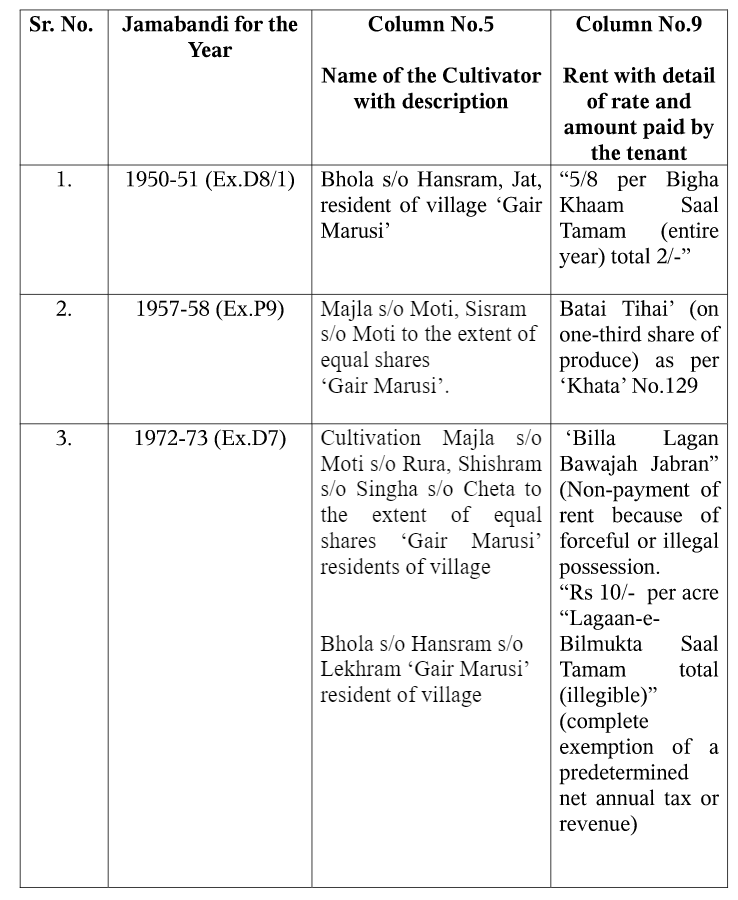
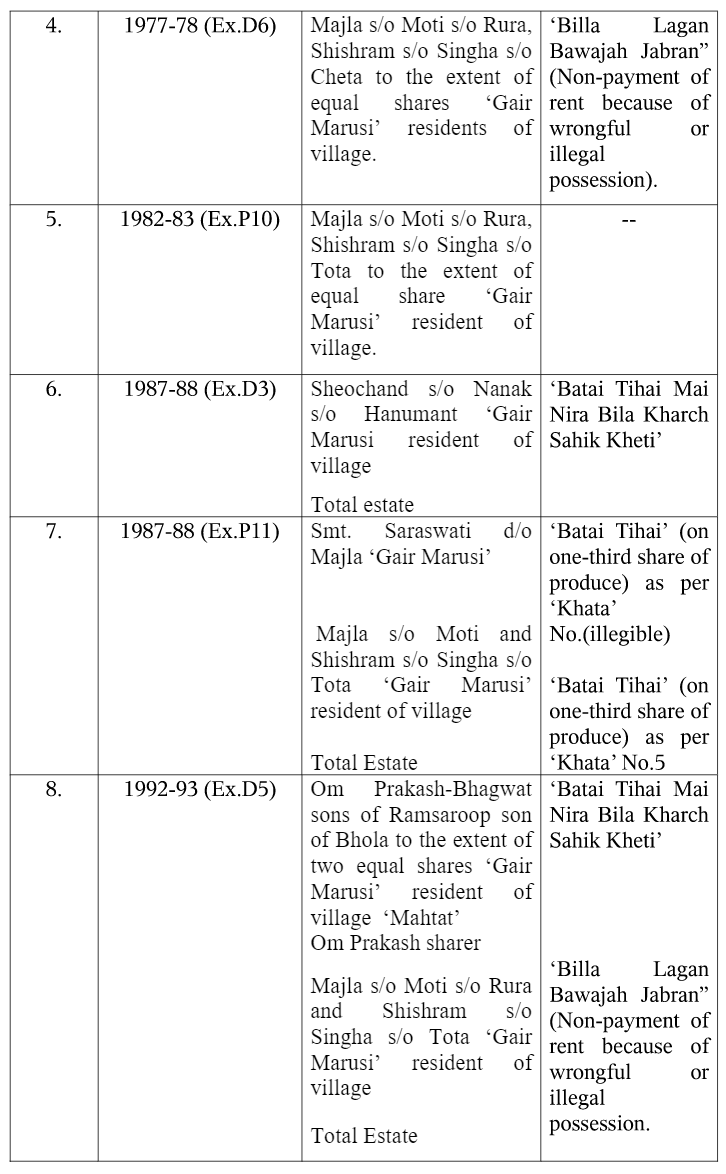
2.3. Plaintiffs in order to prove their tenancy relied upon Jamabandi for the year 1957-58 — Ex.P9, Jamabandi for the year 1982-83 - Ex.P10 and Jamabandi for the year 1987-88-Ex.P11.
2.4. Defendants relied upon Jamabandi for the year 1950-51 — Ex.D8, Jamabandi for the year 1972-73 — Ex.D7, Jamabandi for the year 1977-78-Ex.D6, Jamabandi for the year 1987-88 — Ex.D3 and Jamabandi for the year 1992-93 — Ex.D5, to dislodge the claim of plaintiffs of being tenants over the suit property.
2.5. While answering issue No.1, the Court of the First Instance found that though plaintiffs are proved to be in possession of the suit land, but they failed to prove their status as tenants. There being no other document apart from jamabandi for the year 1957-1958 to prove the relationship between vendors and the plaintiffs, the plaintiffs are not entitled for decree of possession by way of pre-emption.
2.6. Unsuccessful plaintiffs preferred appeal. The Lower Appellate Court reversed the findings recorded by the Court of the First Instance holding that ‘once a tenant always remains