
 Back


2025 Supreme(P&H) 1670
IN THE HIGH COURT OF PUNJAB AND HARYANA AT CHANDIGARH
PANKAJ JAIN, J.
Malak Singh - Appellant
Versus
Balwinder Singh And Ors. - Respondents
RSA-2832-2014 (O&M)
Decided On : 18-08-2025
Important Points
Subject
Property Law - Hindu Succession
Act Referred
Headnote
(B) Will - Legal validity - Shingara Singh, having inherited property from Wadhawa Singh, was found entitled to execute a will for that property. (Para 8)
(C) Succession - Distinction between intestacy and survivorship - A detailed examination of the interpretations of Sections 4, 6, 8, and 19 clarifies that after distribution as per intestacy, the nature of property changes to tenants in common. (Para 7)
Facts of the case:
The dispute arose over property claims related to the estate of Wadhawa Singh, who died issueless. The appellant claimed ownership based on a will from Shingara Singh, while the lower courts ruled against the validity of the will.
Findings of Court:
The findings that the property retained its ancestral character were overturned; thus, Shingara Singh had the right to dispose of property via will.
Issues: The main issues revolved around the intra-family dispute concerning the validity of a will executed by an heir of a property that was inherited versus one acquired through testamentary means.
Ratio Decidendi: The court articulated that inherited property does not carry ancestral character, allowing for testamentary disposition.
Result: The appeal is allowed.
For the Appellant :Mr. Piyush Aggarwal, Advocate
For the Respondent:Mr. Hitesh Malik, Advocate
| Table of Content |
|---|
| 1. ownership and inheritance of property under hindu law. (Para 2 , 3 , 4 , 5 , 6) |
| 2. provisions of hindu succession act on property inheritance. (Para 7) |
| 3. court decision to set aside previous findings. (Para 8) |
| 4. conclusion on pending applications. (Para 9) |
JUDGMENT :
PANKAJ JAIN, J.
Defendant No.1 is in second appeal.
2. For convenience and to avoid confusion, the parties hereinafter are referred to by their original position before the Trial Court i.e. the appellant as ‘defendant No.1; respondent No.1 as ‘plaintiff’ and respondents No.2 to 8 as ‘defendants No.2 to 8’.
3. Plaintiff filed suit seeking decree of declaration to the effect that he is owner in possession of land in dispute as described in the plaint. Judgment and decree dated 27.07.1989 and the consequential mutation are illegal, null and void.
4. In order to appreciate the controversy between the parties, it will be apt to peruse pedigree table which reads as under:
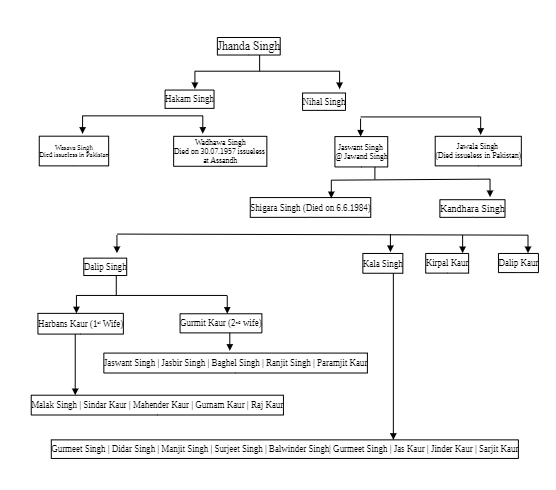
5. The parties are at loggerheads w.r.t. estate left by Wadhawa Singh, who died on 30.07.1957 issueless. The estate of Wadhawa Singh was succeeded by Shingara Singh and Kandhara Singh. In the earlier suit, Malak Singh propounded Will claimed to have been executed by Shingara Singh, dated 11.04.1984. The suit was decreed. In the present suit, the courts below held that Shingara Singh having inherited property from Wadhawa Singh, he was not entitled to execute WILL.
6. Admittedly, Wadhawa Singh died after Hindu Succession Act, 1956 came into operation. He died issueless. Thus, Shingara Singh and Kandhara Singh inherited his estate under Section 8 by succession and not by survivorship. In view thereof, the findings recorded by the Courts below holding that Shingara Singh could not have bequeathed the property inherited from Wadhawa Singh by way of WILL, cannot be sustained.
7. Trite it is that once a property is acquired by way of succession, the same loses its ancestral character. Reliance can be placed upon law laid down by the Apex Court in the case of Commissioner of Wealth Tax, Kanpur etc. vs. Chander Sen Etc. 1986 (3) SCC 567 . The same was further relied upon by Supreme Court in the case of Uttam Vs. Saubhag Singh & ors. 2016 4 SCC 68 holding as under :
“20. Some other judgments were cited before us for the proposition that joint family property continues as such even with a sole surviving coparcener, and if a son is born to such coparcener thereafter, the joint family property continues as such, there being no hiatus merely by virtue of the fact there is a sole surviving coparcener. Dharma Shamrao Agalawe v. Pandurang Miragu Agalawe (1988) 2 SCC 126, Sheela Devi v. Lal Chand, 2006(4) RCR (Civil) 912 : (2006) 8 SCC 581, and Rohit Chauhan v. Surinder Singh 2013(4) RCR (Civil) 40 : 2013(4) Recent Apex Judgments (RAJ) 532 : (2013) 9 SCC 419, were cited for this purpose. None of these judgments would take the appellant any further in view of the fact that in none of them is there any consideration of the effect of Sections 4 , 8 and 19 of the Hindu Succession Act. The law, therefore, insofar as it applies to joint family property governed by the Mitakshara School, prior to the amendment of 2005, could therefore be summarized as follows:-
(i) When a male Hindu dies after the commencement of the Hindu Succession Act, 1956, having at the time of his death an interest in Mitakshara coparcenary property, his interest in the property will devolve by survivorship upon the surviving members of the coparcenary (vide Section 6).
(ii) To proposition (i), an exception is contained in Section 30 Explanation of the Act, making it clear that notwithstanding anything contained in the Act, the interest of a male Hindu in Mitakshara coparcenary property is property that can be disposed of by him by will or other testamentary disposition.
(iii) A second exception engrafted on proposition (i) is contained in the proviso to Section 6, which states that if such a male Hindu had died leaving behind a female relati







