
 Back
Back





IN THE HIGH COURT OF PUNJAB AND HARYANA AT CHANDIGARH
Anoop Chitkara, J.
Karandeep Singh - Petitioner
Versus
State of Punjab - Respondent
CRM-M-45818-2025
Decided On : 24-09-2025
| Table of Content |
|---|
| 1. petitioner's incarceration context. (Para 1 , 2 , 3) |
| 2. grounds for seeking bail. (Para 4 , 5 , 6) |
| 3. opposition to bail by the state. (Para 7 , 10) |
| 4. philosophy and factors in bail consideration. (Para 11 , 13 , 18) |
| 5. interpretation of ndps act concerning bail. (Para 15 , 16 , 17) |
| 6. conditions for bail and surety. (Para 19 , 20 , 21) |
| 7. restrictions and conditions imposed for bail. (Para 22 , 23 , 24) |
| 8. consequences of bail and conditions for future offenses. (Para 25 , 26 , 27 , 28) |
| 9. nature and limits of the bail order. (Para 29 , 30 , 31) |
| 10. final conclusion of the petition. (Para 32) |
JUDGMENT :
ANOOP CHITKARA, J.
| FIR No. | Dated | Police Station | Sections |
|---|---|---|---|
| 112 | 11.06.2025 | Chheharta | 21(b), 27(a), 29/61/85 of Amritsar NDPS Act |
1. The petitioner incarcerated in the FIR captioned above had come up before this Court under Section 483 of Bharatiya Nagarik Suraksha Sanhita, 2023, [ BNSS ], seeking regular bail.
2. Per paragraph 9 of the bail petition, the petitioner has no criminal antecedents.
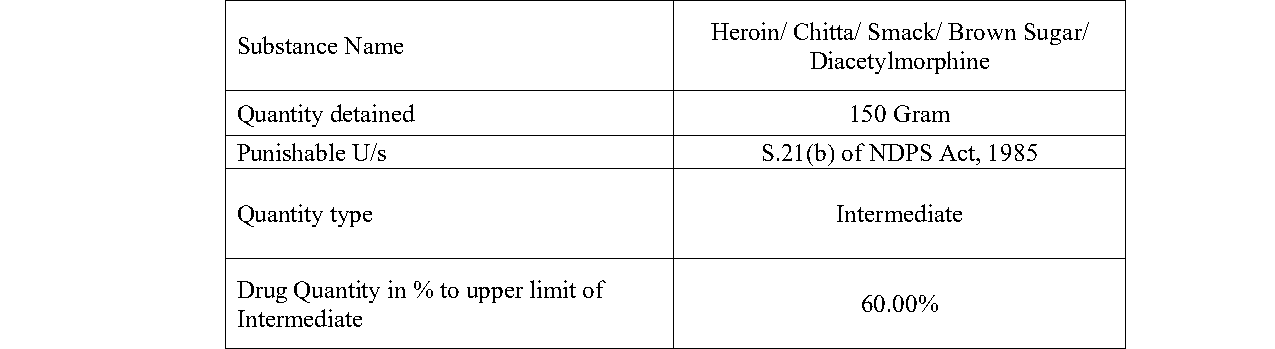
3. The facts and allegations are taken from the status report filed by the State. On 11- 06-2025, based on a chance recovery, the Police seized 150 grams of heroin from the petitioner’s possession. The Investigator claims to have complied with all the statutory requirements of the NDPS Act, 1985, and the BNSS , 2023.
4. The petitioner's counsel seeks bail on the grounds of prolonged pretrial custody.
5. The petitioner's counsel prays for bail by imposing any stringent conditions and contends that further pre-trial incarceration would cause an irreversible injustice to the petitioner and their family.
6. The petitioner’s counsel submits that the petitioner would have no objection whatsoever to any stringent conditions that this Court may impose, including that if the petitioner repeats the offense or commits any non-bailable offense which provides for a sentence of imprisonment for more than seven years, or commits any offence under the NDPS Act, where the quantity involved is more than half of the intermediate, or commercial quantity, or violates S. 19, or 24, or 27-A of the NDPS Act, the State may file an application to revoke this bail before the concerned Court having jurisdiction over this FIR, which shall have the authority to cancel this bail, and may do so at their discretion, to which the petitioner shall have no objection.
7. The State’s counsel opposes bail and refers to the status report.
8. As per paragraph 7 of the status report, the contraband is 150 grams of heroin.
9. Dealing in 150 grams of heroin in contravention of the NDPS Act, 1985, constitutes an offense under the following provisions and notifications:
| Declared as punishable under NDPS Act | |
| Notification No. & date | Expert Committee Report dated 24.03.1995 & 23.08.2001 (Small and Commercial) |
| Specified as small & Commercial in S.2(viia) & 2(xxiiia) NDPS Act, 1985 | ||
| Notification No. & dated | S.O.1055(E) | 10/19/2001 |
| Sr. No | 56 | |
Common Name (Name of Narcotic Drug and Psychotropic Substance (International non-proprietary name (INN) | Heroin | |
| Other non-proprietary name | ***** | |
| Chemical Name | Diacetylmorphine | |
| Small Quantity | < 5 Gram | |
| Commercial Quantity | > 250 Gram | |
0
| Declared as punishable under NDPS Act and as per schedule defined in S.2(xi) & 2(xxiii) NDPS Act, 1985 | ||
| Notification No. & dated | S.(xvi)(d) NDPS Act, 1985 (61 of 1985), S.O. 821 (E) | 11/14/1985 |
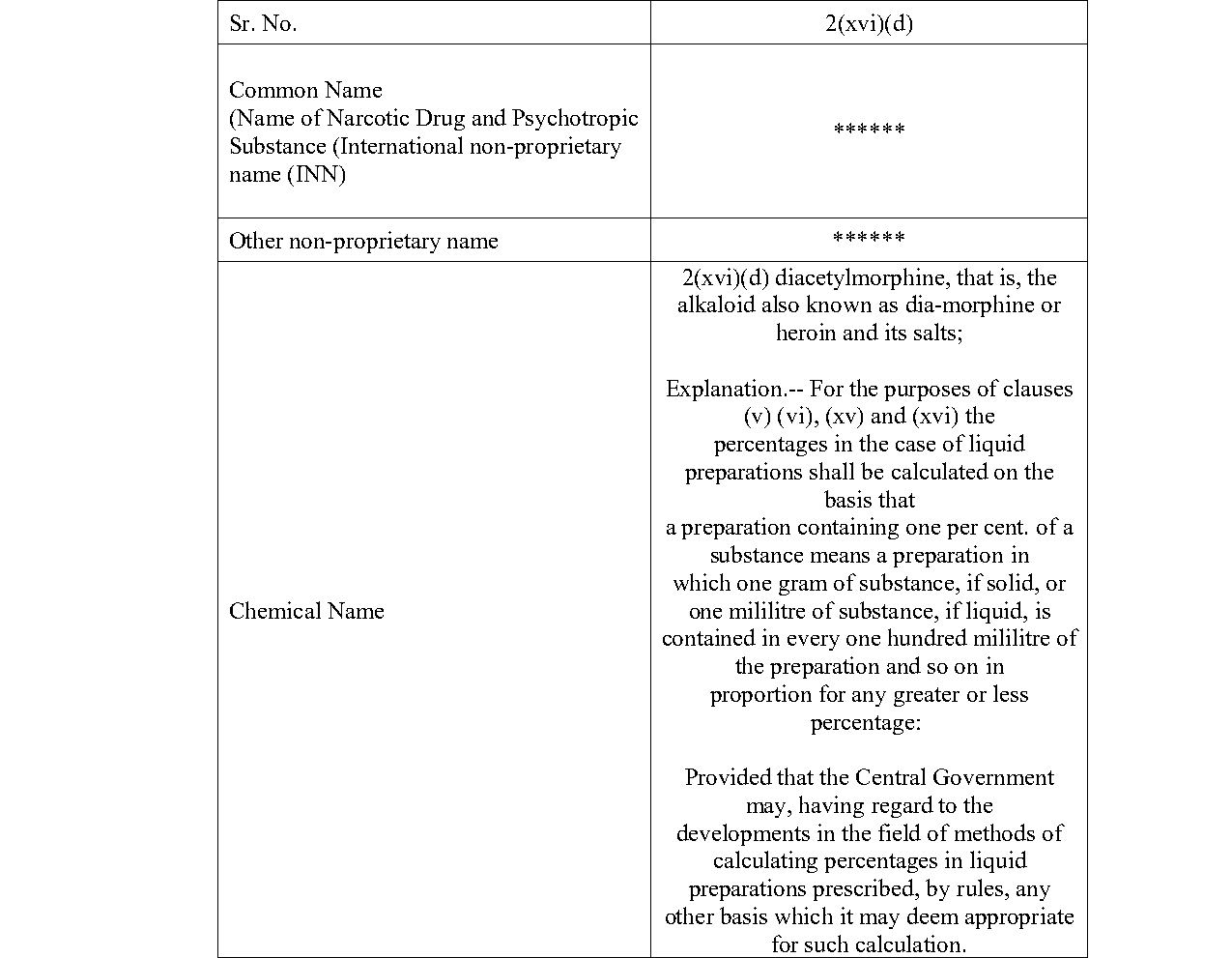
10. Given the quantity involved, rigors of Section 37 of NDPS Act would not apply in the present case.
11. Section 2 (vii-a) of the NDPS Act defines commercial quantity as the quantity greater than the quantity specified in the schedule. (xxiii-a) defines a small quantity as a quantity less than the quantity specified in the table of the NDPS Act. The remaining quantity falls in an undefined category, generally called an intermediate quantity. All sections in the NDPS Act specify an offence and mention the minimum and maximum sentence, depending upon the quantity of the substance. The commercial quantity mandates a minimum sentence of ten years of imprisonment
AI
The court determined that the non-commercial quantity of heroin possessed allows for regular bail conditions rather than the strictures of Section 37 NDPS Act.

The court held that the restrictions of Section 37 of the NDPS Act do not apply to intermediate quantities, allowing bail due to insufficient evidence linking the accused to drug money.

The main legal point established in the judgment is that the applicability of bail provisions under the NDPS Act depends on the quantity of contraband and the specific circumstances of the case, as i....
The main legal point established in the judgment is the judicious consideration of bail petitions for accused with a criminal history and the imposition of stringent conditions to prevent further cri....
The court emphasized the need for judicious consideration of bail applications involving individuals with criminal history and the importance of considering the quantity of contraband in relation to ....
The main legal point established in the judgment is that the quantity of contraband and the petitioner's criminal history must be considered in conjunction with specific circumstances to determine ba....



An indispensable Tool for Legal Professionals, Endorsed by Various High Court and Judicial Officers
Please visit our Training & Support
Center or Contact Us for assistance

Scan Me!
India’s Legal research and Law Firm App, Download now!


For Daily Legal Updates, Join us on :



 Back to top


