
 Back
Back





IN THE HIGH COURT OF PUNJAB AND HARYANA AT CHANDIGARH
ANIL KSHETARPAL, ROHIT KAPOOR, JJ.
Uggar Singh - Petitioner
Versus
State of Punjab and others - Respondents
CWP-28680 of 2018(O&M)
Decided On : 14-07-2025
| Table of Content |
|---|
| 1. statutory provisions governing stamp duty. (Para 2 , 4 , 5) |
| 2. supreme court rulings on stamp duty assessment. (Para 6 , 7) |
| 3. analysis of relevant case law impacting decision. (Para 8 , 9 , 10) |
| 4. determining applicability of past judgments. (Para 11) |
| 5. final determination on stamp duty assessment timing. (Para 12 , 13) |
JUDGMENT :
ANIL KSHETARPAL, J.
I Brief facts of the case:-
1. This matter has been placed before the Division Bench in view of divergence of views by the co-ordinate Benches of this Court. The short question which requires adjudication is “whether the valuation of the stamp duty should be assessed on the market rate prevailing at the time of the registration of the sale deed or when the parties entered into agreement to sell?”
II Analysis and Discussion:-
2. This Bench now proceeds to discuss and analyse the statutory provisions and judgments governing the subject of valuation. 3. Payment of stamp duty on sale deeds/conveyance deeds is governed by the Stamp Act, 1899 (hereinafter referred to as ‘1899 Act’, which has been amended not only by the Union of India but also by the States. Relevant bare provisions of the Act read as under:-
2(10) Conveyance.—“Conveyance” includes a conveyance on sale and every instrument by which property, whether movable or immovable, is transferred inter vivos and which is not otherwise specifically provided for by Schedule I;
2(14) “instrument” includes—
(a) every document, by which any right or liability is, or purports to be, created, transferred, limited, extended, extinguished or recorded;
(b) a document, electronic or otherwise, created for a transaction in a stock exchange or depository by which any right or liability is, or purports to be, created, transferred, limited, extended, extinguished or recorded; and
(c) any other document mentioned in Schedule I,
but does not include such instruments as may be specified by the Government, by notification in the Official Gazette;]
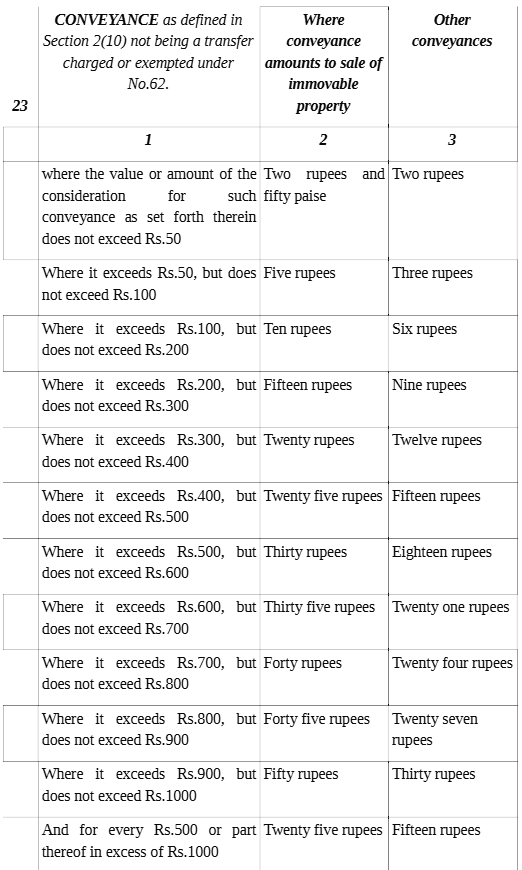
3. Instrument chargeable with duty.—Subject to the provisions of this Act and the exemptions contained in Schedule I, the following instruments shall be chargeable with duty of the amount indicated in that Schedule as the proper duty therefore, respectively, that is to say—
(a) every instrument mentioned in that Schedule which, not having been previously executed by any person, is executed in [India] on or after the first day of July, 1899;
(b) every bill of exchange [payable otherwise than on demand], [* * *] or promissory note drawn or made out of [India] on or after that day and accepted or paid, or presented for acceptance or payment, or endorsed, transferred or otherwise negotiated, in [India]; and (c) every instrument (other than a bill of exchange [* * *] or promissory note)
mentioned in that Schedule, which, not having been previously executed by any person, is executed out of [India] on or after that day, relates to any property situate, or to any matter or thing done or to be done, in [India] and is received in [India]:
Provided that no duty shall be chargeable in respect of—
(1) any instrument executed by, or on behalf of, or in favour of, the Government in cases where, but for this exemption, the Government would be liable to pay the duty chargeable in respect of such instrument;
(2) any instrument for the sale, transfer or other disposition, either absolutely or by way of mortgage or otherwise, of any ship or vessel, or any part, interest, share or property of or in any ship or vessel registered under the Merchant Shipping Act, 1894, or under Act, 19 of 1838, or the India Registration of Ships Act, 1841 (57 and 58 Vict., Sections 60, 10 of 1841), as amended by subsequent Acts.
(3) any instrument executed, by, or, on behalf of, or, in favour of, the Developer, or Unit or in connection with the carrying out of purposes of the Special Economic Zone.
xxxx xxxx xxxx
17. Instruments executed in India.—All instruments chargeable with duty and executed by any person in India shall be stamped before or at t
AI
Stamp duty is assessed based on the market rate prevailing at the time of execution of the sale deed, not at the time of agreement to sell.


Stamp duty on a Sale Deed must be based on the market value at the time of registration, not the consideration mentioned in the document.

Stamp duty payable on a conveyance will be in accordance with market value of subject property on date of conveyance unless consideration shown therein is more than prevailing market value.

Unregistered agreement for sale with possession, stamped as conveyance under amnesty, is principal instrument under Section 4; subsequent registered sale deed is other instrument attracting fixed dut....

Point of law: Once certificate under section 31 was issued by the respondents, they should not be allowed to reopen their own valuation after four years to say that valuation of the property is highe....

Stamp duty on sale deeds executed under court decrees for specific performance must reflect the original sale agreement value, not the current market value at registration.

In Court-ordered sales, stamp duty applies only to the sale consideration, not to market value, as established by the Transfer of Property Act.


Market value for stamp duty must reflect the actual rights transferred, not limited landlord interests.



An indispensable Tool for Legal Professionals, Endorsed by Various High Court and Judicial Officers
Please visit our Training & Support
Center or Contact Us for assistance

Scan Me!
India’s Legal research and Law Firm App, Download now!


For Daily Legal Updates, Join us on :



 Back to top


