Back
Back





2026 Supreme(P&H) 265
IN THE HIGH COURT OF PUNJAB AND HARYANA AT CHANDIGARH
Harkesh Manuja, J.
Ashwani Bedi – Appellant
Versus
Shamshad Ali And Ors. – Respondents
FAONo.334 of 2012(O&M) of 2012(O&M)
Decided On : 13-02-2026
For the Appellant :Mr. Ashwani Arora, Advocate
For the Respondent:Mr. Abhinav Singla, Advocate
JUDGMENT :
HARKESH MANUJA, J.
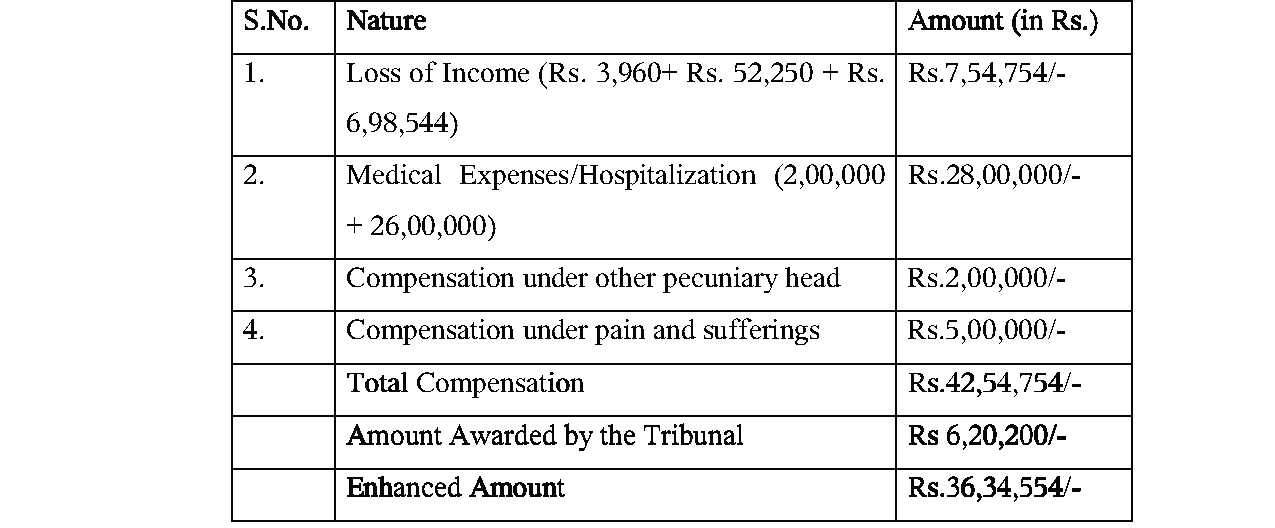
[1]. By way of present appeal, challenge has been laid to an award dated 12.10.2011, passed by the learned Motor Accident Claims Tribunal, Fatehgarh Sahib (for brevity, “the Tribunal”), whereby an amount of Rs.6,20,200/- was awarded as compensation to the appellant/claimant along with interest @ 7.5% per annum from the date of institution of claim petition till its actual realization, on account of injuries suffered by him in a vehicular accident, which occurred on 07.06.2008.
FACTS
[2]. The appellant, being injured filed a claim petition before the learned Tribunal praying for grant of compensation on account of injuries suffered by him in a motor vehicular accident which took place on 07.06.2008 while alleging rash and negligent driving of vehicle bearing registration No.PB-23-D-1297 being driven by respondent No. 1/driver.
[3]. After going through the claim petition and evaluating the evidence led by both the parties, learned Tribunal vide award dated 12.10.2011, arrived at a conclusion that the accident occurred on account of rash and negligent driving of respondent No. 1 and awarded Rs.6,20,200/- as compensation to the appellant/claimant.
[4]. Being aggrieved against the aforesaid award dated 12.10.2011; the present appeal has been preferred by the appellant/claimant for enhancement of compensation. Facts as specified in the claim petition and the issue regarding negligence of the driver been recorded in favour of the appellant/claimant by the learned Tribunal being not in dispute, therefore, for the sake of brevity, those are not being repeated here.
ARGUMENTS ON BEHALF OF LEARNED COUNSEL FOR THE APPELLANT/CLAIMANT.
[5]. Learned counsel for the appellant/claimant assailed the aforementioned award while submitting that the amount awarded by the learned Tribunal was grossly meager and disproportionate to the nature and extent of injuries sustained by the appellant/claimant. It was submitted that the Tribunal failed to appreciate the settled principles laid down by the Hon’ble Apex Court governing the assessment of just and fair compensation in injury cases. He further argued that the appellant/claimant suffered permanent disability to the extent of 70%, thereby rendering him incapable of performing his daily activities; therefore, the Tribunal ought to have granted adequate compensation towards loss of income by applying appropriate multiplier and taking into consideration the permanent and incapacitating nature of the disability. Accordingly, he prayed that the compensation awarded be suitably enhanced in accordance with the settled law so as to meet the ends of justice.
ARGUMENTS ON BEHALF OF LEARNED COUNSEL FOR RESPONDENT No.3/INSURANCE COMPANY
[6]. Per contra, learned counsel for respondent No.3/Insurance Company vehemently contended that in the facts and circumstances of the case, the appellant was adequately compensated, thus, the present appeal was liable to be dismissed.
DISCUSSION
[7]. I have heard learned counsel for the parties and perused the paper- book of the case. I find force in the arguments advanced by learned Counsel for the appellant.
[8]. Before determining the quantum of compensation, it is essential to draw guidance from the principles laid down in similar cases by the Hon’ble Apex Court. In “Raj Kumar vs. Ajay Kumar and Ors.” reported as (2011) 1 SCC 343 the Court laid down the heads under which compensation is to be awarded for personal injuries.
“6. The heads under which compensation is awarded in personal injury cases are the following:
Pecuniary damages (Special damages)
(i) Expenses relating to treatment, hospitalization, medicines, transportation, nourishing food, and miscellaneous expenditure.
(ii) Loss of earnings (and other gains) which the injured would have made had he not been injured, comprising:
(a) Loss of earning during the period of treatment;
(b) Loss of future earnings on account of permanent disability.
(iii) Future medical expenses.
Non-pecuniary damages (General Damage