
 Back
Back





IN THE HIGH COURT OF PUNJAB & HARYANA AT CHANDIGARH
SUDEEPTI SHARMA, J.
Dhanpati Devi and ors. - Appellants
Versus
DHBVNL & ors. – Respondents
RSA-1485 of 2007 (O&M)
Decided On : 21-01-2026
JUDGMENT :
SUDEEPTI SHARMA J.
1. The present Regular Second Appeal is directed against the judgment and decree dated 12.12.2006 passed by the learned District Judge, Hisar, whereby the appeal preferred by the respondent was partly allowed and the judgment and decree dated 27.10.2005 passed by the learned Civil Judge (Senior Division), Hisar were modified. The First Appellate Court reduced the compensation awarded by the trial Court from Rs.10,00,000/- to Rs.4,02,528/-, along with interest at the rate of 9% per annum. The appellant, aggrieved by the said reduction of the decretal amount in a suit for recovery of 10,00,000/-, has approached this Court by way of the present Regular Second Appeal.
FACTS NOT IN DISPUTE
2. Brief facts of the case are that Ram Niwas, a Sub-Inspector in the Haryana Police, was on leave and residing at Hisar. He had constructed a shop near Barwala Chowk, Hisar, which was to be inaugurated on 07.04.2000. On 06.04.2000, while arrangements were being made for the inauguration, Pardeep, owner of a neighbouring shop, went to the first floor of the said premises and came into contact with a live electric wire passing through the roof, resulting in his electrocution. On hearing his cries, Ram Niwas attempted to rescue him but was himself electrocuted. He was removed to the Civil Hospital, where he was declared dead.
3. The plaintiffs alleged that despite representations made on 08.10.1998 by the then owners of the premises and deposit of the requisite charges in November 1998 for removal of the high-tension wire, no steps were taken by the electricity department. An FIR under Section 304-A IPC was registered on 03.05.2000 at Police Station City, Hisar, though no further action followed.
4. It was pleaded that the deceased was the sole breadwinner of the family, earning Rs.9,315/- per month. A legal notice dated 20.12.2000 claiming compensation of Rs.15,00,000/- was served upon the defendants.
5. Upon their failure to respond, the civil suit was instituted under the Fatal Accidents Act, 1855 seeking compensation of Rs.10,00,000/- by the appellants, which was decreed in their favour vide judgment and decree dated 27.10.2005 passed by the learned Civil Judge (Senior Division), Hisar, awarding compensation of 10,00,000/- along with interest at the rate of 9% per annum.
6. Aggrieved thereby, the respondents preferred an appeal, which was partly allowed by the learned District Judge, Hisar vide judgment and decree dated 12.12.2006. By the said judgment, the compensation awarded by the trial Court was modified and reduced to 4,02,528/-, while maintaining the rate of interest at 9% per annum.
7. The appellants, being dissatisfied with the interference made by the First Appellate Court in the quantum of compensation, have filed the present Regular Second Appeal.
SUBMISSIONS OF LEARNED COUNSEL FOR THE PARTIES
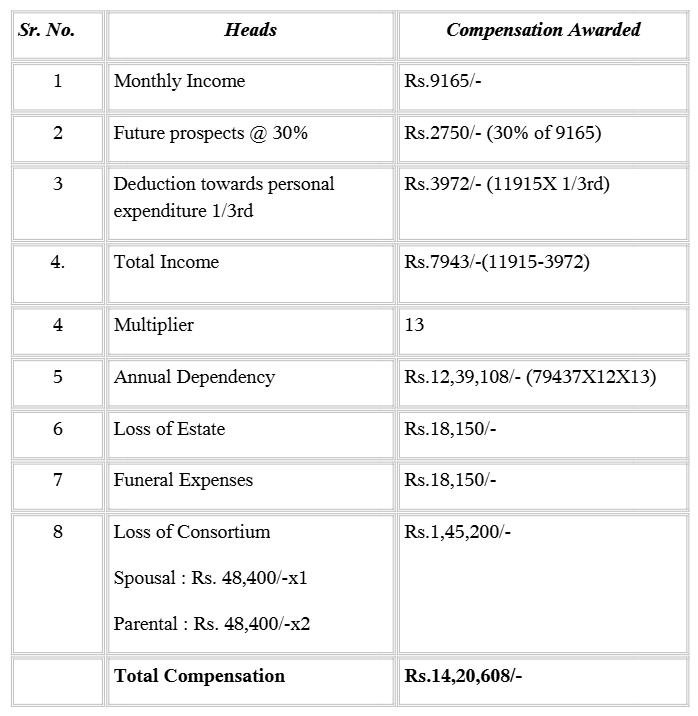
8. Learned counsel appearing for the appellants contends that the learned District Judge has committed a manifest error in determining the quantum of compensation payable to the claimants under the Fatal Accidents Act. It is argued that the First Appellate Court wrongly deducted amounts from the gross monthly salary of the deceased, assessed at Rs.9,165/-, and determined the net income as Rs.5,590/- per month. Such deductions, according to the learned counsel, are contrary to the settled principles of law governing assessment of compensation.
9. It is further contended that, in the absence of any specific statutory formula under the Fatal Accidents Act for computation of compensation, the courts are required to be guided by the principles evolved for determination of compensation in motor accident claim cases. Reliance in this regard has been placed upon the judgment of this Court in Kanwaljit Kaur v. State of Punjab, (2018) 2 PLR 5, wherein it was held that, in the absence of statutory guidelines, the principles applicable to motor vehicular accident claims may be safely applied for awarding just compensation. On these premi


The sequence of negligence leading to electrocution requires compensation reflecting the deceased's potential earnings, emphasizing that strict evidence is not mandatory for assessing damages within ....


The main legal point established in the judgment is the duty of the court to grant 'just compensation' under the PLI Act, considering the age, income, and dependents of the deceased, as per the princ....
Compensation in electrocution cases must consider income assessment, dependency claims, and legal precedents, with the Court able to enhance awards even after decrees are satisfied.

Electricity suppliers are strictly liable for injuries resulting from their installations, irrespective of negligence, highlighting the burden of proof rests with them in cases of electrocution.

Compensation under the Motor Vehicles Act must consider gross income without arbitrary deductions and allow future prospects based on statutory guidelines, ensuring just compensation for victims' dep....

The main legal point established in the judgment is the liability for compensation due to negligence resulting in an electric shock and the application of principles from motor accidents claims cases....



An indispensable Tool for Legal Professionals, Endorsed by Various High Court and Judicial Officers
Please visit our Training & Support
Center or Contact Us for assistance

Scan Me!
India’s Legal research and Law Firm App, Download now!


For Daily Legal Updates, Join us on :



 Back to top


