
 Back
Back





THE HIGH COURT OF SIKKIM : GANGTOK
MEENAKSHI MADAN RAI, J.
The Branch Manager, SBI General Insurance Company Limited - Appellant
Versus
Songmit Lepcha And Others - Respondents
MAC App. No.02 of 2025
Decided On : 03-03-2025
| Table of Content |
|---|
| 1. overview of appeal grounds for compensation modification. (Para 1 , 2 , 3 , 5) |
| 2. legal analysis for determining personal expenses, consortium, and estate losses. (Para 4 , 6 , 7 , 8) |
| 3. final calculation, distribution, and mandatory payment orders for compensation. (Para 9 , 10 , 11 , 12 , 13 , 14 , 15) |
JUDGMENT :
Meenakshi Madan Rai, J.
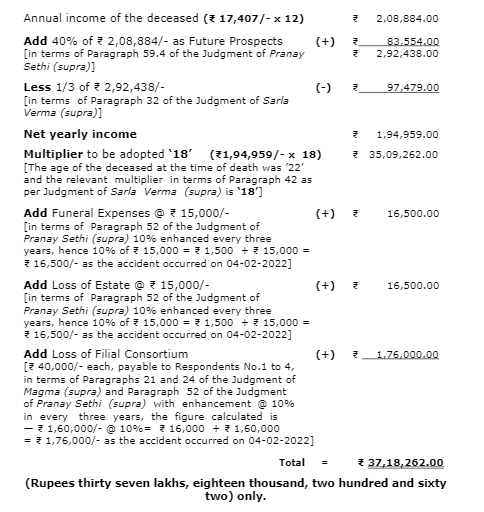
1. The only grievance raised by the Appellant, in this Appeal, which assails the Judgment of the Learned Motor Accidents Claims Tribunal, Namchi, Sikkim, dated 28-11-2024, in MACT Case No.06 of 2022 (Songmit Lepcha and Others vs. The Branch Manager, SBI General Insurance Company Limited and Others), is the alleged erroneous compensation of Rs. 40,22,908/- (Rupees forty lakhs, twenty two thousand, nine hundered and eight) only, granted to the Claimants (Respondents No.1 to 4 herein). It is urged that only ¼ (one-fourth) was deducted from the loss of earnings of the deceased while computing the award, when such deduction ought to have been ½ (one-half), in terms of the Judgment of the Hon’ble Supreme Court in Sarla Verma (Smt) and Others vs. Delhi Transport Corporation and Another, (2009) 6 SCC 121 as the deceased was a twenty-two yearold bachelor at the time of the unfortunate accident. That, the compensation is accordingly required to be re-computed and modified, in view of the obvious error made therein. That, no other grounds are being pressed in this Appeal.
2. Respondent No.1 is the mother of the deceased who is a widow and Respondents No.2, 3 and 4 are his younger siblings. Respondents No.5 and 6 are the owner and driver of the vehicle respectively.
3. Learned Counsel for the Respondents No.1, 2, 3 and 4 and Respondents No.5 and 6 concede to the submissions advanced by Learned Counsel for the Appellant, however they submit that the compensation may be computed as deemed “just” by this Court.
4. I have heard the submissions advanced by Learned Counsel for the parties. I have also perused the records of the case including the impugned Judgment.
5. The facts that led to the accident, briefly narrated are that; the deceased a resident of Pedong village, District Kalimpong, West Bengal, was working as a “Boomer Helper” in Surya Pest Control Services Company and posted at Tunnel 9 and 10, Sevoke- Rangpo Railway project. On 04-02-2022, when he was driving a Scooty and was on his way to work at the Railway project NH10, one Tata Truck driven at high speed by Respondent No.6, hit the scooty driver, at 11th Mile Tarkhola, resulting in his death.
6. The concept of “just compensation” has been succinctly explained by the Supreme Court in a litany of cases which for brevity are not being discussed here. Apart from “just compensation” the Supreme Court in Sarla Verma (supra) has also discussed the percentage that ought to be deducted as personal and living expenses of the deceased. The relevant paragraph is extracted hereinbelow;
“32. Thus even if the deceased is survived by parents and siblings, only the mother would be considered to be a dependant, and 50% would be treated as the personal and living expenses of the bachelor and 50% as the contribution to the family. However, where the family of the bachelor is large and dependent on the income of the deceased, as in a case where he has a widowed mother and large number of younger non-earning sisters or brothers, his personal and living expenses may be restricted to one-third and contribution to the family will be taken as two-third.” [emphasis mine]
(i) On the anvil of this observation, it is appropriate in the instant matter to place loss of earning at 1 / (one-third) and not ¼ 3 (one-fourth), considering the number of family members of the deceased, who were dependant on his income and the fact that he had a widowed mother.
7. While perusing the impugned Judgment it appears that under the head “loss of consortium”, the Learned MACT has granted Rs. 30,000/- (Rupees thirty thousand) only, to the Respondent No.1 and Rs. 10,000/- (Rupees ten tho
AI
In fatal accident claims, the personal expense deduction for a deceased bachelor should be one-third if the family is large and dependent. Furthermore, families are entitled to compensation for filia....

In motor accident compensation claims for a bachelor, the personal expense deduction should be one-third depending on dependency, and conventional heads (filial consortium, loss of estate, funeral ex....

Legal representatives of a deceased must demonstrate dependency to claim compensation under motor accident laws; deductions for personal expenses vary based on marital status and family dependency.
Legal representatives must demonstrate dependency to claim compensation; appropriate deduction for personal expenses in compensation should be one-third for married deceased as per established jurisp....

The main legal point established in the judgment is the application of principles for assessment of compensation in case of death, including the denial of compensation to certain claimants and the ap....


Compensation for motor vehicle accidents must consider full taxable income, including allowances and future prospects, with appropriate deductions for living expenses based on dependents.

Point of Law : Amounts for loss of consortium shall be awarded to parents as ‘filial consortium’ for the loss of their grown-up children, to compensate their agony, love and affection, care and compa....



An indispensable Tool for Legal Professionals, Endorsed by Various High Court and Judicial Officers
Please visit our Training & Support
Center or Contact Us for assistance

Scan Me!
India’s Legal research and Law Firm App, Download now!


For Daily Legal Updates, Join us on :



 Back to top


