
 Back
Back





IN THE HIGH COURT OF ALLAHABAD
SAURABH LAVANIA, J.
Bare Lal Pandey – Appellant
Versus
State of Uttar Pradesh and Others – Respondents
Application U/s 482 No. 5716 of 2024
Decided On : 03-07-2024
CRIMINAL PROCEDURE - APPLICATION UNDER SECTION 156(3) CR.P.C. - Sections 154, 156(3), 65B of the Indian Evidence Act, 1872 - The court discussed the legal framework surrounding the registration of FIRs and the discretion of magistrates under Section 156(3) of the Cr.P.C. It emphasized that a magistrate must apply judicial reasoning when deciding whether to direct an investigation or treat an application as a complaint case. The court highlighted that if a cognizable offence is disclosed, registration of an FIR is mandatory, but if the allegations are of a civil nature or lack sufficient grounds, the magistrate may refuse to order an investigation. The interpretation of Section 65B of the Indian Evidence Act was also significant, as it pertains to the admissibility of electronic evidence, which was available to the applicant in this case. Ultimately, the court upheld the lower courts' decisions to treat the application as a complaint case, finding no error in their discretion.
Fact of the Case:
The applicant filed an application under Section 156(3) Cr.P.C. alleging conspiracy against the opposite parties, claiming they intended to attack him and his wife, implicate them in false cases, and commit theft. The trial court treated the application as a complaint case, leading to a revision application that was dismissed by the revisional court.
Finding of the Court:
The court found that the trial court acted within its discretion in treating the application as a complaint case rather than ordering an investigation. It noted that the applicant had CCTV footage as evidence, which he could present in the complaint process.
Issues: Whether the trial court erred in treating the application under Section 156(3) Cr.P.C. as a complaint case instead of directing an investigation.
Ratio Decidendi: The court reiterated that a magistrate must apply judicial reasoning when deciding on applications under Section 156(3) Cr.P.C. If the information does not disclose a cognizable offence or if the allegations are civil in nature, the magistrate may refuse to order an investigation. The presence of evidence, such as CCTV footage, does not automatically necessitate an investigation if the magistrate finds it unnecessary.
Final Decision: The court rejected the applicant's plea, affirming the decisions of the trial and revisional courts to treat the application as a complaint case, finding no illegality in their actions.
JUDGMENT :
SAURABH LAVANIA, J.
1. Heard learned counsel for the applicant and learned A.G.A. for the State as well as perused the records.
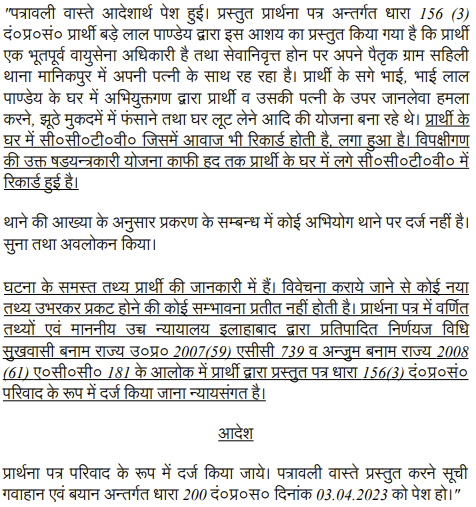
2. By means of the present application, the applicant has assailed the order dated 28.02.2023 passed by Chief Judicial Magistrate, Pratapgarh (in short “trial Court”) in Criminal Misc. Case No. 349 of 2023 (Bade Lal Pandey Vs. Arpan alias Anil Pandey and Another) whereby the trial Court entertained the application preferred by the applicant under Section 156(3) Cr.P.C. as a complaint case. The order impugned, on reproduction, reads as under:
3. The applicant has also assailed the order dated 06.03.2024 passed by Additional Sessions Judge/Fast Tract Court, Pratapgarh (in short “revisional Court”) passed in Criminal Revision No. 180 of 2023 (Bade Lal Pandey Vs. Arpan alias Anil Pandey and Another) whereby the revisional Court dismissed the criminal revision filed by the applicant impeaching the order dated 28.02.2023. The relevant portion of the order, on reproduction, reads as under:
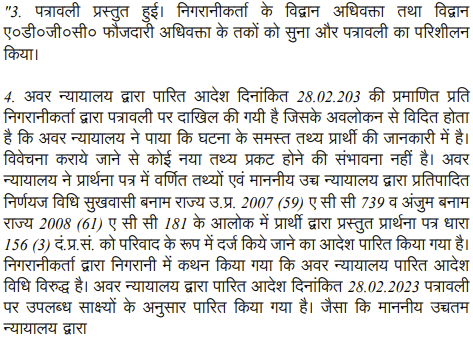
Krishna Kumar Tiwari vs. State of U.P., 2009 (5) ALU 1 (AII-LB.) esa vo/kkfjr fd;k gS fd Where an application u/s. 156(3) CrPC was rejected on the ground that the alleged offence was not of heinous nature and the allegations levelled in the application were not of such a nature which could not be levelled falsely, it has been held that rejection of the application u/s. 156(3) CrPC was not erroneous. Magistrate will not work u/s. 156(3) CrPC like a postman but he has to examine whether from reading of application/complaint filed u/s. 156(3) CrPC prima facie commission of offence is disclosed or not. If the dispute is purely of civil nature, refusal to order registration of FIR is proper.
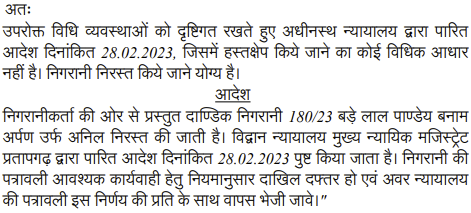
4. Brief facts of the case are to the effect that the applicant preferred an application under Section 156(3) Cr.P.C. levelling allegations of conspiracy against the private opposite party nos. 2 to 6. According to this application, in nutshell, the opposite parties in the premises of the applicant hatched a conspiracy (i) to attack the applicant and his wife, (ii) to implicate the applicant and his family in false criminal cases and (iii) to commit loot in the house of the applicant and this incident was recorded in the Closed Circuit Television (in short “CCTV”) situated at the premises of the applicant. The relevant portion of the application, on reproduction, reads as under:
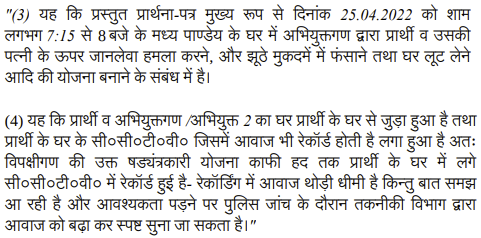
5. It appears that the trial Court, taking note of the facts indicated above which includes the availability of the evidence i.e. CCTV footage with the applicant, observed that investigation in the matter is not required. Accordingly, treated the application under Section 156(3) Cr.P.C. filed by the applicant as a complaint case vide order dated 28.02.2023, quoted above.
6. The order dated 28.02.2023 was challenged by the applicant by preferring revision under Section 397 Cr.P.C., which was registered as Criminal Revision No. 180 of 2023. In the memo of revision, in nutshell, it has been stated that in the present matter, the investigation is required as such, the trial Court erred in entertaining the application under Section 156(3) Cr.P.C. as a complaint case. The revisional Court dismissed the revision vide order dated 06.03.2024, quoted above.
7. Learned counsel for the applicant, while impeaching the orders in issue, stated that the case of the applicant is squarely covered by the judgment passed by the Hon'ble Apex Court in the case of XYZ Vs. State of M.P. and Ors. 2023 (1) JIC 538 (SC) and Lalita Kumari Vs. State of Uttar Pradesh (2014) 2 SCC 1. In continuation, he stated that the evidence i.e. CCTV footage can only be retrieved/collected/recovered by the Investigating Officer during the investigation. As such, the orders are liable to be interfered and direction be issued to police to lodge an FIR.
8. Learned counsel for the applicant also submitted that an application was preferred before the trial Court in terms of order dated 26.02.2024 and along with s
AI

The Magistrate has discretion under Section 156(3) of the CrPC to determine whether to direct an investigation, particularly in civil disputes masquerading as criminal matters.
The Magistrate has discretion under Section 175(3) of the BNSS to decide whether to register an FIR based on the application, assessing whether a cognizable offense is made out.

Direction for Police Investigation – Option to direct registration of case and its investigation by police should be exercised where some “investigation” is required, which is of a nature that is not....

The Magistrate must judiciously exercise discretion in registering FIRs under Section 156(3) Cr.P.C., ensuring that mechanical refusals are avoided when cognizable offences are disclosed.
distinction between the investigation by the police officer under Section 156(3) and under Section 202(1) Cr.P.C. is that the former is at the pre-cognizance stage and the latter is at post cognizanc....

The duty of the Magistrate to apply judicial mind while directing the registration of FIRs, and the consequences of filing frivolous and vexatious proceedings.



An indispensable Tool for Legal Professionals, Endorsed by Various High Court and Judicial Officers
Please visit our Training & Support
Center or Contact Us for assistance

Scan Me!
India’s Legal research and Law Firm App, Download now!


For Daily Legal Updates, Join us on :



 Back to top


