


 Back
Back





2024 Supreme(All) 1032
IN THE HIGH COURT OF ALLAHABAD
Hon'ble Saurabh Shyam Shamshery, J.
Vinesh Kumar Yadav – Applicant
Versus
State of Uttar Pradesh and Another – Opposite Parties
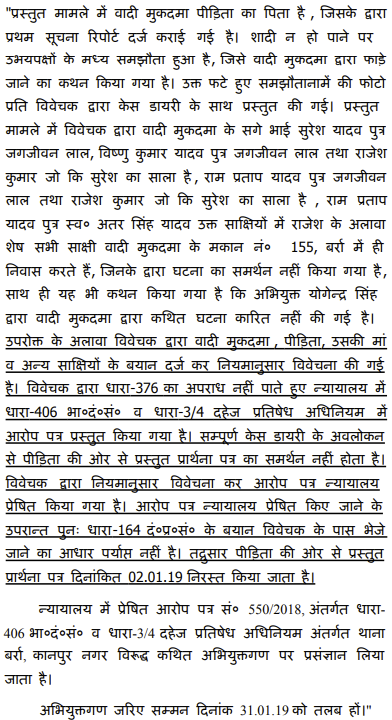
Application U/S 482 No. - 1077 of 2020
Decided On : 08-07-2024
Advocate Appeared:
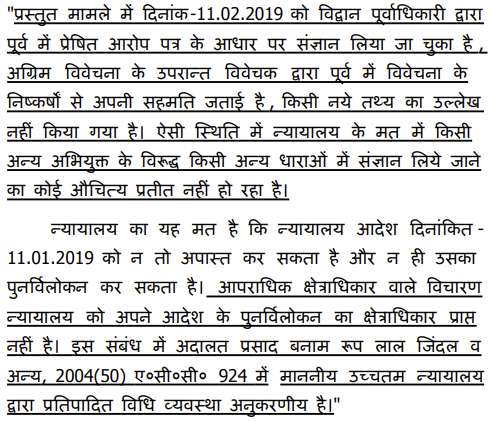
For the Applicant : Shishir Tandon
For the Opposite Party : G.A.
IMPORTANT POINT
The court established that the trial court cannot add or subtract charges at the cognizance stage and that the Sessions Court has the jurisdiction to summon individuals based on prima facie evidence.
Headnote:
QUASHING - DOWRY PROHIBITION AND IPC OFFENCES - Section 406 IPC, Section 3/4 Dowry Prohibition Act - The court discussed the limitations on adding or subtracting charges at the cognizance stage, referencing the Supreme Court's ruling in State of Gujarat Vs. Girish Radhakrishnan Varde. It emphasized that the trial court cannot summon additional accused unless their complicity is evident from the charge-sheet. The court also highlighted the jurisdiction of the Sessions Court to summon individuals based on prima facie evidence, as established in the cases of Dharampal & Ors Vs. State of Haryana and Kishun Singh & Ors. Vs. State of Bihar.
Fact of the Case:
The applicant, father of the victim, sought to quash an order from the Special Chief Judicial Magistrate regarding a case involving allegations of dowry and IPC offences against him and others. The FIR included charges under Sections 376, 406 IPC, and Section 3/4 of the Dowry Prohibition Act, but the charge-sheet only included Sections 406 IPC and 3/4 of the Dowry Prohibition Act against two accused, excluding the complainant's husband.
Finding of the Court:
The court found that the trial court correctly rejected the application to summon the complainant under Section 376 IPC, as it could not add or subtract charges at the cognizance stage. The court noted that there was insufficient evidence to summon the complainant for the offences under Section 406 IPC and Section 3/4 of the Dowry Prohibition Act.
Issues: Whether the trial court could summon the complainant for additional charges at the cognizance stage and whether there was sufficient evidence to support the charges against the complainant.
Ratio Decidendi: The court reiterated that at the cognizance stage, the trial court is bound by the charges in the charge-sheet and cannot summon additional accused unless their complicity is evident from the material on record. The court also affirmed the Sessions Court's jurisdiction to summon individuals based on prima facie evidence, as established in previous Supreme Court rulings.
Final Decision: The application to quash the order was rejected, and the court upheld the trial court's decision not to summon the complainant for the additional charges at this stage.
JUDGMENT :
Hon'ble Saurabh Shyam Shamshery, J.
1. Heard Sri Shishir Tandon, learned counsel for applicant, Mrs. Mamta Singh, Advocate on behalf of O.P. No.2 and Sri B.P.Singh, learned A.G.A.
2. Applicant before this Court has approached for quashing the impugned order dated 29.11.2019 passed by Special Chief Judicial Magistrate, Kanpur Nagar in Case No. 1049 of 2019, (State of Uttar Pradesh Vs. Narendra Yadav and others) arising out of Case Crime No.885 of 2018 under Section 406 of I.P.C. and Section ¾ of Dowry Prohibition Act, Police Station-Barra, District-Kanpur Nagar.
3. Applicant before this Court is father of the victim, whose marriage was fixed with O.P. No.2 i.e. complainant.
4. Complainant lodged an F.I.R. under Sections 376, 406 I.P.C. and 3/4 of Dowry Prohibition Act 1961 against present applicant and 12 co-accused being his close family members including women. Contents of F.I.R. is reproduced hereinafter :
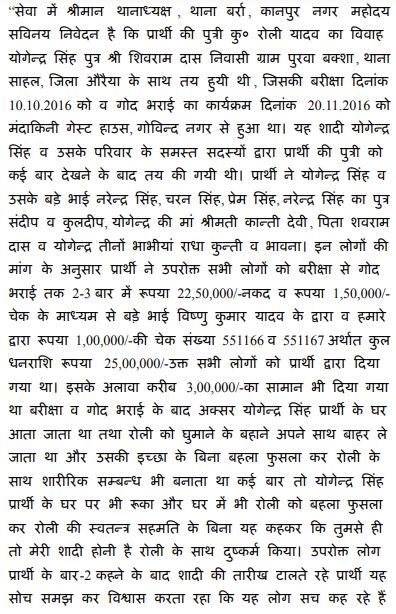
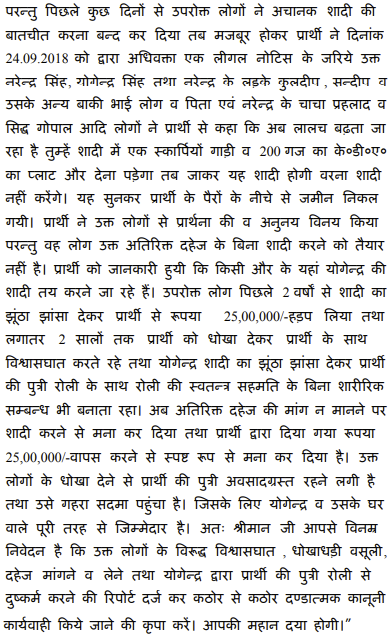
5. Investigation was conducted in aforesaid F.I.R. wherein statement of victim was recorded under Section 161 and 164 Cr.P.C. For reference same are reproduced hereinafter:
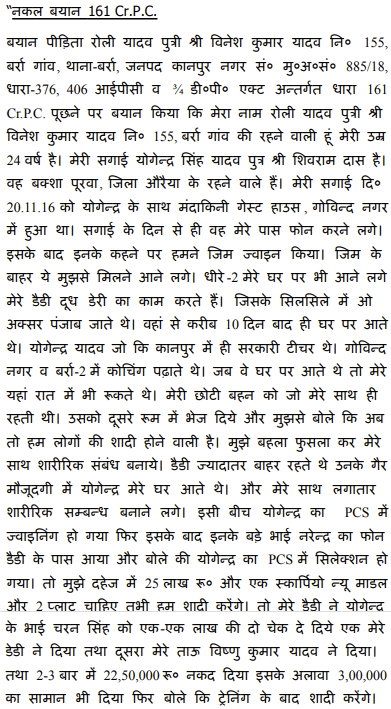
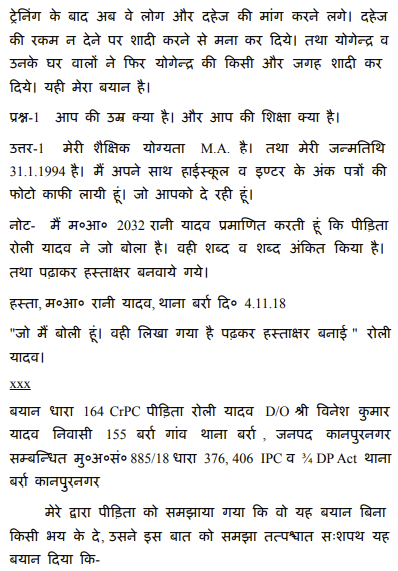
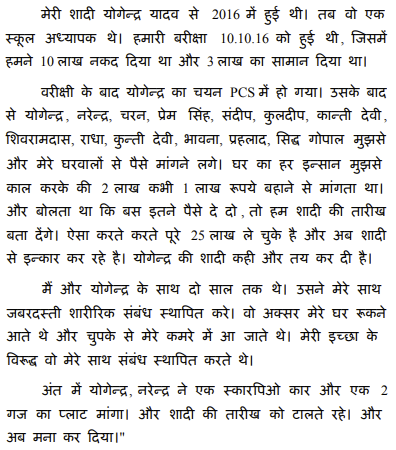
6. After investigation, a charge-sheet was filed only under Section 406 I.P.C. and 3/4 of Dowry Prohibition Act against Narenda Singh and ShivRam Das i.e. brother of O.P. 2 and his father. No charge-sheet was filed against any other accused persons named in the F.I.R., including opposite party no.2 herein i.e. complainant’s husband as well as no offence was found under Section 376 of I.P.C.
7. At the stage of cognizance, victim filed an application dated 2.1.2019 with a prayer that during investigation, statement of victim recorded under Section 164 Cr.P.C. was not considered, therefore, it may be sent to the Investigation Officer for further investigation.
8. Learned Trial Court considered the above referred application and rejected the same and thereafter took cognizance of the offence and summoned two accused persons against whom charge-sheet was filed. Relevant part of said order is mentioned hereinafter:
9. It appears that a report was filed by Investigation Officer after further investigation, whereby the charge-sheet submitted earlier was again approved.
10. Learned counsel for applicant has submitted that aforesaid order is impugned in present case. It was urged on behalf of complainant that O.P. No.2 be summoned under Section 376 I.P.C. as on basis of material available, said offence was made out.
11. Aforesaid argument was considered by learned Trial Court and by impugned order dated 29.11.2019, it was rejected and relevant part thereof is mentioned hereinafter:
12. Learned counsel for applicant has not been able to deny that that at the stage of cognizance in view of judgment passed by Supreme Court in State of Gujarat Vs. Girish Radhakrishnan Varde (2014) 3 SCC 659, learned Trial Court has no option, to add or subtract any offence other than offence under which a charge-sheet has been filed, therefore, at this stage, offence under Section 376 I.P.C. could not be added.
13. Learned counsel for applicant has referred judgments passed by Supreme Court in case of Dharampal & Ors Vs. State of Haryana & Anr (2014) 3 SCC 306 and Kishun Singh & Ors. Vs. State of Bihar (1993) 2 SCC 16 to emphasize that Court of Sessions has complete and unfettered jurisdiction to take cognizance of offence which would include summoning of a person or persons whose complicity in commission of crime was prima-facie evident gathered from material available on record, even though no charge sheet was filed against them and for that learned Trial Court does not need to wait till the stage of Section 319 Cr.P.C. is reached in trial. For reference relevant paragraphs of aforesaid judgments Dharampal and Kishun Singh (Supra) are reproduced hereinafter :
“40. Dharampal (supra) In that view of the matter, we have no hesitation in agreeing with the views expressed in Kishun Singh case [Kishun Singh v. State of Bihar, (1993) 2 SCC 16 : 1993 SCC (Cri) 470] that the Sessions Court has












